
Historic Masonry Restoration · Chicagoland, IL
Church Steeple and Bell Tower Masonry: Why Towers Fail First and What Restoration Costs
A church tower is the tallest, most exposed, most ornamental masonry most congregations will ever own — and it concentrates every failure mode at once: open belfry louvers, water sitting on cornice ledges, corroding anchors behind stone, and access that costs more than the repair. Here is how tower masonry actually fails, how the work is scoped, and how boards budget it.
2026-08-05
Quick Answer
Church steeples and bell towers fail before the rest of the building because they are the tallest and most exposed masonry, with open belfry louvers admitting driven rain, ornamental ledges that hold water, and embedded anchors that corrode and crack the stone from within. Restoration is scoped from the top down and access is often the largest cost. Emerald Masonry LLC restores church masonry across Chicagoland. Family-owned, career masons, licensed and insured. Call (708) 288-1696.
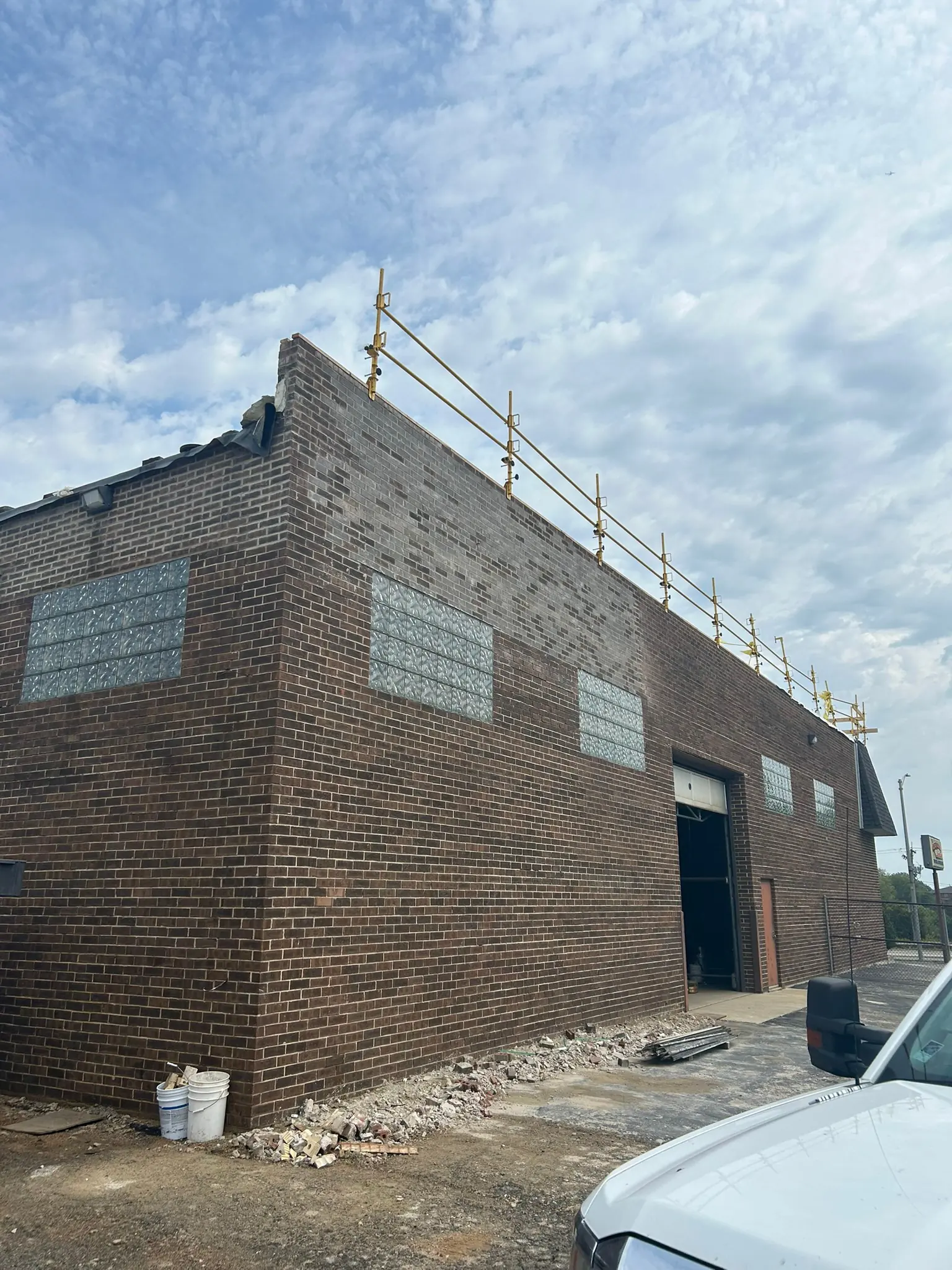
Why Church Towers Fail First
A steeple or bell tower is the tallest, most exposed and most ornamental masonry a congregation will ever own, and it concentrates every failure mode at once — open belfry louvers admitting wind-driven rain, cornices and string courses that hold water instead of shedding it, embedded steel anchors corroding behind stone, and access costs that frequently exceed the repair itself. Emerald Masonry LLC restores church and institutional masonry across Chicago and the Chicagoland suburbs. Family-owned, licensed, bonded and insured, career masons with decades of experience, free on-site assessments. Call (708) 288-1696.
Almost every congregation we work with discovers the tower the same way: a leak inside, or a piece of masonry on the walk after a hard freeze. By then the tower has usually been deteriorating for a decade, because nobody can see the top of it.
Six Reasons Towers Deteriorate Ahead of the Building
1. Total exposure. Every other wall on the church has a roof above and heated interior behind it. A tower has weather on four sides, top to bottom, with an unheated shaft inside.
2. Height and wind. Wind-driven rain hits a tower harder and from more directions than anything at ground level, and it drives water into joints that would shed a vertical rainfall.
3. Belfry louvers are open by design. The bell chamber has to let sound out, so it lets weather in. Driven rain enters the belfry directly and has to be managed by the interior masonry, the louver detailing and whatever drainage exists below. When that fails, the tower is wetting from the inside as well.
4. Ornament holds water. Cornices, string courses, belt courses, corbelling, finials and pinnacles all create horizontal ledges. Horizontal masonry holds water rather than shedding it, and a tower has dozens of these surfaces stacked vertically.
5. Embedded metal. Ornamental and cladding elements are anchored — cramps, dowels, ties, shelf angles, and on steeples the finial and cross anchorages. Corroding steel expands to several times its original volume, cracking masonry from within. This is rust jacking, and on a tower it happens where nobody can see it.
6. Nobody inspects it. Realistically, congregations look at the tower from the parking lot. Real assessment requires getting a person next to the masonry, which is expensive enough that it gets deferred.
What Actually Fails, Top Down
The very top — finial, cross, cap
Anchorage into the masonry, and whatever cap or coping crowns the structure. Failure here admits water down the full height of the shaft.
Cornices and projecting courses
The most water-exposed ornamental masonry on the building, and the elements most likely to displace and fall. On terra cotta or cast stone these are also the units most dependent on anchors.
The belfry chamber
Interior masonry taking driven rain, plus louver frames, sills and any drainage below the openings.
The shaft
Joints on all four elevations, with the north face typically worst because it dries slowest.
The base and transition to the roof
Flashing where the tower meets the main roof, and through-wall flashing in the tower wall. This is the same misdiagnosed problem as a parapet: water entering high in the tower appears inside the building far below, and gets blamed on the roof.
Steeple, Tower, Spire — What Do You Actually Have?
The terms get used interchangeably in conversation and they describe different structures with different repair implications. Worth establishing before anyone quotes.
A masonry bell tower is a load-bearing masonry shaft, usually square, carrying its own weight to the ground, often with a belfry chamber near the top and a flat or low cap. Everything in this article applies directly. Repairs are masonry repairs.
A spire is the tapered pointed element rising above a tower. It may be masonry — stone or brick, sometimes with elaborate detailing — or it may be framed and clad in slate, copper or shingle over a wood structure. If your spire is framed and clad, the top of the project is a carpentry and roofing scope, and the masonry contractor's work stops where the masonry stops. Establishing that boundary early avoids two trades each assuming the other has it.
A steeple in common usage means the whole assembly — tower plus spire — and that is exactly where the confusion starts.
A tower with a separate framed belfry or cupola is very common on Chicagoland churches: masonry to a certain height, then a wood-framed, clad structure above. The transition detail between the two is a classic leak point, and it belongs to whichever trade is willing to own the flashing.
Why this matters for scoping: a "steeple restoration" proposal that does not say clearly where the masonry ends and the framed or clad work begins is going to produce a gap, a change order, or a leak at the junction. Ask for that line to be drawn on the drawings or in the photographs, and ask who is responsible for the flashing at the transition.
Warning Signs
- Masonry debris on the roof, entry walk, parking area or in gutters after freeze cycles.
- Displaced, tilted or projecting units in the cornice or ornamental courses.
- Rust staining bleeding from joints or from within stone — embedded steel corroding.
- Open, sandy or washed-out joints, visible with binoculars from the ground.
- Spalling brick or delaminating stone faces.
- Efflorescence on the tower or on interior walls below it.
- Water staining inside the tower shaft, the narthex ceiling or the wall below the tower.
- Vegetation growing from joints or ledges — proof of persistent saturation.
- Deteriorated louvers, missing slats, or daylight where there should not be any.
- A visible lean or bulge in the shaft — urgent.
How Restoration Is Scoped
- Close-up assessment. A tower cannot be evaluated from the ground. Real assessment means hands-on access — lift, swing stage or scaffold — sounding masonry for hollow and delaminated areas and probing anchor conditions.
- Stabilize immediate hazards. Loose material removed or secured, protection installed below, before anything else.
- Identify and stop water paths, working top down — cap, cornices, belfry, flashing, joints.
- Address embedded steel where it is corroding: expose, clean or replace with stainless components. This is the actual fix; the visible masonry repair depends on it.
- Repair units — repointing with matched mortar, dutchman inserts and matched patching on stone, salvaged brick for replacements, ornamental units repaired or replicated where beyond saving.
- Restore flashing and drainage at the tower-to-roof transition and within the wall.
- Gentle cleaning only — never sandblasting or high-pressure washing on historic masonry.
- Document with photographs for the board, the insurer and the next assessment.
Mortar: Match the Tower, Not the Nave
The governing rule is that mortar must be softer than the units it holds, so the joints take the stress instead of the brick or stone faces.
Most Chicagoland church towers predate 1930 and were laid with soft, lime-based mortar and softer brick or local limestone. Repointing with hard modern Portland mortar inverts the relationship and spalls the faces within a few winters — permanent loss on a building the congregation likely intends to keep for another century.
One caution specific to towers: do not assume the tower matches the rest of the church. Towers were sometimes built later, rebuilt after storm or fire damage, or reconstructed at a different date than the nave. The mortar is matched to what is actually in the tower.
Materials
Lime-based and lime-modified mortars custom-blended to the original, matched sands, salvaged brick, Indiana limestone and matched stone patching compounds for dutchman work, stainless anchors, pins and cramps replacing corroded originals, stainless and copper through-wall flashing, and vapor-permeable sealers only where warranted. Related work: historic masonry restoration, limestone and sill repair, parapet wall repair, tuckpointing, brick repair and commercial masonry restoration.
What Drives Cost — Access Usually Leads
- Access. Scaffolding, swing stage or lift on a tall tower, plus ground protection and pedestrian routing. Frequently the largest single line item, and sometimes larger than the masonry work.
- Height and elevation count — a four-sided tower is four elevations.
- Ornamental complexity — cornices, corbelling and carved work are skilled, slower work than plain shaft repointing.
- Embedded steel scope — how much must be exposed and replaced.
- Stone sourcing and replication for units beyond repair.
- Custom lime mortar blending.
- Congregational scheduling — working around services, weddings, funerals and school programs.
- Documentation for boards, insurers and capital campaigns.
We assess in person, provide a written scope with photographs in the format building committees need, and carry the certificate of insurance institutional property requires.
Phasing: The Order That Protects the Building
Most congregations cannot fund a full tower restoration in one budget year, and they do not have to. What matters is doing it in the right sequence:
- Safety. Anything loose above ground people walk on.
- Water entry at the top — cap, cornice, belfry, flashing. Everything below depends on this.
- Embedded steel that is actively corroding.
- Damage the water caused — spalled units, failed joints.
- Ornamental and cosmetic restoration.
Phasing by visibility is the expensive way. The cornice you cannot see from the parking lot is often what is soaking the wall you can.
Storm Damage and Insurance
One distinction worth understanding before a claim is filed. Sudden damage from a covered peril — a lightning strike to a steeple, wind displacing masonry in a storm, a falling tree limb — is generally claimable. Gradual deterioration, freeze-thaw damage and deferred maintenance are generally not, because insurers treat those as maintenance regardless of how expensive they have become.
Towers sit awkwardly across that line, since a storm frequently finishes off masonry that had been deteriorating quietly for a decade. Two things help: dated photographic records of tower condition from before the event, and a written assessment distinguishing storm damage from pre-existing deterioration. Congregations that document the tower on a cycle are in a far stronger position when something does come down.
Chicagoland Context
The region delivers dozens of freeze-thaw crossings each winter, and towers take them at full exposure with no thermal buffer. Lake-effect moisture keeps north elevations damp for long periods. Chicago and the older suburbs hold an exceptional density of late-19th and early-20th century churches — brick, Athens Marble and Joliet limestone, terra cotta and cast stone ornament — built by congregations that expected them to last, in a climate that tests that expectation every February.
Maintenance Between Projects
- Get eyes on the tower on a cycle, not only after something falls. Binoculars from the ground annually; hands-on access periodically.
- Walk the perimeter after hard freezes and storms and note what is landing.
- Treat rust staining as urgent.
- Keep gutters, downspouts and tower drainage clear.
- Log conditions with dated photographs so change over time is visible.
- Budget the envelope as a recurring capital item, the way the roof and boiler are budgeted.
The Bottom Line
A church tower is a hundred-year-old structure doing the hardest weather job on the property, full of ornament that holds water and steel that nobody can see. It does not fail suddenly — it fails for a decade quietly and then announces itself with a piece of cornice on the walk.
The congregations that handle this well do two things: they get somebody up there on a schedule, and they fix the top of the tower first. Everything below the leak is downstream of it.
Emerald Masonry LLC is a family-owned, licensed and insured masonry contractor serving Chicago and the Chicagoland suburbs led by career masons with decades of hands-on experience in tuckpointing, chimney repair, brick repair and replacement, lintel and parapet repair, foundation and limestone/sill repair, caulking, sealing, and commercial, residential and historic masonry restoration. We work with churches, property managers, HOAs, building owners and insurance companies.
Free on-site assessments. Call (708) 288-1696 or request an estimate.
Frequently Asked Questions
Why does the tower always need work before the rest of the church?
Because it is the tallest, most exposed masonry on the property, weathered on all four sides with no heated interior drying it, and it carries the most ornament — every cornice, string course and projecting ledge holds water rather than shedding it. Towers also have open belfry louvers that let driven rain directly into the masonry.
How much does church steeple or bell tower restoration cost?
It varies enormously with height, access method, how much of the scope is ornamental, and whether embedded steel must be addressed. On a tall tower, access — scaffolding or a swing stage — is frequently the single largest line item, sometimes exceeding the masonry work itself. Emerald Masonry provides a free written scope with photographs suitable for a board or building committee.
Can the work be phased across multiple budget years?
Yes, and for most congregations it should be. The correct order is safety first, then anything actively admitting water at the top of the tower, then the damage that water caused, then cosmetic and ornamental work. Phasing by what is most visible from the street is the expensive way to do it.
Why is water getting in through the belfry?
Belfry openings are louvered rather than glazed so the bells can be heard, which means wind-driven rain enters by design and has to be managed by the masonry, the louver detailing and the drainage below. When the interior masonry, flashing or drainage in that chamber deteriorates, the tower starts wetting from the inside as well as the outside.
What does rust staining on a stone tower mean?
Embedded steel is corroding — anchors, cramps, ties or a lintel behind the stone. Corroding steel expands to several times its original volume and cracks the masonry from within, so the staining is an early external signal of an internal structural problem. On a tower with material above public ground, it warrants prompt assessment.
Do we need scaffolding or can it be done from a lift?
It depends on tower height, site access, ground conditions and how much hands-on time the scope requires. A lift is faster to mobilize for limited work; scaffolding is often more economical when crews need sustained access across a full elevation. That decision belongs in the estimate because it materially changes the cost.
Should the tower be repointed with the same mortar as the rest of the church?
Only if they are the same era and materials, which is not always the case — towers were sometimes built or rebuilt separately. The governing rule is that mortar must be softer than the units it holds, so the mix is matched to the masonry actually in the tower rather than assumed from the nave.
What documentation should a church get from a masonry contractor?
A written scope itemized by element with dated photographs of the conditions found, a priority ranking, a phasing option, the certificate of insurance, and completion documentation for the records. Building committees and insurers both need that paperwork, and it makes the next assessment far easier.
Is falling masonry from a tower a liability issue?
Yes. Loose or displaced material above entrances, walkways, parking or public sidewalk is a life-safety matter rather than deferred maintenance, and it should be stabilized or protected immediately while a repair is scoped. Congregations have foot traffic directly beneath towers every week.