
Commercial & Industrial Masonry · Chicagoland, IL
CMU vs. Brick: Repair Differences Property Managers Should Understand
Concrete masonry units and fired brick look like they should behave the same — both are masonry, both need mortar, both fail over time. But the repair approaches differ in important ways, and mixing up the methods or specifications leads to premature failure and wasted money.
2026-04-13
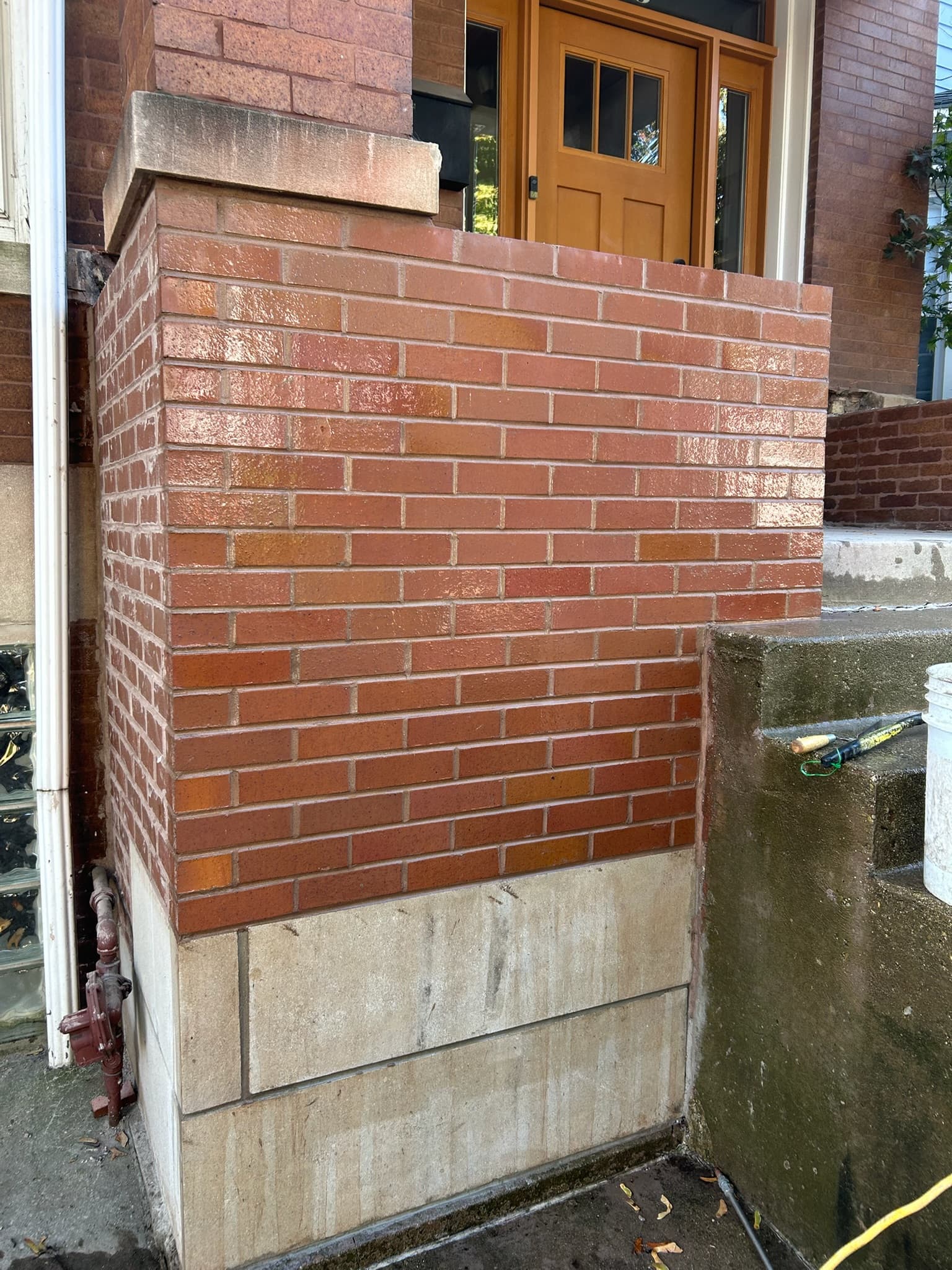
Property managers who oversee mixed-use commercial portfolios often have buildings with both fired brick and concrete masonry units — sometimes on the same property, sometimes on the same building. From a distance they look similar. Both are masonry. Both use mortar. Both require periodic maintenance. But the repair process, the mortar specification, and the failure modes differ enough that treating them identically is a reliable way to generate repair callbacks.
Here's what you actually need to understand about how CMU and brick behave differently in the Chicago climate, and what that means when you're evaluating repair proposals.
The Physical Difference Matters for Repairs
Fired brick is kiln-fired clay or shale, manufactured at high temperatures to produce a dense, relatively impermeable unit. Older face brick from the early-to-mid 20th century was fired at lower temperatures and is more porous. Modern brick is fired harder and more consistently. The mortar joint carries most of the water management burden in brick assemblies.
Concrete masonry units (CMU) are manufactured from Portland cement, aggregates, and water, cast in molds and cured rather than fired. CMU is more porous than face brick by design — it's intended as a structural backup material, often with additional coatings or finishes for exterior applications. CMU blocks are larger, heavier, and have more surface area exposed to moisture infiltration.
This matters for repairs because the two materials have different moisture absorption and release characteristics, different thermal expansion coefficients, and different mortar compatibility requirements.
Mortar Specification: Different for Each
The single most common error we see on mixed-masonry properties is contractors using the same mortar mix on both CMU and brick. It causes problems in both directions.
For historic brick: Older fired brick (pre-1950) requires softer mortar — typically a lime-rich blend (Type O or NHL) — that matches the brick's compressive strength and allows thermal flexibility without stressing the brick face. Using Type S or Type N Portland on old brick creates a mismatch where the mortar is harder than the brick; stress concentrates at the brick face during freeze-thaw cycling and the face pops off.
For CMU: Concrete block requires mortar that bonds chemically with Portland cement-based substrates. Type S mortar is typically specified for exterior CMU — it's stronger than Type N and handles the greater freeze-thaw exposure of a larger, more porous unit. Using a lime-rich Type O mix on CMU provides insufficient bond strength and compressive resistance for block-scale joints.
If you're getting a single mortar specification for a project that involves both materials, ask questions. The spec should differentiate.
Failure Modes: What Goes Wrong and Why
Brick failure patterns:
- Spalling: The face of the brick pops off, exposing the rough interior. Caused by moisture trapped in porous brick freezing and expanding, or by incompatible hard mortar transferring stress to the brick face. Most common in pre-war brick and on buildings previously repointed with wrong-spec mortar.
- Joint erosion: Mortar recedes behind the brick face, opening the wall to water infiltration. Gradual and predictable — the leading indicator for tuckpointing needs.
- Stair-step cracking: Diagonal cracks following mortar joints along a stair-step pattern. Typically indicates differential settlement or seasonal movement at a building corner or wall transition.
- Vertical cracking above openings: Almost always indicates lintel failure. The steel angle above the window corrodes, expands, and cracks the brick coursework above.
CMU failure patterns:
- Face shell spalling: The outer face shell of the block breaks away, exposing the hollow cores. Once the face shell is gone, water enters the cores directly and accelerates structural deterioration. More dramatic and urgent than brick spalling.
- Mortar joint washout: CMU joints in high-exposure locations — building corners, north-facing walls, grade-level walls near plowing — erode faster than brick joints because of the larger mortar bed area and the block's porosity.
- Horizontal cracking: Often appears at the same course level across a CMU wall. Usually indicates a structural issue — differential expansion, inadequate reinforcing, or concentrated load at that level. This is not a cosmetic repair; it requires structural assessment.
- Efflorescence: CMU is highly prone to efflorescence because of its Portland cement content. White deposits on block walls are common and indicate active water movement through the wall. Treatment starts with source identification, not surface washing.
Access and Scope Considerations
Brick on commercial facades is typically applied as a veneer or a full brick wythe on framed or block backup construction. Access for tuckpointing is straightforward — scaffold or aerial lift, standard tuckpointing tools. Selective brick replacement requires matching the existing unit and carefully removing surrounding mortar without damaging adjacent brick.
CMU is often the structural element itself — warehouse walls, industrial buildings, and many commercial flex buildings use CMU as the primary wall material without a brick veneer. Repointing CMU uses wider joints and larger pointing tools than brick work. Replacing damaged CMU requires cutting out the failed block without compromising the adjacent units or the wall's structural continuity — a meaningfully more involved operation than replacing an individual brick.
On block buildings at grade level, vehicle impact and heavy equipment contact are common damage sources. We see this frequently on industrial properties in Will County and western DuPage — fork truck contact at corners, loading dock impacts, snow plow damage at grade. Repairs to these locations need to be robust, properly reinforced, and matched to the existing block.
What to Ask When Getting Proposals
When you're soliciting bids on a commercial masonry project, the mortar specification question separates contractors who understand what they're working with from those who don't:
- What mortar type will you use, and why? A contractor who specifies the same mix for brick and block on the same building, or who can't explain the difference, is a risk.
- How are you removing existing mortar on the CMU sections? CMU joints are wider and require different cutting tools than brick joints. Cold chisels and small oscillating tools appropriate for brick can damage block face shells.
- On the brick sections, what's your approach if you find hard Portland mortar from a previous repair? The right answer involves removing the incompatible mortar before repointing, not tuckpointing over it.
When Both Materials Are Present on One Building
Office parks and industrial facilities often combine brick veneer on the office front elevation with CMU construction on the warehouse or utility sections. This is common in DuPage and Will County's commercial corridor.
Scoping these buildings requires treating each material separately — mortar specification, repair methods, and inspection criteria all vary. We walk and photograph each elevation distinctly, note material transitions, and write the scope to address each section appropriately. The price per square foot for CMU repointing typically differs from brick tuckpointing, and the difference should be reflected in any honest proposal.
For commercial properties throughout the Chicago south and southwest suburbs, Emerald Masonry LLC handles both brick and CMU repair with appropriate specifications for each. We work with property managers on full-building assessments, phased repair plans, and capital budgeting documentation.
Call (708) 288-1696 or contact us here to schedule a free on-site assessment. For additional reading, see our pages on commercial masonry and brick repair.