
Tuckpointing & Repointing · Chicagoland, IL
How to Read a Masonry Contractor's Scope of Work — What the Line Items Actually Mean
Most property managers reviewing masonry estimates are evaluating price without the context to evaluate scope. Knowing what the line items in a masonry scope of work actually mean — and what's missing from a weak scope — is what separates a decision based on price from a decision based on value.
2026-05-20
Why Masonry Estimates Are Hard to Compare
Most property managers responsible for building maintenance have solid instincts for evaluating contractor bids. They know how to compare HVAC quotes, understand the line items in a roofing estimate, and can usually tell whether a vendor is scoping work accurately.
Masonry is harder. The work is technical in ways that aren't visible from the surface, the terminology is inconsistently used across contractors, and the process differences between a correct tuckpointing job and a surface patch that fails in three years are largely invisible to anyone who isn't doing the work. A scope of work document that looks complete may be missing the most important step.
This guide explains what the common line items in a masonry scope actually mean, what questions to ask about each, and what's typically absent from a weak estimate.
Line Item 1: Tuckpointing / Repointing
What it should mean: Mechanical removal of deteriorated mortar to a minimum depth of 3/4", followed by packing with matched mortar and tooling the joint to the original profile.
What it sometimes means instead: Applying new mortar over existing mortar without mechanical cutting (surface patching). The result looks identical immediately after the work, fails within 3–7 years, and is undetectable without probing the joints.
Questions to ask:
- "What depth will joints be cut to, and what tool will you use for cutting?"
- "What mortar specification are you using, and why is that appropriate for this building?"
A contractor who answers the first question with "we'll grind it out" without specifying a depth hasn't committed to anything. A contractor who says "we use standard mortar" without connecting the specification to the building age hasn't thought about the critical question of mortar hardness relative to brick hardness.
What a strong scope says: "Mechanical removal of existing mortar to minimum 3/4" depth using angle grinder / oscillating tool. Repoint with [specific mortar type] mortar, matched to existing joint profile."
Line Item 2: Brick Replacement
What it should mean: Removal of specific failed brick units and installation of matched replacement brick using compatible mortar. Should specify approximate quantity.
What it sometimes means instead: Contractors sometimes include "brick repair as needed" without specifying scope. This is a blank check — it either means they'll charge extra for every unit they touch, or it means they've identified specific units that need replacing and haven't quantified it.
Questions to ask:
- "How many units are you planning to replace, and which openings or sections are they in?"
- "How are you sourcing matched brick for a building of this age?"
On older buildings (pre-1980), matching brick requires sourcing from reclaimed suppliers. A contractor who says "we'll find something close" is telling you the match will be approximate. This may be acceptable or not depending on the visibility of the repaired section — for rear elevations on industrial buildings it may be fine; for a visible historic facade it's not.
What a strong scope says: "Replace approximately [X] brick units in [described sections]. Replacement brick sourced from [reclaimed supplier / our inventory] to match existing color and texture."
Line Item 3: Lintel Inspection / Lintel Replacement
What it should mean: Physical inspection of the steel angles spanning each window and door opening to assess corrosion stage. Replacement involves temporary shoring, extraction of the corroded lintel, installation of a new galvanized steel angle, and brick reset above the opening.
What's sometimes missing: Many masonry scopes on older buildings don't include explicit lintel inspection or replacement at all — even when cracking above windows is visible in the photos. This is often not negligence; it's scope limitation. Some tuckpointing contractors don't do lintel work and simply don't include it. But it leaves the building owner with an incomplete picture.
Questions to ask:
- "Does this scope include inspection of the lintels above window and door openings?"
- "If active lintel corrosion is found, is lintel replacement included in this scope or would it be a separate quote?"
What a strong scope says: "Full lintel inspection included. Replacement of failed lintels at [identified openings] with new galvanized steel angles, including temporary shoring, extraction, installation, and brick reset."
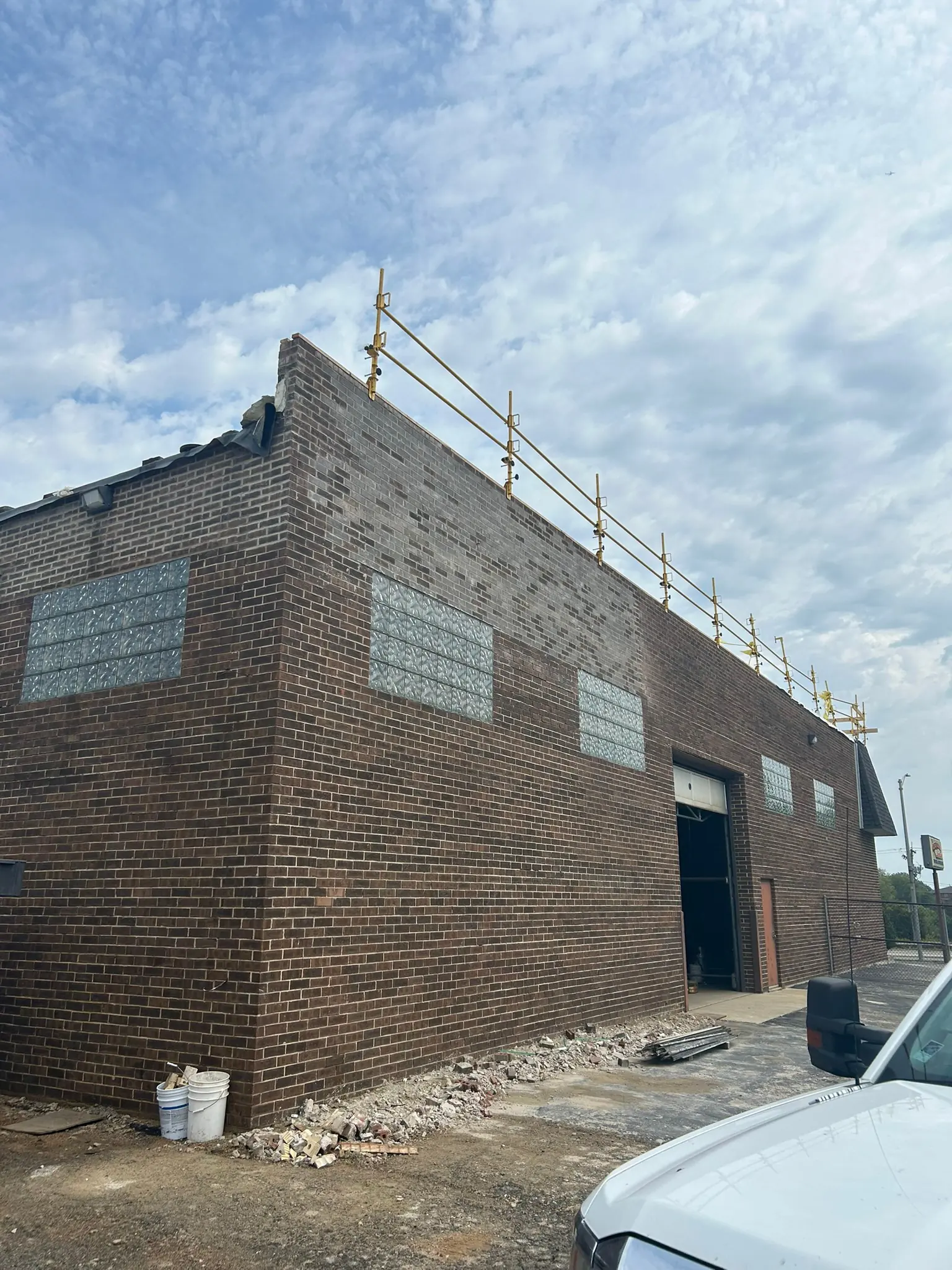
Line Item 4: Parapet Repair / Coping Joint Repointing
What it should mean: Repointing of the coping head and bed joints at the top of the parapet wall, with possible replacement of cracked coping units. Often requires aerial lift access. Should specify which elevations and approximate lineal footage.
What's sometimes missing: Parapet work is frequently scoped separately from wall tuckpointing on commercial buildings — the access method differs (aerial lift vs. ground-level scaffolding) and it's easier to price separately. But if a scope describes tuckpointing "the building exterior" without specifying whether the parapet is included, it almost certainly is not.
Questions to ask:
- "Does the tuckpointing scope include the parapet above the roofline on all four elevations?"
- "Are coping joints included, or just the parapet face below the coping?"
Coping joints — the head joints between coping units at the very top of the wall — are the highest-priority joints on a commercial building. If they're open, water is entering the wall at the worst possible location. A scope that tuckpoints the parapet face but omits coping joint repair is addressing a secondary concern while ignoring the primary one.
What a strong scope says: "Coping joint repointing on [X] elevations — approximately [X] linear feet. Parapet face tuckpointing above roofline to parapet cap. Aerial lift required."
Line Item 5: Chimney Work
What it should mean: Tuckpointing of the accessible chimney courses, crown inspection and repair or replacement, and assessment of the upper brick courses where freeze-thaw damage concentrates.
What's sometimes missing: Chimney work is often treated as add-on scope for a separate visit, particularly on residential projects. If the building has chimneys and the scope doesn't mention them, they weren't included.
Questions to ask:
- "Does this scope include the chimney? Crown condition?"
- "If upper course replacement is needed, is that included here or priced separately?"
What a Weak Scope Looks Like
A scope of work document that consists primarily of:
- "Tuckpointing entire building"
- "Brick repair as needed"
- "Clean and seal"
...with no specifications, quantities, or process descriptions should be treated as an incomplete bid. You can't evaluate quality, you have no basis for comparison with other bids, and the contractor has made no commitments about how the work will be done.
A scope document that says "tuck point entire building per walk through" is legally committing to essentially nothing except showing up. If the results don't meet your expectations, there's no specific commitment to point to.
What a Strong Scope Looks Like
A strong masonry scope of work includes:
- Joint cutting depth and tool method
- Mortar type specification and rationale relative to building age
- Approximate quantities for tuckpointing (linear feet or square footage by elevation)
- Explicit identification of brick units to be replaced with quantity and sourcing plan
- Parapet and coping work explicitly included or excluded
- Lintel inspection included; replacement pricing either included or clearly stated as additional scope
- Chimney scope explicitly stated
- Work sequence (if applicable — lintel work before tuckpointing)
- Warranty terms for workmanship
A scope at this level of specificity is a meaningful commitment. You can evaluate it on its merits, compare it to other scopes at the same level of detail, and hold the contractor to it.
FAQ
Is a more detailed scope always better, or can it just mean more paperwork?
Detail is meaningful when it commits the contractor to specific process (joint cutting depth, mortar type) or specific quantities (units to replace, linear footage). Detail that just describes what the contractor will do at a general level without committing to process or quantity standards doesn't add value. Look for commitments, not descriptions.
If I ask a contractor to provide a more detailed scope and they won't, what does that tell me?
It usually indicates that the contractor doesn't want to commit to a specific process because they know their default process is a shortcut. A contractor confident in their work will describe it specifically — because their competitive advantage is their process. A contractor doing surface patches doesn't want to write "mechanical joint removal to 3/4" depth" because they're not planning to do that.
Emerald Masonry LLC provides detailed written scopes of work on all projects before any commitment is required. For a free on-site assessment and estimate in Chicagoland, call (708) 288-1696 or email emeraldmasonryil@gmail.com.