
Brick Repair & Replacement · Chicagoland, IL
Solid Masonry vs. Brick Veneer — Why the Two Walls Fail Differently and Get Repaired Differently
Two brick buildings can look identical from the street and need completely different repairs — because one is a solid load-bearing masonry wall and the other is a thin brick veneer hung on a frame. Knowing which one you have changes how you read the damage and what the fix should be.
2026-06-03
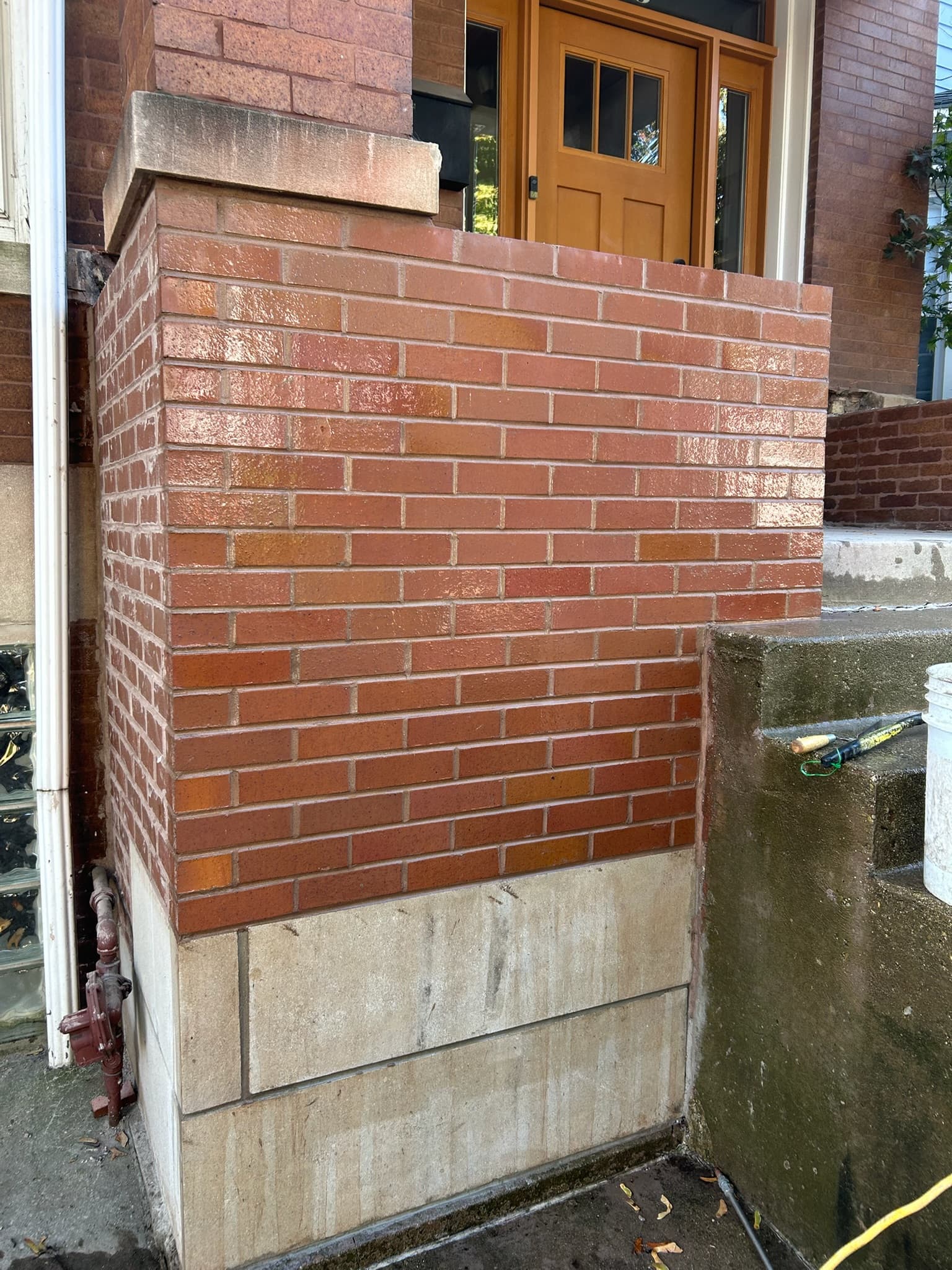
Two Brick Walls, Two Completely Different Problems
From the sidewalk, two brick buildings can look the same — same brick, same joints, same color. But behind the face, they can be built in two fundamentally different ways, and that difference dictates how they fail and how they have to be repaired. Get it wrong and you can spend money on a repair that doesn't address the actual problem.
The two systems are solid (structural) masonry and brick veneer. Most of the confusion we run into with property owners and managers comes from not knowing which one they have. So let's make the distinction concrete.
What the Two Walls Actually Are
Solid masonry (load-bearing)
In a solid masonry wall, the brick is the structure. There's no separate frame holding the building up — the masonry itself carries the load of the floors and roof above. These walls are typically multiple wythes (layers of brick) thick, with the layers bonded together. You see this construction in older Chicago-area buildings: pre-WWII houses, two-flats and three-flats, vintage commercial buildings, churches, and institutional buildings. If a wall is genuinely load-bearing brick, removing or damaging it has structural consequences.
Brick veneer
In a veneer wall, the brick is not structural. The building is held up by a separate frame — wood, steel, or concrete block — and a single layer of face brick is hung on the outside of it for appearance and weather protection. Between the brick and the structure there's an air gap, and the brick is tied back to the building with metal wall ties. Nearly all construction from roughly the 1960s onward is veneer: postwar subdivisions, townhomes, modern commercial buildings, and most new construction.
The brick can look identical in both cases. What's different is what the brick is doing.
How to Tell Which One You Have
A few reliable tells:
- Age and era — pre-1940s Chicago-area buildings are very often solid masonry; buildings from the 1960s and later are almost always veneer. The transition decades (1940s–'50s) are mixed.
- Brick bonding pattern — solid walls often show header courses (bricks turned end-out, showing their short face) every several rows. Those headers tie the wythes together. A wall that's all "stretchers" (long faces) with no headers is usually veneer.
- Wall thickness at openings — look at the depth of the brick at a window or door. A deep, thick reveal suggests solid multi-wythe masonry; a thin reveal suggests a single veneer layer.
- Weep holes — small open vertical joints near the base of the wall and above openings are a veneer feature; they let the air gap drain. Solid walls don't have them.
If you're not certain, a masonry contractor can tell quickly on site. It matters because the failure modes and repairs are different.
How Each Wall Fails
Solid masonry failures
Because the brick is structural, the failures tend to be about the wall losing its integrity:
- Mortar deterioration through the wall — as joints erode, water penetrates the full thickness, and the bond between wythes weakens.
- Bulging and bowing — when the bond between the multiple wythes fails, the outer wythe can separate and bulge outward. In a solid wall this is a structural concern.
- Cracking from settlement or overload — because the wall carries load, cracks can reflect structural movement, not just cosmetic stress.
- Spalling — same freeze-thaw mechanism as any brick, but on a structural wall the loss of material has more consequence.
Brick veneer failures
Because the brick is just a skin, veneer failures are usually about the connection and the water management behind it:
- Wall tie corrosion — the metal ties rust over decades. When enough fail, sections of veneer lose their anchor and bow, bulge, or pull away from the building. This looks like the bulging you'd see on a solid wall, but the cause and the fix are entirely different.
- Lintel and shelf-angle rust — veneer is supported over openings by steel lintels and, on multi-story buildings, by shelf angles. Rusting steel expands and cracks the brick above. This is one of the most common veneer failures.
- Trapped moisture in the air gap — when flashing or weep holes fail, water collects behind the veneer instead of draining, and freeze-thaw spalls the brick from behind.
- Differential movement — veneer and the frame behind it expand and contract differently; without proper expansion joints, the brick cracks.
Why the Repair Approach Has to Match the Wall
Here's where the distinction stops being academic. Consider a bulging brick wall — the same visible symptom on both systems:
- On a solid masonry wall, bulging means the wythes have separated and the structural wall is compromised. The fix involves assessing structural integrity and may require rebuilding the affected section, possibly with the building shored.
- On a veneer wall, the same bulge means the wall ties have failed. The brick itself may be fine. The fix is to re-anchor the veneer to the structure — a completely different, often less invasive repair.
Tear into a veneer bulge as if it's structural, or treat a structural bulge as if it's just loose ties, and you've either over-built or under-fixed the problem. Same with cracks above a window: on veneer it's almost always a rusting lintel; on solid masonry it could be structural movement that needs diagnosis first.
There's also the matter of what you can safely remove. You can cut out and replace brick on a veneer wall fairly freely because it's non-structural. On a solid load-bearing wall, removing brick affects the structure — it has to be done in controlled sections, sometimes with temporary support, never casually.
What This Means for You as an Owner or Manager
- Don't assume two brick buildings need the same fix — even in the same portfolio, a 1920s building and a 1980s building are different animals.
- Be skeptical of a quote that doesn't mention which wall you have. A contractor who diagnoses a bulging wall without establishing whether it's tie failure or wythe separation is guessing.
- Bulging, bowing, and recurring cracks deserve a real assessment, not just a re-lay of the visible brick. The visible damage is a symptom; the wall type tells you the cause.
- Match the repair to the construction. The right fix for veneer is often simpler and cheaper than the wrong fix for solid masonry — and vice versa.
The Bottom Line
The single most useful question to answer before any significant brick repair is: is this wall holding the building up, or just hanging on the front of it? The answer changes the diagnosis, the repair, the cost, and the risk. A masonry contractor who starts there is one worth listening to.
If you've got a bulging wall, a recurring crack, or brick damage and you're not sure what kind of wall you're dealing with, contact Emerald Masonry for a free on-site assessment. We'll identify the construction, diagnose the real cause, and recommend a repair that fits the wall you actually have. Call (708) 288-1696 or email emeraldmasonryil@gmail.com.