
Masonry Restoration · Chicagoland, IL
Through-Wall Flashing in Masonry: The Hidden Layer That Keeps Brick Walls Dry
Brick walls are not waterproof — they are designed to let water in and drain it back out. Through-wall flashing is the hidden layer that makes that work, and when it is missing or failed, walls leak. Here is how it works.
2026-06-22
Quick Answer
Through-wall flashing is a concealed waterproof layer built into a masonry wall that collects water inside the wall and directs it back out through weep holes. Brick is not waterproof, so without working flashing, water gets trapped and causes leaks, efflorescence, and freeze-thaw damage. Emerald Masonry LLC repairs masonry water problems across Chicagoland — (708) 288-1696.
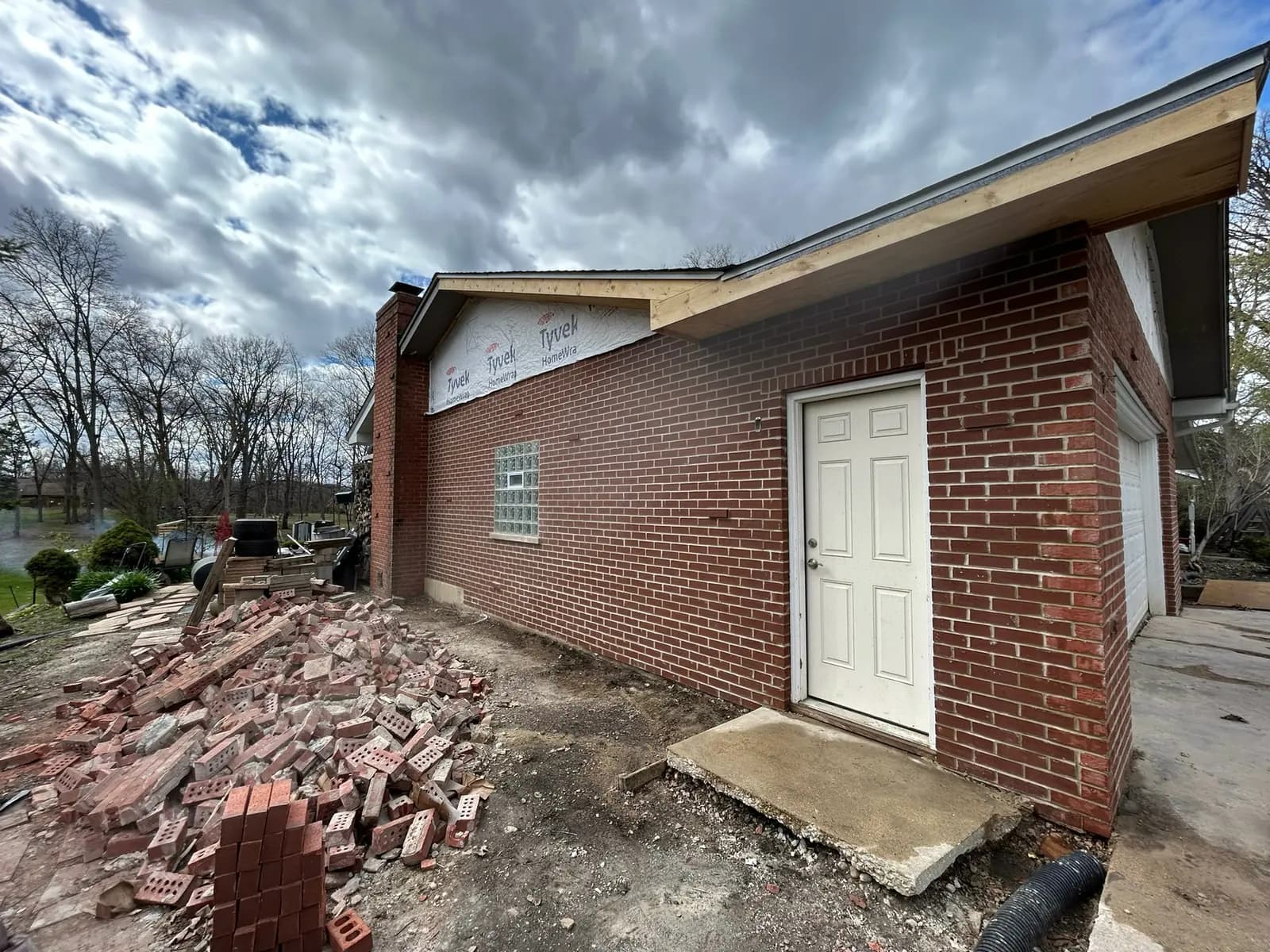
Most people assume a brick wall keeps water out the way a raincoat does — that the brick itself is the barrier. It isn't. Brick and mortar absorb water and, in a hard wind-driven rain, pass it straight through. Masonry walls are not designed to be waterproof; they are designed to manage water — to let it in and then drain it back out. The hidden hero of that system is through-wall flashing, and when it is missing or failed, otherwise solid-looking walls leak. At Emerald Masonry LLC we trace and repair these water problems across Chicagoland — (708) 288-1696. Here is how the system actually works.
Brick Walls Are Drainage Systems, Not Barriers
A modern brick veneer wall has an outer layer of brick, an air gap or cavity behind it, and a backup wall. Water that penetrates the brick is supposed to run down the back face of the veneer or the cavity and exit at the bottom. Even solid multi-wythe masonry walls absorb and move water internally. The whole design assumes water will get in — so the wall's job is to give that water a clean path back out before it reaches anything that can be damaged.
That path has two parts working together: flashing and weep holes.
What Through-Wall Flashing Does
Through-wall flashing is a waterproof membrane or metal layer built horizontally into the wall at the points where water collects. It spans the full thickness of the relevant section — hence "through-wall" — so any water traveling down inside the wall hits the flashing and is forced back out to the face of the building rather than continuing down into the structure.
Flashing is installed at the spots where water naturally wants to pool or change direction:
- At the base of the wall (above grade), so absorbed water exits instead of wicking into the foundation.
- Over windows, doors, and lintels, so water above an opening is shed outward, not into the frame.
- At shelf angles on taller buildings, where the veneer is supported floor by floor.
- Under copings and at parapets, the most exposed horizontal surfaces on the building.
Weep Holes: Where the Water Comes Out
Flashing alone just collects water; it needs an exit. Weep holes are the small gaps left open in the mortar joints directly above a line of flashing. Water riding on top of the flashing drains out through the weeps. You'll see them as open head joints or small vents along the bottom course of a brick wall and above openings.
Flashing and weep holes are a pair: flashing collects the water, weep holes let it out — block or omit either one and the wall traps water. A frequent mistake is sealing weep holes shut (sometimes well-meaning caulk, sometimes a paint job), which converts the drainage system into a bathtub.
What Goes Wrong
In the buildings we work on around Chicago, flashing problems usually come from one of these:
- No flashing at all — common in older masonry and in cut-rate construction. The wall has no internal drainage plane.
- Flashing that stops short — it doesn't extend to the face of the wall, so water drips back into the cavity instead of out (a "buried" or incomplete flashing).
- Damaged or deteriorated flashing — old felt or thin metal that has corroded, torn, or pulled loose.
- Blocked weep holes — mortar droppings during construction, debris, paint, or caulk closing them off.
- Coping and parapet flashing failure — the number-one source of top-down leaks in commercial brick buildings.
The symptoms show up as interior water stains, peeling paint, efflorescence (white mineral staining where water is exiting the masonry), spalling brick from trapped freeze-thaw water, and damp, musty interior walls — often well away from where the water is actually getting in.
Why It Matters So Much in Chicago
Our climate punishes trapped water. Wind-driven rain drives moisture deep into masonry, and then freeze-thaw cycles do the damage: water held inside the wall freezes, expands, and breaks brick, joints, and the wall's internal components apart over repeated winters. A wall with working flashing and weeps sheds that water before it can freeze in place. A wall without it accumulates damage every season. This is why two buildings on the same block, the same age, can be in completely different condition — one drains, one doesn't.
How Flashing Is Repaired
The right repair depends entirely on where the flashing is and how the wall is built:
- Diagnose the actual entry and exit points. The leak inside is rarely directly below where water gets in; we trace the path.
- Clear and restore weep holes where the flashing is sound but the drainage is blocked.
- Repair accessible flashing at copings, parapets, and lintels — often the highest-payoff, least-invasive fix.
- Remove and rebuild a section where flashing is buried in the veneer and has failed, installing proper flashing and weeps as the brick goes back.
- Detail the terminations so water is actually directed out, not back into the wall.
Flashing is not something you can spray on or seal over from the outside — it is built into the wall, so honest flashing repair means getting to it, not hiding the symptom. A breathable sealer can help a sound wall, but it is no substitute for a working drainage plane.
The Takeaway
If your brick wall leaks, shows efflorescence, or keeps spalling despite looking solid, the problem is often not the brick at all — it's the hidden flashing and weep system that is supposed to drain the wall. Diagnosing that correctly is the difference between a lasting repair and chasing the same leak for years.
Emerald Masonry LLC is a family-owned, licensed and insured masonry contractor serving Chicago and the Chicagoland suburbs led by career masons with decades of hands-on experience in tuckpointing, chimney repair, brick repair and replacement, lintel and parapet repair, foundation and limestone/sill repair, caulking, power washing, sealing, and commercial, residential, and historic masonry restoration. Free on-site estimates — call (708) 288-1696.
For related reading and services, see our parapet wall repair, lintel repair, masonry sealing and waterproofing, and commercial masonry restoration.
Frequently Asked Questions
What is through-wall flashing in a brick wall?
Through-wall flashing is a concealed waterproof layer built horizontally into a masonry wall — at the base, over windows and doors, at shelf angles, and under copings. It catches water that gets inside the wall and redirects it back to the outside through weep holes, instead of letting it travel down into the structure.
Why does my brick wall leak if brick sheds water?
Because brick and mortar are not waterproof — they absorb and pass water, especially in wind-driven rain. Masonry walls are designed to manage water, not block it: water gets in, and flashing plus weep holes are supposed to drain it back out. When flashing is missing, damaged, or installed wrong, that water has nowhere to go and shows up as interior leaks, efflorescence, and spalling.
Can flashing be repaired without rebuilding the wall?
Sometimes. Flashing at a coping, a parapet, or a single lintel can often be addressed with targeted masonry work. Flashing buried deep in a veneer wall is harder to reach and may require removing and rebuilding a section of brick. A masonry contractor can assess where the flashing is failing and what the least-invasive effective repair is.
Frequently Asked Questions
What is through-wall flashing in a brick wall?
Through-wall flashing is a concealed waterproof layer built horizontally into a masonry wall — at the base, over windows and doors, at shelf angles, and under copings. It catches water that gets inside the wall and redirects it back to the outside through weep holes, instead of letting it travel down into the structure.
Why does my brick wall leak if brick sheds water?
Because brick and mortar are not waterproof — they absorb and pass water, especially in wind-driven rain. Masonry walls are designed to manage water, not block it: water gets in, and flashing plus weep holes are supposed to drain it back out. When flashing is missing, damaged, or installed wrong, that water has nowhere to go and shows up as interior leaks, efflorescence, and spalling.
Can flashing be repaired without rebuilding the wall?
Sometimes. Flashing at a coping, a parapet, or a single lintel can often be addressed with targeted masonry work. Flashing buried deep in a veneer wall is harder to reach and may require removing and rebuilding a section of brick. A masonry contractor can assess where the flashing is failing and what the least-invasive effective repair is.