
Tuckpointing & Repointing · Chicagoland, IL
Tuckpointing vs. Caulking in Masonry — Why the Distinction Matters More Than You'd Think
Mortar and caulk are both used in masonry construction, and they're often confused — or worse, used interchangeably by contractors who should know better. The distinction isn't academic. Using caulk where mortar belongs, or mortar where caulk belongs, produces failures that look like normal weathering until the water damage inside the wall reveals the actual cause. Understanding which material goes where is one of the most practically useful things a property owner or manager can know about masonry maintenance.
2026-04-26
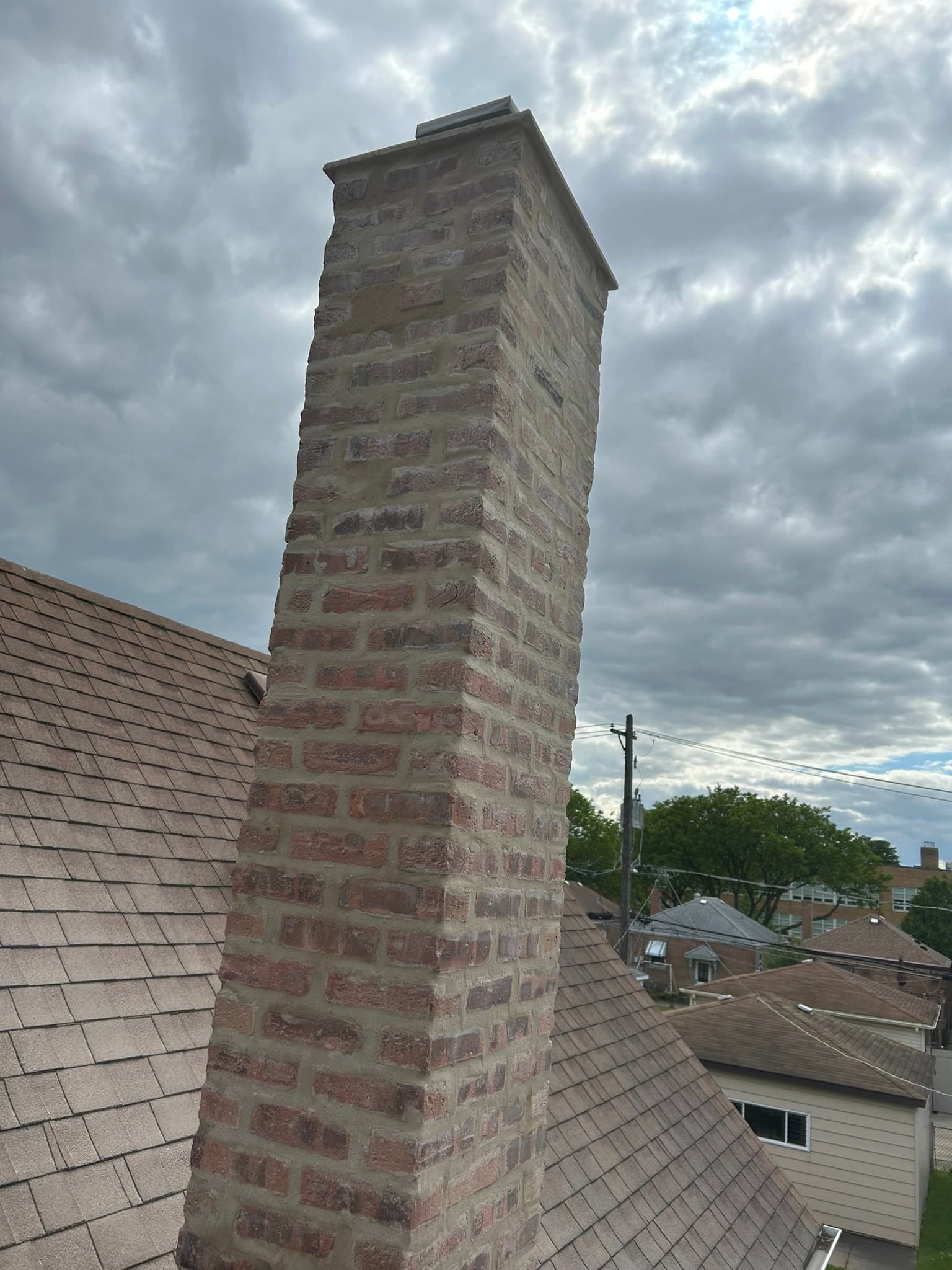
If you've ever looked closely at a brick building and noticed joints that look slightly different — smoother, perhaps darker, with a rubberized texture — you may have been looking at caulk used in place of mortar. It's more common than you'd expect, and it causes predictable failures.
Understanding the difference between mortar joints and sealant joints — where each belongs, how each ages, and why using the wrong material in the wrong location causes problems — is useful knowledge for anyone responsible for a masonry building.
Mortar: What It Is and Where It Belongs
Portland cement mortar (and lime mortar in historic applications) is a rigid, cementitious material that bonds brick and block units together. Mortar joints in standard masonry construction are the packed, hardened material between each brick course and between vertically adjacent bricks.
Mortar's function in a masonry wall:
- Structural bonding. Mortar ties brick units together into a composite structural system. In load-bearing masonry, the mortar joints are integral to the wall's load-carrying capacity.
- Water shedding. A properly profiled, intact mortar joint sheds water from its surface rather than collecting it. The slightly convex or concave face of a tooled joint is designed to direct water away.
- Vapor management. Mortar is vapor-permeable (particularly lime mortar). It allows moisture vapor to pass through the wall assembly in both directions, which is critical in buildings where vapor pressure can build on either side of the wall.
- Sacrificial element. Mortar is intended to be softer than the brick and to absorb thermal and mechanical stress before the brick does. When mortar reaches the end of its service life, it is removed and replaced — the brick remains.
Where mortar belongs: Every joint between brick units in a standard masonry wall. Mortar joints in horizontal courses (bed joints), vertical joints between bricks (head joints), and raked joints in specific architectural applications.
Caulk and Sealant: What They Are and Where They Belong
Elastomeric sealants — commonly called caulk — are flexible, polymer-based materials that accommodate movement while maintaining a weathertight seal. Unlike mortar, they do not harden completely; they retain flexibility throughout their service life.
Sealant's function in masonry construction:
- Sealing control joints. Control joints are intentional vertical gaps built into masonry walls to accommodate thermal expansion and shrinkage. These joints must flex — mortar would crack immediately in a control joint. Sealant, backed by a foam backer rod, fills and seals control joints while accommodating the expected movement.
- Window and door perimeters. The joint between a masonry wall and a window or door frame is a transition between dissimilar materials that move differently. Sealant accommodates this movement.
- Flashing interfaces. Where metal flashing meets masonry — at the roof-to-chimney junction, at parapet base flashings, at shelf angles — the seal between the metal and masonry requires a flexible sealant, not rigid mortar.
- Expansion joints at building corners or material transitions. Where masonry meets concrete, steel, or other materials with different coefficients of thermal expansion, sealant-filled expansion joints accommodate differential movement.
Where sealant belongs: Control joints, expansion joints, window and door perimeters, flashing interfaces, and other intentional flexible connections in masonry construction.
What Goes Wrong When Caulk Is Used in Mortar Joints
This is the most common error we see on buildings that have had previous masonry "maintenance":
A contractor — or a building owner with a caulk gun — fills eroded or cracked mortar joints with elastomeric caulk rather than repacking them with mortar. This looks better immediately after application than bare, eroded joints. Within 3-7 years:
The caulk debonds. Mortar joints are not designed to flex. When caulk is applied to a standard mortar joint, it bonds to the brick faces on either side but doesn't have the movement to work against — there's no control joint geometry maintaining a uniform gap for the sealant to span. As the sealant ages and the building moves thermally, the caulk bead cracks or peels from one brick face.
Water infiltration increases at the joint. A failed caulk bead that has partly debonded creates a worse situation than the eroded mortar joint it replaced: the gap between the caulk and the brick face is a water entry channel that's partly protected from rain evaporation by the overhanging caulk bead. Water sits against the brick face longer than it would have with the original open eroded joint.
The caulk degrades and becomes a debris trap. Aged, crumbling caulk in mortar joints holds dirt, traps moisture, and creates a surface that's harder to clean and more difficult to properly repoint. Removing failed caulk from brick joints requires more care than removing failed mortar — caulk residue adheres differently to masonry surfaces.
The underlying cause is unaddressed. If the mortar joint was eroded, the erosion is still there behind the caulk. The caulk applied over it doesn't restore the mortar joint — it just covers it temporarily.
What Goes Wrong When Mortar Is Used in Control Joints
This error is less common on initial construction but occurs regularly during repairs when the person doing the work doesn't recognize that a particular joint is a control joint.
Mortar in a control joint cracks immediately. Control joints are designed to move. Mortar can't move — it cracks under even small displacement. A mortar-filled control joint will develop a crack at or near the center of the joint within the first heating-cooling cycle after application.
The crack becomes a water entry point. A cracked mortar plug in what should be a sealed control joint is actually worse than an open joint, because the crack geometry allows water to enter and be held against the masonry face. The backing doesn't drain; it sits.
Rebuilding is necessary. Removing mortar from a control joint requires careful grinding or hand-chiseling that risks damaging the brick edges at the joint opening. The correct repair after a mortar-filled control joint involves removing all the mortar, installing proper backer rod at the correct depth, and applying compatible sealant.
How to Tell the Difference on Your Building
On an existing building, distinguishing mortar joints from control joints and sealant joints:
Visual texture. Mortar joints have a slightly rough, matte surface. Sealant joints typically have a smoother, slightly glossy surface when intact, or a cracked and peeling surface when aged.
Flexibility test. Gently press on the joint material with a fingernail or small tool. Intact mortar won't flex — it's rigid. Sealant that's still functional will have some elasticity. Failed sealant may crumble or separate from the masonry face.
Joint orientation and location. Control joints are vertical, continuous through the wall height, and located at regular intervals (typically every 20-25 feet in commercial masonry) and at changes in wall geometry. They look intentional — not eroded, but deliberately open or sealed. Mortar joints follow the coursework of the brick.
Window and door perimeters. The joint at the frame-to-masonry interface should be sealant. If you see mortar packed directly against a window frame, that's wrong — mortar cracks at this interface and leaves a gap.
The Right Call for Each Situation
Eroded or damaged standard mortar joints: Remove to ¾" depth and repoint with mortar of appropriate specification. Do not caulk.
Cracked or failed control joint sealant: Remove failed sealant, clean the joint, install backer rod at the correct depth (½ to ¾ of the joint width), apply compatible polyurethane or silicone sealant.
Window/door perimeter joint: Remove failed caulk, clean the surface, apply fresh elastomeric sealant. Do not use mortar.
Flashing-to-masonry interface: Reapply roofing sealant or compatible elastomeric sealant as recommended by the flashing manufacturer. Do not mortar over flashing seams.
Emerald Masonry LLC uses the right material in the right joint on every project. We're based in Palos Heights and serve commercial and residential properties throughout Chicagoland. Call (708) 288-1696 or contact us online.
See also: Tuckpointing | Waterproofing | Masonry Restoration