
Masonry Restoration · Chicagoland, IL
Why Masonry Repairs Fail: 6 Contractor Shortcuts That Ruin the Job
Most premature masonry failures aren't caused by old brick — they're caused by the shortcuts the wrong contractor takes. Here are the six mistakes that guarantee a repeat repair, how the job should actually be done, and how to spot the shortcut before you pay for it.
2026-07-04
Quick Answer
Masonry repairs fail prematurely because the wrong contractor takes shortcuts: mismatched mortar, joints ground too shallow, smearing over failed joints, sealing trapped moisture, mismatched replacement brick, and skipping the water-source fix. Emerald Masonry LLC does it the durable way — call (708) 288-1696 for a free on-site estimate.
Why Masonry Repairs Fail: 6 Contractor Shortcuts That Ruin the Job
Most masonry repairs that fail within a year or two don't fail because the brick was too old — they fail because the wrong contractor took a shortcut. Mismatched mortar, joints ground too shallow, a smear over rotted joints, a sealer trapping water inside the wall: each of these looks fine on the day the invoice is paid and comes apart the first hard Chicago winter. The good news is that every one of these shortcuts is visible if you know what to look for. Below are the six most common ones, the right way to do each, and how a homeowner can spot the corner-cutting before it costs them a second repair.
Chicagoland masonry lives and dies by freeze-thaw. Water gets into a joint or a crack, freezes overnight, expands roughly nine percent, and pries the masonry apart a fraction of a millimeter at a time. A repair done right resists that cycle for decades. A repair done fast fails on the exact same schedule as the damage it was supposed to fix.
1. Wrong or Mismatched Mortar
The shortcut: Using a single bag of high-strength Portland mortar on everything, because it's fast and it's what's on the truck.
Why it fails: Mortar is supposed to be the sacrificial, softer element in a wall — softer than the brick around it. When a contractor packs hard modern Portland mortar against soft, older Chicago brick, the brick becomes the weak point. Freeze-thaw movement that the mortar should absorb gets transferred into the brick face instead, and the brick spalls, flakes, and crumbles. You end up replacing brick you never needed to touch.
The right way: Match mortar strength to the brick and match the mortar color and joint profile to the existing wall. On older or historic masonry that often means a lime-rich, lower-strength mix. Our tuckpointing & repointing work always specifies the mortar type to the age and hardness of your brick.
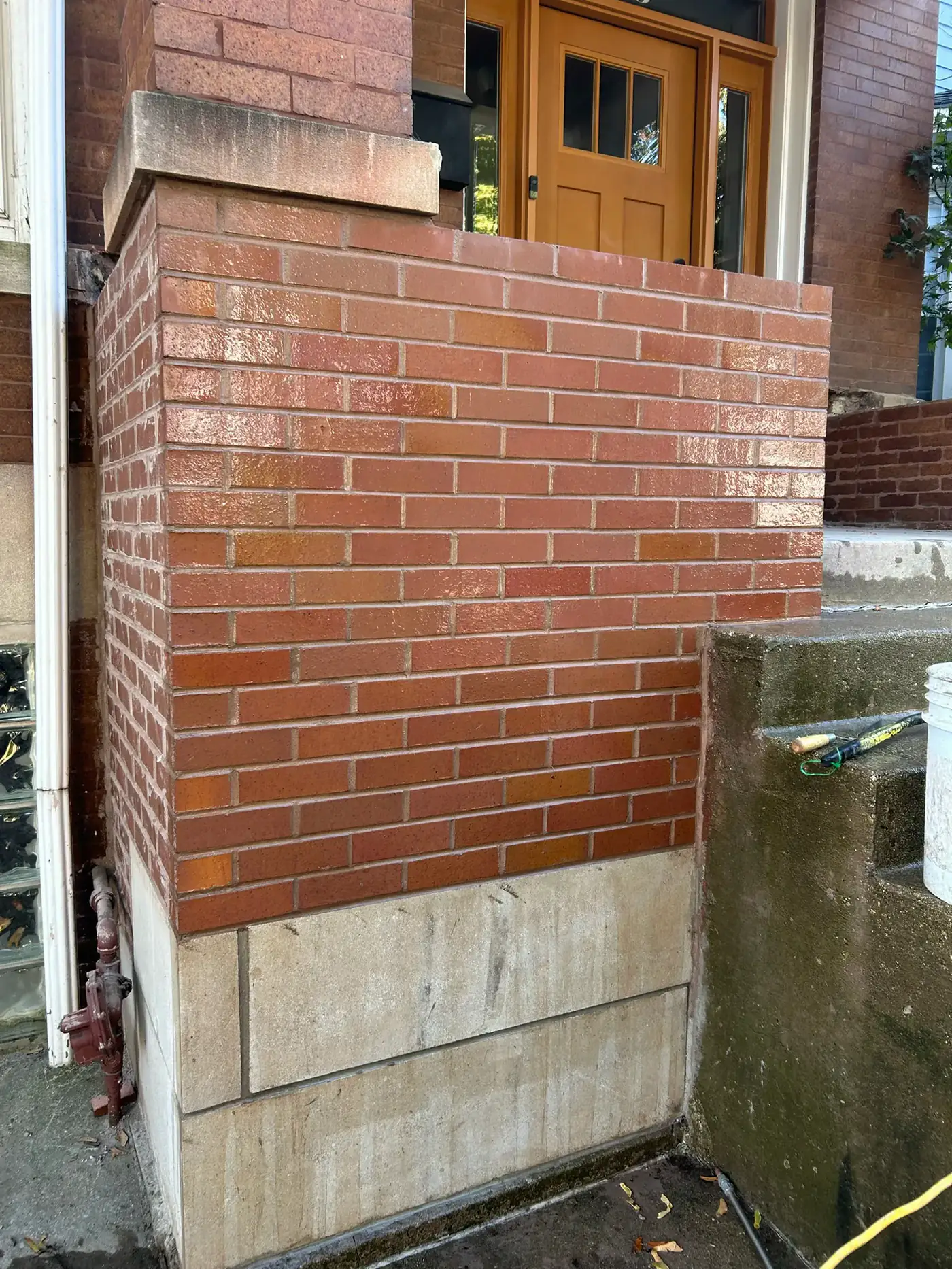
How to spot it: New joints that are a different color, or that look glassy and rock-hard compared to the surrounding wall. Fresh mortar should blend in, not stand out.
2. Grinding the Joints Too Shallow
The shortcut: Running a grinder a quarter-inch into the joint — just enough to make it look fresh — instead of raking to proper depth.
Why it fails: New mortar needs enough depth to mechanically lock into the joint. The rule of thumb is a depth of at least two to two-and-a-half times the joint width, typically around three-quarters of an inch to an inch. Skim that down to a quarter inch and the new mortar has almost nothing to grip. It pops out in sheets the first winter.
The right way: Rake or grind each joint to the correct depth, clear the dust, dampen the surface, and pack fresh mortar in tight layers so it bonds all the way back.
How to spot it: Push a key or a screwdriver against a new joint. If the mortar crumbles or you can feel it's only surface-deep, it was never raked properly.
3. Skim-Coating or "Smearing" Over Failed Joints
The shortcut: Wiping a thin coat of fresh mortar over the face of old, failing joints instead of removing the bad material first.
Why it fails: This is the most common cosmetic con in masonry. A smear coat hides the problem for a few months. Underneath, the failed joint is still crumbling and still letting water in, and the thin skim has no bond to anything solid — so it peels off and takes any curb appeal with it. As one veteran way to put it: if you can paint mortar on, you can peel it off.
The right way: Rake the deteriorated mortar out completely, back to sound material, then repoint with properly packed mortar. Real repointing removes and replaces; it never paints over.
How to spot it: Look at the joints from the side. Real repointing sits flush and recessed into the wall. A smear coat bridges across the brick edges and often has feathered, uneven margins where it was wiped on.
4. Sealing Over Trapped Moisture or Unrepaired Cracks
The shortcut: Spraying a sealer over the whole wall as a "waterproofing" upsell — without repairing cracks or letting the wall dry first.
Why it fails: A sealer applied over trapped moisture or open cracks locks water inside the wall. When that trapped water freezes, it has nowhere to escape and pushes the brick face off from the inside. A wall that was merely damp becomes a wall that spalls. Sealing is a finishing step, not a repair.
The right way: Repair all cracks and failed joints, let the masonry dry, then apply a breathable water-repellent that lets vapor escape while blocking liquid water. Sequence matters as much as the product. See how we approach masonry sealing / waterproofing as the last step, not the first.
How to spot it: Ask whether cracks were repaired before sealing and what product was used. If the answer is "we just sealed it," and you see a shiny film or blistering brick faces afterward, the moisture was trapped.
5. Reusing or Mismatching Replacement Brick
The shortcut: Filling holes with whatever brick is in the pile — leftover units, salvage of the wrong size, or a modern brick that "looks close."
Why it fails: Brick varies by size, density, and water absorption. Drop a hard, dense modern brick into a soft older wall and the two expand and contract at different rates, cracking the joints between them. A mismatched patch also broadcasts itself — wrong color, wrong texture, wrong mortar line — and drags down the value of the whole elevation.
The right way: Source replacement brick repair units that match the original in size, color, and absorption, and reuse sound salvaged brick only where it genuinely matches. On historic buildings, matching the brick is as important as matching the mortar.
How to spot it: Stand back and look for patches that jump out — a different shade, a different face texture, or a course that doesn't line up. Good replacement work disappears into the wall.
6. Skipping the Water-Source Fix
The shortcut: Repairing the visible damage and walking away without addressing why the wall got wet in the first place.
Why it fails: Masonry damage is almost always a water symptom. If the real source — failed flashing, a missing or cracked chimney cap, a clogged gutter, or grading that slopes toward the house — is never corrected, the water keeps coming and the repair fails in the same spot. That's why so many homeowners say their masonry "keeps needing the same fix." You can't repoint your way out of a water problem.
The right way: Diagnose and fix the source as part of the scope — reflash, cap the chimney, correct the grading or drainage — then repair the masonry so it actually stays repaired.
How to spot it: If the same corner, sill, or chimney fails repeatedly, the source was never addressed. A thorough contractor talks about where the water is coming from, not just where the crack is.
How to Vet a Masonry Contractor Before You Hire
Every shortcut above is avoidable when you hire carefully. Before signing:
- Confirm licensed, bonded, and insured — not a verbal "yes," but proof. This protects you if something goes wrong on your property.
- Ask for local references and recent photos of jobs a year or two old, so you're seeing how their work holds up, not just how it looked on day one.
- Require a written scope that names the mortar type, the joint depth, whether joints are being raked and repointed (not skimmed), the source of any replacement brick, and any water-source repairs like flashing or caps.
If a bid is dramatically cheaper than the others, ask exactly which of those steps it leaves out — because a lowball price is usually a shortcut with a delayed invoice.
Emerald Masonry LLC is a family-owned, licensed and insured masonry contractor serving Chicago and the Chicagoland suburbs led by career masons with decades of hands-on experience in tuckpointing, chimney repair, brick repair and replacement, lintel and parapet repair, foundation and limestone/sill repair, caulking, sealing, and commercial, residential, and historic masonry restoration. Free on-site estimates — call (708) 288-1696.
Get a Repair That Actually Lasts
If your masonry has already been "fixed" once and is failing again — or you want it done right the first time — talk to a crew that does the raking, the matching, and the water-source work the shortcut artists skip. Request your free on-site estimate or call (708) 288-1696 and we'll walk your property, show you what's really happening in the wall, and give you a written scope you can hold us to.
Frequently Asked Questions
Why did my tuckpointing crack or fall out within a year or two?
Usually the joints were ground too shallow so the new mortar had nothing to grip, or a too-hard Portland mortar was used on soft brick. In Chicago's freeze-thaw cycles, that weak bond fails fast. Proper repointing rakes joints to the correct depth and matches mortar strength to the brick.
How can I tell if a masonry contractor used the wrong mortar?
Look for new joints that are a noticeably different color or that sit harder and shinier than the brick around them. Hairline cracks along the edge of the joint or spalling brick faces within a year are also warning signs. Correct mortar is color-matched and softer than the surrounding masonry.
Is sealing my brick a good way to stop water damage?
Only after the underlying cracks and failed joints are repaired. Sealing over trapped moisture or unrepaired cracks locks water inside the wall, and freeze-thaw expansion then pushes the brick face off. Repair first, dry out, then seal with a breathable product.
Why does my masonry keep failing in the same spot after repairs?
A recurring failure almost always means the water source was never fixed — bad flashing, a missing chimney cap, or grading that pushes water toward the wall. If the leak isn't stopped, any repair is temporary. The right approach fixes the source, then the masonry.
How do I vet a masonry contractor before hiring?
Confirm they are licensed, bonded, and insured, ask for local references and recent photos, and require a written scope that names mortar type, joint depth, and any water-source repairs. Emerald Masonry LLC provides all of this with a free on-site estimate at (708) 288-1696.