
CMU Block Repair · Evergreen Park, IL
CMU Block Repair in Evergreen Park, IL — Concrete Masonry Unit Repair for Cook County Commercial Properties
Concrete masonry unit (CMU) block is the dominant wall material in Evergreen Park's commercial and light-industrial buildings — and it deteriorates differently than brick veneer. Block mortar joints erode, paint and block filler coatings fail, and unsealed CMU absorbs water at a rate that can cause significant interior moisture problems. Emerald Masonry LLC diagnoses CMU block deterioration and restores the wall assembly's water resistance for Evergreen Park commercial and institutional properties.
Quick Answer
Concrete masonry unit (CMU) block is the dominant wall material in Evergreen Park's commercial and light-industrial buildings — and it deteriorates differently than brick veneer. Block mortar joints erode, paint and block filler coatings fail, and unsealed CMU absorbs water at a rate that can cause significant interior moisture problems. Emerald Masonry LLC diagnoses CMU block deterioration and restores the wall assembly's water resistance for Evergreen Park commercial and institutional properties.
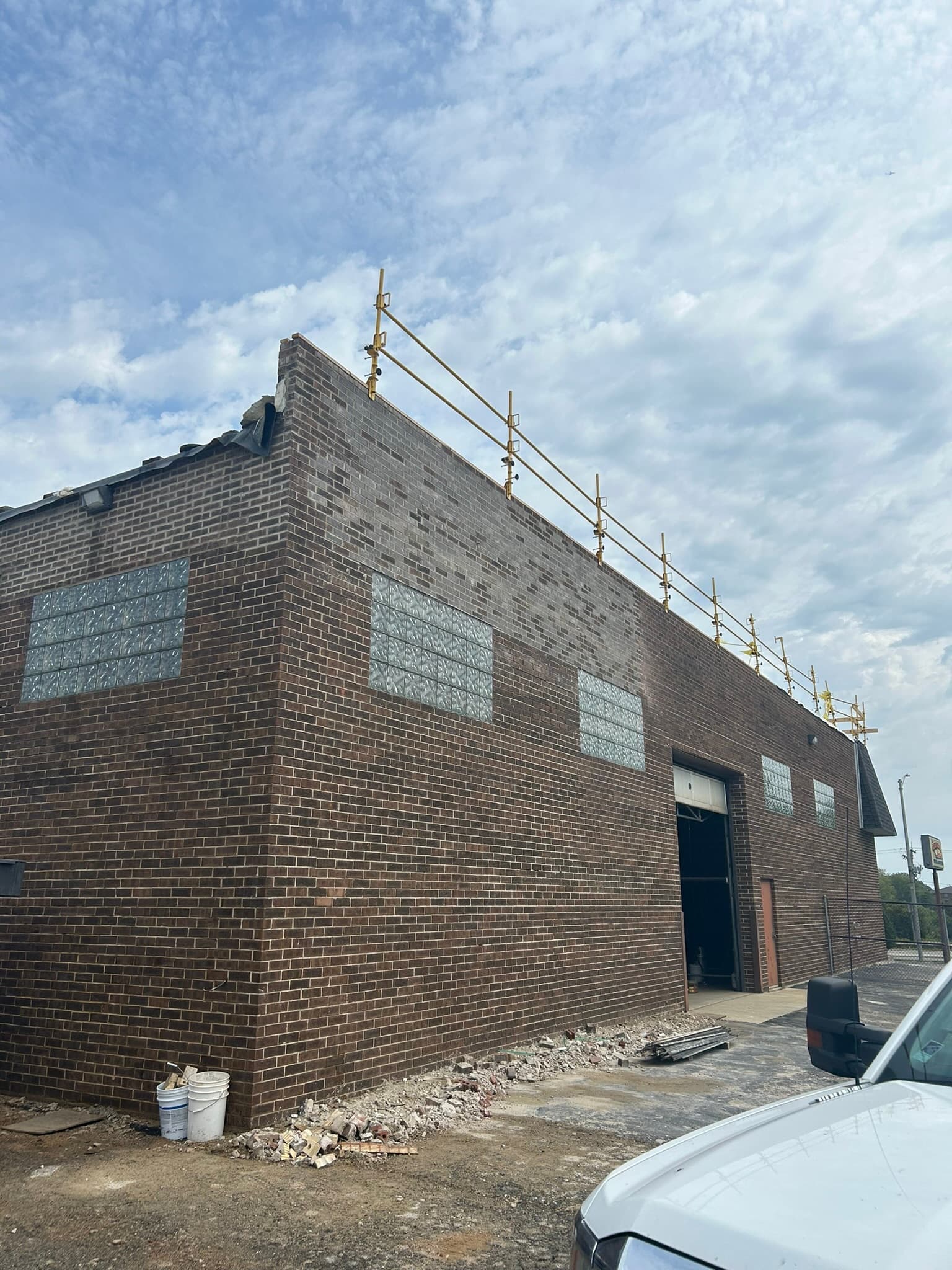
Concrete masonry unit block — CMU — is ubiquitous in commercial construction throughout Evergreen Park and the south Cook County corridor. Retail centers along 95th Street, institutional buildings, light-industrial facilities, and municipal buildings all rely heavily on CMU construction. It's fire-resistant, structurally capable, and economical — and it requires maintenance that's consistently underestimated by building owners and property managers.
The core issue: CMU is far more porous than brick. Water gets in. When it does, it creates interior moisture problems, damages the wall assembly over time, and accelerates the deterioration of mortar joints. Left unaddressed, water infiltration through CMU walls causes mold, damages insulation and wallboard, corrodes embedded metal, and eventually compromises the structural integrity of the wall.
How CMU Differs from Brick in Repair Requirements
Brick veneer masonry and CMU block construction have different repair profiles, and confusing the two leads to missed maintenance.
Brick veneer is a single wythe of brick attached to a backup wall (typically CMU or steel stud framing), with a cavity between them. Water that enters through brick veneer joints typically drains down the cavity and exits through weep holes. The cavity provides some protection for the backup structure.
CMU construction — common in commercial buildings where the block is structural, not just veneer — typically has no drainage cavity. Water that enters through mortar joints or through the block face itself enters directly into the wall assembly. On Evergreen Park's older commercial buildings, the original moisture management relied on paint coatings and block filler to reduce water absorption. When those coatings fail, the block is essentially unprotected.
Signs of CMU deterioration:
- Mortar joint erosion (same visual indicators as brick — joints recessing below the block face)
- Paint or coating delamination (blistering, peeling, or missing sections of the protective coating)
- Efflorescence (white mineral deposits indicating water migration through the block)
- Interior moisture staining at the base of walls or at penetrations
- Visible cracks through block units or along mortar joints
- Spalling or crazing of the block face in freeze-thaw affected areas
CMU Block Repair Process
Step 1: Joint Assessment and Repointing
CMU block mortar joints are typically struck flush or slightly tooled. As they erode, water entry accelerates. The repair process mirrors brick tuckpointing: grind out deteriorated mortar to ¾" depth, clean the joint, and pack new mortar.
Mortar selection for CMU follows similar specifications as brick — Type S for standard commercial block, softer mixes for older or more porous block. The key difference is that CMU joints are often wider than brick veneer joints, requiring more mortar volume and different tooling technique.
Step 2: Crack Repair
Cracks through CMU block or along mortar joints are addressed based on cause. Hairline shrinkage cracks can be filled with compatible mortar or elastomeric crack filler. Active structural cracks — those that have moved, show rust staining from embedded steel, or are associated with obvious structural deflection — require engineering assessment before repair.
Step 3: Surface Preparation
Before applying a protective coating, the block surface must be clean and sound. Existing delaminating paint or block filler is removed. Loose material at joint faces is cleaned. Any significant surface contamination (mold, oil, efflorescence) is treated appropriately.
Step 4: Block Filler Application
Block filler is a high-viscosity coating designed to fill the open pores and texture of CMU block face. Applied by roller to a properly prepared surface, it creates a smooth, continuous film that dramatically reduces water absorption. Block filler is the first coat in a protective coating system — it's not a finish coat.
Step 5: Elastomeric Coating
Over the block filler, a high-quality elastomeric masonry coating provides the primary water resistance layer. Elastomeric coatings are formulated to bridge hairline cracks (they flex with thermal movement rather than cracking) while providing a vapor-open or controlled-vapor film depending on the product specification.
Important note on vapor permeability: The coating system's vapor permeability matters for the specific application. For Evergreen Park's commercial buildings, where interior HVAC creates vapor pressure from inside the building, a coating system that allows some outward vapor transmission reduces condensation risk within the wall assembly. A fully vapor-impermeable coating on the exterior of a building with high interior humidity can cause condensation problems at the wall.
Step 6: Control Joint Inspection and Sealing
CMU construction includes control joints — intentional vertical gaps in the block wall that accommodate thermal expansion without cracking. Control joints should be filled with elastomeric backer rod and sealant, not mortar, because they need to flex. Existing control joint sealant that has hardened, cracked, or fallen out is a consistent water entry point in older commercial CMU construction.
Evergreen Park's Commercial Building Stock
Evergreen Park developed its commercial corridor along 95th Street through the 1950s-1980s, with many institutional and retail buildings from this era still in active use. The block construction from this period is now 40-70 years old. Original protective coatings from the 1960s-1980s are long past their service life, and many buildings are on their second or third generation of paint coatings.
Repaint without repointing is the most common maintenance mistake. A fresh coat of paint on a block wall with eroded mortar joints seals over the visible surface but doesn't address the water entry at the joint level. Water continues to enter through the joints, migrates behind the new coating, and causes the coating to blister and delaminate within a few years. The correct sequence is always: repoint first, then coat.
FAQ: CMU Block Repair in Evergreen Park
Can I just paint over deteriorated CMU? Painting over deteriorating block without addressing joint erosion and surface preparation produces a cosmetic fix that lasts 3-5 years at best. When the paint begins to peel (accelerated by moisture entering through unapplied joints), you're left with peeling paint on top of deteriorated joints — a harder and more expensive restoration starting point than if you'd started correctly. The right sequence is joint repair first, surface preparation second, coating application third.
How do I know if my block wall's coating system is the problem or just cosmetic? Look at where the coating is failing. Blistering or delaminating in isolated patches above floor level, particularly near control joints or at block courses near grade, usually indicates moisture entering through specific pathways. Widespread delamination indicates a coating that has exceeded its service life or was applied without adequate surface preparation. Interior moisture staining on the wall below the coating failure confirms active infiltration.
How often does CMU require maintenance? A properly installed block filler and elastomeric coating system lasts 10-15 years before recoating is warranted, assuming the mortar joints were in good condition at the time of application. Mortar joints in standard commercial CMU last 25-35 years before repointing. Buildings where maintenance has been deferred significantly are typically best addressed with a complete cycle: full repoint, block filler, and coating application in one coordinated project.
Is there a difference between CMU block repair and tuckpointing? The joint repair process is essentially the same — mortar removed to ¾" depth, new mortar installed. "Tuckpointing" is typically used for brick construction; "block repointing" or "CMU joint repair" for block construction. The difference lies more in the surface treatment after joint repair (block gets filled and coated; brick typically doesn't) and in the coating products used.
Service Area
Emerald Masonry LLC serves Evergreen Park and the surrounding south Cook County communities from our base in Palos Heights. We work throughout Oak Lawn, Chicago Ridge, Worth, Blue Island, Alsip, and the full 95th Street and 87th Street commercial corridor. Our commercial masonry division works regularly with property managers, institutional owners, and retail operators on CMU maintenance and restoration projects.
Contact us online or call (708) 288-1696 for a free on-site assessment.
See also: Commercial Masonry | Waterproofing | Masonry Restoration
Ready to get started?
Free on-site estimates for commercial and large-scale projects.