
Masonry Restoration · Blue Island, IL
Masonry Restoration in Blue Island, IL — Brick and Mortar Repair for a Dense South Cook County City
Blue Island's downtown commercial corridor and surrounding residential neighborhoods represent some of the oldest continuously occupied built environment in south Cook County — much of it brick construction from the late 19th and early 20th centuries. Masonry restoration in Blue Island means working with pre-war building stock, historic brick, and the full range of deterioration that comes with 80-130 years of Illinois winters. Emerald Masonry LLC provides comprehensive masonry restoration for Blue Island's commercial, institutional, and residential properties.
Quick Answer
Blue Island's downtown commercial corridor and surrounding residential neighborhoods represent some of the oldest continuously occupied built environment in south Cook County — much of it brick construction from the late 19th and early 20th centuries. Masonry restoration in Blue Island means working with pre-war building stock, historic brick, and the full range of deterioration that comes with 80-130 years of Illinois winters. Emerald Masonry LLC provides comprehensive masonry restoration for Blue Island's commercial, institutional, and residential properties.
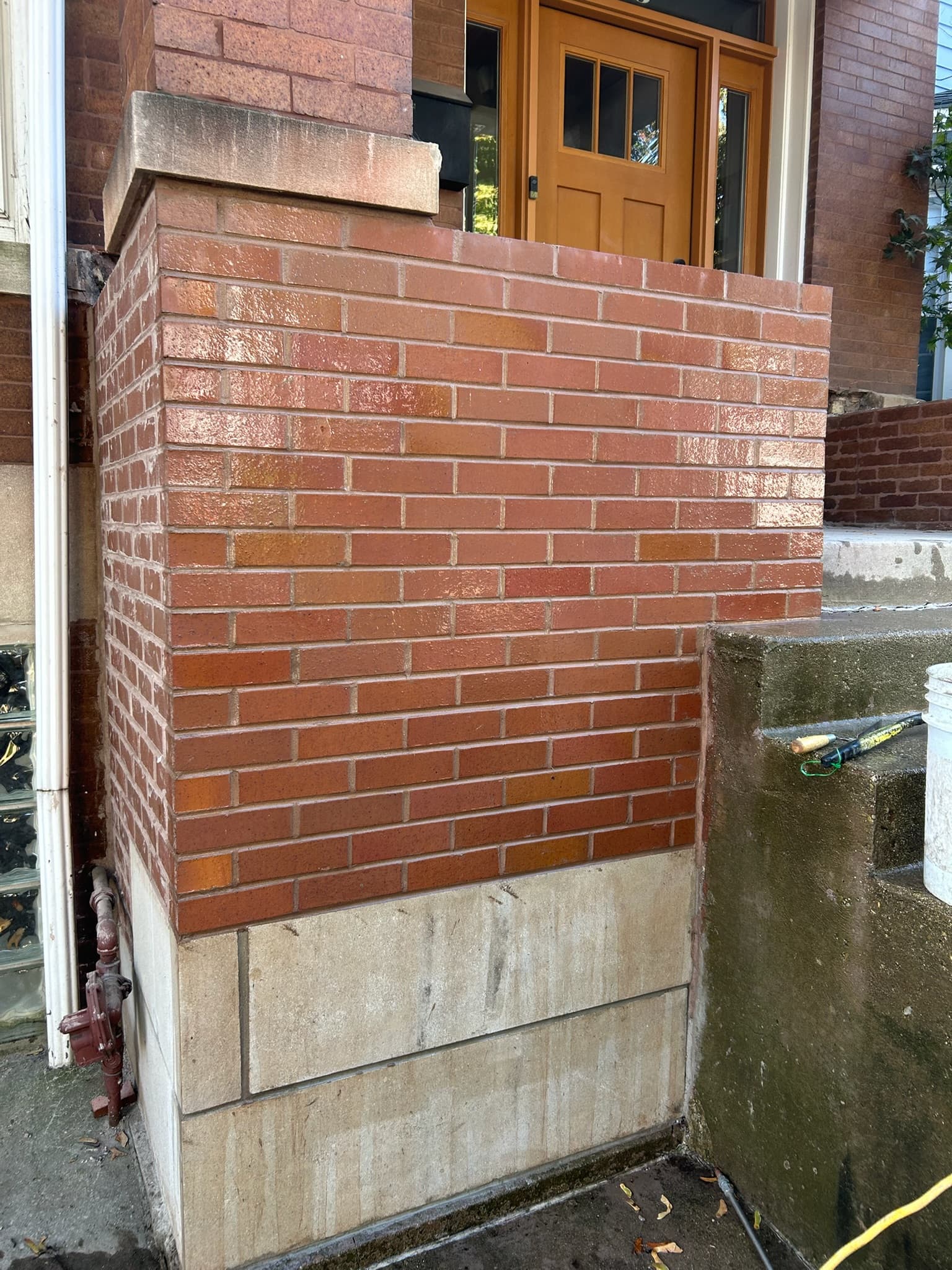
Blue Island is older than most people realize. Incorporated in 1872, it developed through the late 19th and early 20th centuries as a rail hub and light-industrial center, and its downtown along Western Avenue and Vermont Street contains commercial buildings that date to the 1880s and 1890s — some of the oldest commercial masonry in the suburban Chicago area. The residential neighborhoods surrounding downtown add layers of construction from the 1900s through the 1940s, creating one of the denser concentrations of pre-war brick in south Cook County.
Masonry restoration in Blue Island is, disproportionately, historic masonry restoration. That distinction matters.
The Challenge of Historic Masonry in Blue Island
Buildings constructed in the late 19th and early 20th century were built with materials and methods that require a different restoration approach than post-WWII construction.
The brick is softer. Pre-1930 brick, and especially pre-1900 brick, was fired at lower temperatures than modern production brick. The result is more porous, more water-absorbent material with lower compressive strength — typically 1,500 to 3,000 psi compared to 8,000+ psi for modern brick. This brick was designed to work with soft lime mortar. When exposed to incompatible hard mortar or to water that's been entering through failed joints for years, it deteriorates faster than dense modern brick.
The mortar is (or was) lime. Original mortar in Blue Island's older construction was lime-based — soft, flexible, vapor-permeable, and sacrificial. It was designed to absorb stress and wear so the brick didn't have to. When original lime mortar has reached end of life and needs replacement, the replacement must match the original's properties. The most common restoration mistake in buildings of this era is installing hard Portland cement mortar in place of lime mortar, which transfers stress to the brick and causes spalling.
The details are different. Late 19th century and early 20th century masonry used construction details that differ from modern practice: thicker walls, different flashing approaches, brick-to-grade construction without damp courses, and ornamental details that require careful reproduction when damaged.
What Full Masonry Restoration Covers
Unlike targeted tuckpointing or individual brick repair, masonry restoration addresses the full envelope of a deteriorated building:
Phase 1: Assessment and Documentation
A restoration project begins with a systematic condition assessment. Every elevation is evaluated for mortar joint condition, brick face condition, cracking patterns, lintel status, parapet and coping condition, flashing, and any areas of structural concern. Findings are photographed and documented.
For historic buildings, the assessment also includes evaluation of the mortar specification — identifying whether original lime mortar is still present in sections, whether previous repairs used incompatible Portland mortar, and what specification is appropriate for the restoration.
Phase 2: Repointing
The largest scope element on most restoration projects. Deteriorated mortar joints across the building's elevations are opened to ¾" depth, cleaned, and repointed with specification-matched mortar. For Blue Island's pre-war buildings, this means lime-compatible mortar — typically Type O or a custom NHL (Natural Hydraulic Lime) mix — not standard commercial Type S.
Where previous repairs have introduced hard Portland mortar into joints adjacent to soft historic brick, those joints should be removed and replaced with compatible material. Leaving incompatible mortar in place while repointing surrounding joints extends the spalling cycle in the affected areas.
Phase 3: Brick Repair and Replacement
Spalled, cracked, or structurally compromised brick units are replaced with matched material. Blue Island's older buildings present a brick-matching challenge: late 19th century and early 20th century brick is no longer in commercial production. Regional salvage yards are the primary source for matching period brick — and the search takes time. Good restoration work plans for the brick-sourcing lead time.
Phase 4: Parapet and Coping
Parapets are consistently the most deteriorated element on older commercial buildings. All surfaces exposed, direct precipitation on the top, no overhang protection. Blue Island's downtown commercial buildings — many with flat or low-slope roofs — have parapet conditions that range from heavily deteriorated coping to structural cracks requiring partial rebuilding.
Parapet restoration includes: coping joint repoint or full coping reset, parapet face repoint, flashing evaluation and repair at the parapet-to-roof junction, and any necessary brick replacement in severely deteriorated sections.
Phase 5: Lintel and Structural Elements
Steel lintels in Blue Island's 80-130 year old buildings are well past the age where corrosion should be expected. Active lintel failures — horizontal cracking above window openings, rust staining, brick displacement — are found in a high percentage of buildings in this age range. Lintel replacement is often part of a comprehensive restoration scope.
Phase 6: Waterproofing
After joint repair and brick work, penetrating silane-siloxane waterproofer can be applied to appropriate masonry surfaces. This treatment reduces capillary water absorption without creating an impermeable film — it's vapor-open, allowing moisture inside the wall to escape, while repelling liquid water infiltration. For historic buildings, breathable (vapor-open) products are essential; film-forming sealers that trap vapor can cause internal pressure and accelerated spalling.
What to Look for in a Restoration Contractor
For Blue Island's historic building stock, verify:
Mortar specification knowledge. The contractor should be able to specify what mortar type is appropriate for the building's brick and why. "Type S" is not the right answer for pre-1930 soft brick.
Experience with historic material. Work on 1890s or 1910s commercial masonry is different from work on 1970s residential brick. Ask for references from work on buildings of comparable age.
Documentation and scope in writing. A restoration project should have a written scope that identifies what's included, elevation by elevation. A verbal summary isn't adequate for a multi-phase scope.
Brick matching approach. For historic brick replacement, ask how the contractor sources matching material. A contractor who proposes modern brick for a 100-year-old building without discussing matching isn't thinking about the full outcome.
FAQ: Masonry Restoration in Blue Island
How do I prioritize restoration work when the whole building needs attention? Start with water entry and structural concerns: open parapet coping, failed flashing, active lintel failures, and severely eroded mortar on north and west elevations. These are the conditions that cause accelerating damage if left unaddressed. Cosmetic spalling and stable cracking are lower priority in the first phase. We provide a prioritized scope assessment at the time of estimate so you can phase the work against your budget.
My building has been repointed before with what looks like gray cement mortar. Does that need to come out? If the previous repointing used hard Portland mortar and the surrounding brick is pre-1930 soft material, the incompatible mortar ideally should be removed and replaced — especially if there's adjacent spalling that suggests the incompatibility is active. In practice, this decision depends on the extent of the Portland mortar, the current condition of surrounding brick, and budget constraints. We'll document what we find and advise on the realistic trade-offs.
Can a historic building in Blue Island qualify for preservation programs or tax credits? Potentially yes, depending on whether the building is in a registered historic district or eligible for the National Register. Illinois has a state historic tax credit program that can significantly offset restoration costs for qualified historic structures. We recommend consulting with a historic preservation consultant or the Illinois Historic Preservation Agency for guidance on eligibility before beginning scope work.
What's the difference between masonry restoration and basic tuckpointing? Tuckpointing addresses mortar joints. Masonry restoration addresses the full masonry envelope — including joints, brick units, parapets, lintels, flashing, and waterproofing — typically in a coordinated, multi-phase project. Restoration is appropriate when the building has multiple interacting deterioration issues rather than a single, isolated mortar joint problem.
Service Area
Emerald Masonry LLC serves Blue Island and the surrounding south Cook County communities from our base in Palos Heights. We work regularly in Calumet Park, Alsip, Midlothian, Oak Forest, Harvey, Calumet City, and throughout the south suburban region. With 40+ years of Chicagoland masonry experience, we're familiar with the full range of south Cook County's building stock — from late 19th century commercial brick to postwar residential construction.
Contact us online or call (708) 288-1696 for a free on-site assessment. We document findings systematically, photograph all deficiencies, and provide a complete prioritized scope.
See also: Tuckpointing | Brick Repair | Commercial Masonry
Ready to get started?
Free on-site estimates for commercial and large-scale projects.