
Historic Masonry Restoration · Chicagoland, IL
Athens Marble: The Local Limestone That Built Chicago — and How to Repair It
The cream-colored stone in Chicago's Water Tower, in Lemont's downtown and in thousands of foundations across the region has a name and a specific weakness. Athens Marble is dolomitic limestone quarried out of the I&M Canal, the quarries closed generations ago, and it fails in a way that hard modern mortar makes dramatically worse. Here's how to recognize it and how it's properly restored.
2026-08-05
Quick Answer
Athens Marble is the dolomitic limestone quarried around Lemont and Joliet from the 1830s during I&M Canal construction — not true marble, but a cream-to-buff dolomite that built Chicago's Water Tower and thousands of regional foundations and facades. It fails by delaminating along its bedding planes when water freezes inside it, and hard Portland mortar accelerates that failure. Emerald Masonry LLC restores it with lime-based mortar. Family-owned, career masons, licensed and insured. Call (708) 288-1696.
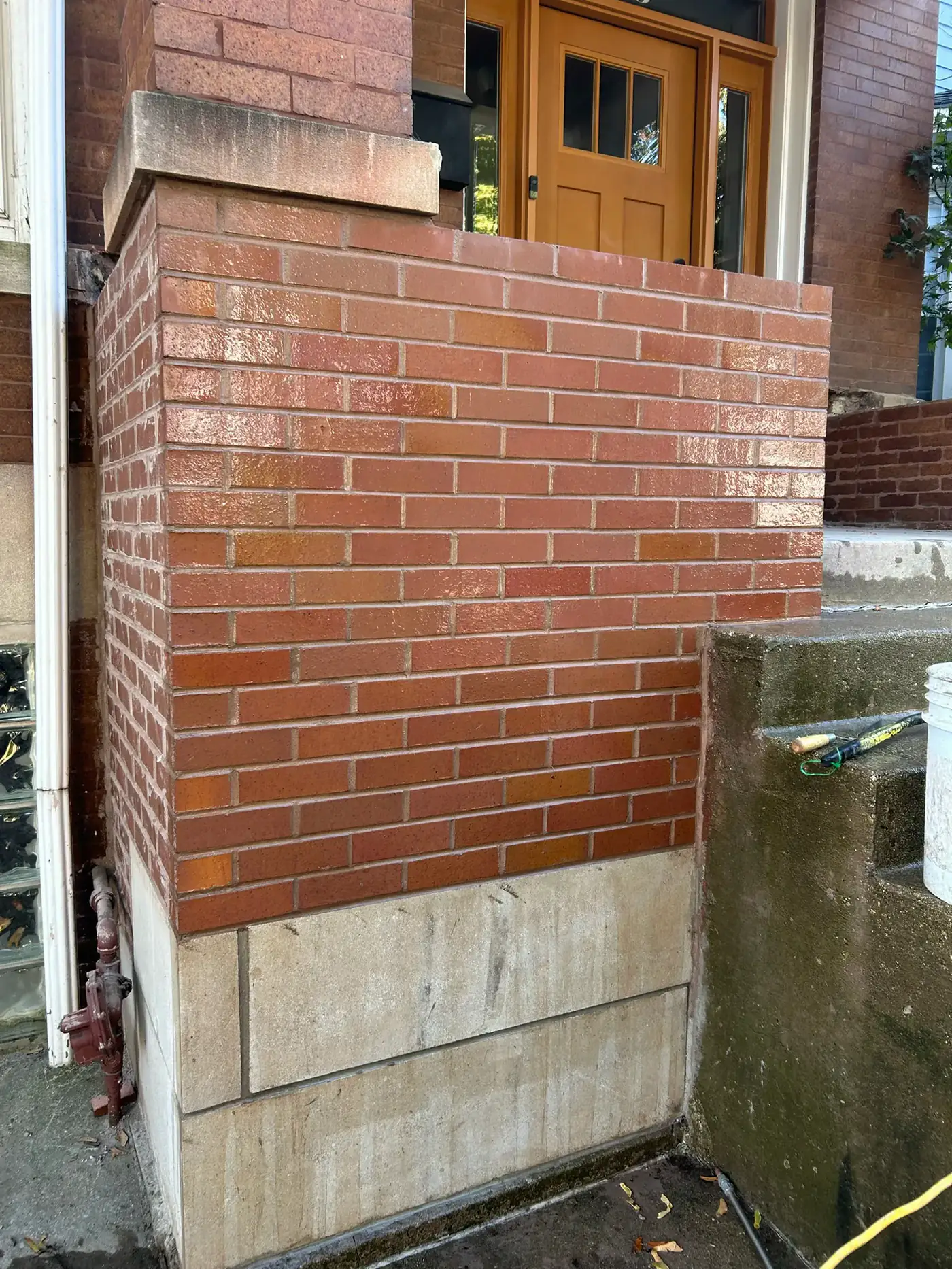
Athens Marble: What It Is and Why It Matters
Athens Marble is the dolomitic limestone quarried in the Des Plaines valley around Lemont and Joliet beginning in the 1830s, when digging the Illinois and Michigan Canal cut straight into the bed. It is not marble — it is a hard, cream-to-buff, magnesium-rich limestone that built Chicago's Water Tower and Pumping Station, which survived the 1871 fire, along with much of Lemont, Lockport and Joliet and thousands of foundations across the region. The quarries closed generations ago, which makes repairing original material a materials reality rather than a preference. Emerald Masonry LLC restores this stone across Chicago and the Chicagoland suburbs — family-owned, licensed and insured, career masons with decades of experience, free on-site estimates. Call (708) 288-1696.
If you own a pre-1900 building anywhere along the canal corridor, or an older Chicago house with a stone foundation, there is a good chance you own some.
Where the Name Came From
In the 1830s the settlement that became Lemont was, for a period, called Athens. When the canal excavation produced enormous quantities of usable building stone, it was marketed under that name — Athens Marble — because "marble" sold better than "dolomite."
The stone traveled by canal boat into Chicago and became a default building material for the pre-fire city. It is the reason the Water Tower is still standing: when the 1871 fire took the wood city, the limestone landmarks came through.
Similar dolomitic limestone was quarried around Joliet and marketed as Joliet limestone or Joliet marble. For repair purposes the two behave essentially the same.
How to Recognize It
- Color: cream, buff, pale gray, sometimes with a warm yellow cast; weathers to gray with darker biological staining.
- Layering: visible horizontal bedding planes running through the face of the stone.
- Finish: often rough-faced, roughly squared or coursed rubble on utilitarian work; smooth-tooled and carved on prominent buildings.
- Where: pre-1900 buildings in Lemont, Lockport and Joliet; foundations under Chicago bungalows, two-flats, greystones and worker cottages; church and institutional buildings; retaining walls and canal structures.
- Weight and hardness: noticeably hard for a limestone — dolomite is denser than ordinary calcium limestone.
The Failure Mode: Delamination
Every material has a characteristic way it goes. For this stone, it is delamination along the bedding planes.
Limestone is sedimentary — deposited in layers, and those layers are planes of relative weakness. The stone is also porous, so it takes on water.
In a Chicagoland winter that absorbed water freezes inside the stone, expands roughly nine percent, and splits it along the bedding. The face separates and sheds in sheets or shells. Once the outer layer is gone, the exposed interior absorbs water faster than the weathered face did, and the process accelerates.
The other failure modes
- Spalling at edges, noses and corners, especially on sills and steps.
- Cracking across a sill span or radiating from a bearing point.
- Surface erosion — carved and tooled profiles rounding over.
- Displacement — units dropping or tilting because the mortar bed beneath failed.
- Biological staining — dark growth on persistently damp faces.
Where it fails first
Horizontal surfaces, always. Sills, water tables, steps, coping and wall caps hold water rather than shedding it. Then anything at or below grade, where splash-back, snow banking and road salt keep the stone saturated for months.
Telling the Regional Stones Apart
Chicagoland buildings use several limestones, and knowing which one you have changes the repair approach and the replacement options.
Athens Marble / Lemont-Joliet dolomite. Cream to buff, sometimes warm yellow, hard and dense for a limestone, with pronounced horizontal bedding. Usually rough-faced or roughly squared on utilitarian work. Pre-1900, concentrated along the canal corridor and in older Chicago foundations. Quarries closed — no new material.
Indiana limestone (Bedford). Pale gray to buff, notably uniform and fine-grained, with far less visible bedding than the local dolomite. Takes crisp carving, which is why it dominates ornamental work — sills, lintels, water tables, cornices and full facades on early-20th-century buildings. Still quarried, which makes it the standard substitute for dutchman inserts and replacement units.
Chicago greystone facades. Most of the celebrated greystone rowhouses use Bedford limestone on the front elevation, over common brick behind. So a greystone front and a canal-era foundation in the same building are two different stones with two different behaviors.
Cast stone. Manufactured concrete cast to imitate carved stone, common from the early 1900s onward. Weathers like concrete, not stone, and can spall from internal reinforcing steel corroding.
| | Athens Marble | Indiana limestone | Cast stone | |---|---|---|---| | Look | Cream/buff, visible bedding, often rough-faced | Uniform pale gray-buff, fine grain | Molded, sometimes with aggregate visible | | Era here | Pre-1900 | 1890s onward | 1900s onward | | Typical use | Foundations, walls, canal-town buildings | Sills, trim, ornament, greystone facades | Trim and ornament imitating stone | | Fails by | Delamination along bedding | Spalling, erosion, sugaring | Surface erosion, rebar corrosion | | Available new? | No | Yes | Yes |
The practical consequence: if your building has Athens Marble, repair beats replacement by a wide margin because there is nothing to replace it with. If it has Bedford, a matched replacement unit is genuinely obtainable — but repair is usually still cheaper and always preserves more of the original.
The Mortar Rule That Governs Everything
Here is the point that decides whether a repair preserves or destroys this stone.
A masonry wall is designed so the mortar is softer than the units it holds. Mortar is the sacrificial layer — it absorbs movement and moisture stress and wears out first, because replacing mortar is cheap and replacing 1840s quarried stone is, given closed quarries, close to impossible.
Canal-era walls were laid in soft, lime-based mortar. Repoint them with hard modern Portland mortar and the relationship inverts: the joints become the strongest element, and every freeze-thaw cycle drives stress into the stone faces instead. On layered dolomite that means accelerated delamination — the repair destroying the material it was meant to protect, typically visible within three to eight winters.
| | Correct for historic stone | Wrong for historic stone | |---|---|---| | Mortar | Lime-rich, soft, breathable | Portland-heavy, hard, dense | | Joint prep | Hand-raked, shallow tools | Aggressive power grinding | | Cleaning | Low pressure, soft brush, masonry-safe cleaners | Sandblasting, high-pressure washing | | Protection | Vapor-permeable sealer, or nothing | Film-forming coating, paint | | Repair approach | Patch, dutchman, repin | Wholesale replacement |
The Repair Hierarchy
Least invasive first — because with irreplaceable stone, that ordering is not aesthetic conservatism, it is arithmetic.
- Repointing. Restoring joints with matched lime mortar. Stone sound, joints failed.
- Matched patching. A cementitious patch rebuilding lost material where spalling is localized.
- Dutchman repair. Cutting out the damaged section cleanly and fitting a matched new stone piece into the original unit. This is the workhorse of stone restoration.
- Repinning and resetting. Removing, rebedding and anchoring a shifted unit with stainless pins.
- Replacement. A new matched unit — last resort, and usually Indiana limestone as the closest available substitute since the original quarries are gone.
How the Work Is Done
- Assessment and documentation. Walk the building, photograph conditions, evaluate the existing mortar's hardness and composition, flag prior inappropriate repairs.
- Correct the water path first. Failed joints, missing caulking, bad flashing, clogged gutters, downspouts discharging onto stone, grade. Repairing stone while water keeps arriving is a repair with a countdown.
- Mortar analysis and matching. A lime-based mix formulated to the original — soft enough to protect the stone, durable enough to serve.
- Hand joint preparation. Raked by hand where the stone is soft; power tools only where the masonry can safely take them.
- Undo bad repairs where hard mortar must come out — carefully, without taking stone with it.
- Repoint in lifts, packed and compacted, tooled to the original joint profile.
- Repair units — patching, dutchman, repinning — chosen unit by unit rather than applied across the board.
- Gentle cleaning and breathable protection, if any.
What Never to Do to This Stone
Sandblasting. It strips the weathered outer surface, exposes the porous interior, and dramatically accelerates delamination. On carved detail it is simply destruction.
High-pressure washing. Same damage delivered by water, plus it drives moisture deep into the wall.
Hard Portland repointing. Covered above, and the most common of these mistakes because it looks like ordinary competent masonry work.
Painting or film-forming sealers. Porous stone must dry outward; trap the moisture and it spalls the face off from behind.
Wholesale replacement when repair was possible. Every original unit removed is gone permanently, and the replacement is a substitute stone.
Cost Drivers
- Number of units and whether repair or replacement is required per unit.
- Repair method — patching is less involved than a dutchman; a dutchman less than replacement.
- Height and access — upper elevations, church towers and bluff sites need real staging.
- Custom lime mortar blending and matching.
- Undoing prior hard-mortar repairs, often the largest variable on an older building.
- Carved and ornamental work, which is slower and more skilled.
- Historic review where a designation applies.
We assess in person and provide a free written scope. We do not quote historic stone work sight unseen.
Chicagoland Context
The climate is why this matters so much here. Dozens of freeze-thaw crossings each winter, with no lake moderation across most of the region — and it is the crossings, not the depth of cold, that break stone. Add lake-effect moisture keeping north elevations damp, road salt at grade attacking the lowest and wettest courses, and mature canopy over the historic districts slowing drying.
A stone that would last for centuries in a mild dry climate is, in the Des Plaines valley, on a clock — and the clock runs faster every time somebody points it with the wrong mortar.
Maintenance
- Keep water off it — gutters clear, downspouts extended, grade sloping away, splash controlled.
- Repoint on schedule with a lime-based matched mix, before delamination starts.
- Repair sills, coping and horizontal surfaces first; they soak everything below.
- Inspect annually, especially at grade, on north elevations, and under gutter runs.
- Never blast, pressure wash or paint it.
- Watch for a band of new damage matching a recent repointing — the signature of a mortar mismatch.
Related Services
Historic masonry restoration, limestone and sill repair, tuckpointing and repointing, foundation masonry repair, brick repair and masonry sealing.
The Bottom Line
The stone in your foundation or your facade came out of a canal cut in the 1840s, was sold under a name that oversold it, and outlasted the city it was shipped to build. It will keep going — dolomite is genuinely durable material — provided two things: water is kept off it, and whatever goes into the joints stays softer than the stone.
Get either wrong and it delaminates, and there is no quarry left to call.
Emerald Masonry LLC is a family-owned, licensed and insured masonry contractor serving Chicago and the Chicagoland suburbs led by career masons with decades of hands-on experience in tuckpointing, chimney repair, brick repair and replacement, lintel and parapet repair, foundation and limestone/sill repair, caulking, sealing, and commercial, residential and historic masonry restoration.
Free on-site estimates. Call (708) 288-1696 or request an estimate.
Frequently Asked Questions
What is Athens Marble?
It is dolomitic limestone quarried in the Des Plaines valley around Lemont and Joliet beginning in the 1830s, when digging the Illinois and Michigan Canal cut into the bed. It was marketed as Athens Marble because Lemont was briefly called Athens. Despite the name it is not marble at all — it is a hard, cream-to-buff magnesium-rich limestone.
How can I tell if my building is Athens Marble?
Look for a cream, buff or pale gray stone with visible horizontal layering, often in rough-faced or roughly squared blocks, on pre-1900 Chicagoland buildings and foundations. It is especially common in Lemont, Lockport, Joliet and in older Chicago foundations and greystone-era construction. A mason familiar with the stone can usually identify it on sight.
Why does this limestone flake apart in layers?
That is delamination, and it follows the stone's natural bedding planes — the horizontal layers formed when the rock was deposited. The stone is porous, so it absorbs water, and when that water freezes inside it the expansion splits it along those layers. It is the defining failure mode of the material.
Can Athens Marble still be bought?
Not as newly quarried material — the commercial quarries closed generations ago. Replacement comes from salvage or from substituting a compatible stone such as Indiana limestone for dutchman inserts and patching. That scarcity is exactly why repairing original units matters more with this stone than with almost any other.
What mortar should be used on historic limestone?
A soft, lime-based or lime-modified mix matched to the original. The governing rule is that mortar must be softer than the stone it holds, so hard modern Portland mortar concentrates freeze-thaw stress at the stone face and accelerates delamination. Using the wrong mix is one of the most common ways historic stone gets destroyed by a repair.
Should limestone be sealed?
Only with a breathable, vapor-permeable product, and only after the water source is corrected. Film-forming coatings and paint trap moisture inside porous stone, and the trapped water then spalls the face off from behind — causing exactly the damage the coating was meant to prevent.
Is a delaminating stone foundation a structural problem?
It depends how deep the loss goes. Surface delamination on an otherwise sound wall is a maintenance issue addressed by repointing and patching; units that have lost substantial depth, shifted or dropped are a different conversation. Bowing or displaced stone in a bearing wall needs professional evaluation before anything else is scoped.
Can eroded carved stone detail be restored?
Often, yes. Lost material can be rebuilt with matched patching compounds, or a damaged section cut out and replaced with a fitted dutchman insert of matched stone. Full replacement of a carved unit is a last resort because matching both the stone and the carving is expensive and rarely perfect.
How much does historic limestone restoration cost?
More than standard repointing on a comparable wall, because the work is slower — hand-raked joints, custom lime mortar, and unit-by-unit repair decisions. Scope drives it, from a few sills to a full facade. Emerald Masonry gives free on-site assessments with a written scope.