
Brick Repair · Chicagoland, IL
Brick Bonds and Patterns: Why the Layout of Your Wall Changes How It's Repaired
Running bond, common bond, soldier courses, rowlocks and headers are not just decoration — the pattern tells a mason whether your wall is solid masonry or veneer, where the structural ties are, and how a repair has to be rebuilt so it disappears. Here is how to read your own brickwork and why getting the bond wrong makes a patch visible forever.
2026-08-02
Quick Answer
A brick wall's bond pattern — running bond, common bond, Flemish bond, soldier and rowlock courses — tells a mason whether the wall is solid multi-wythe masonry or veneer, where its structural ties are, and how a repair must be rebuilt to disappear. Header courses in older Chicagoland walls are structural, not decorative. Emerald Masonry LLC matches bond, coursing and joint profile on every repair. Family-owned, career masons, licensed and insured. Call (708) 288-1696.
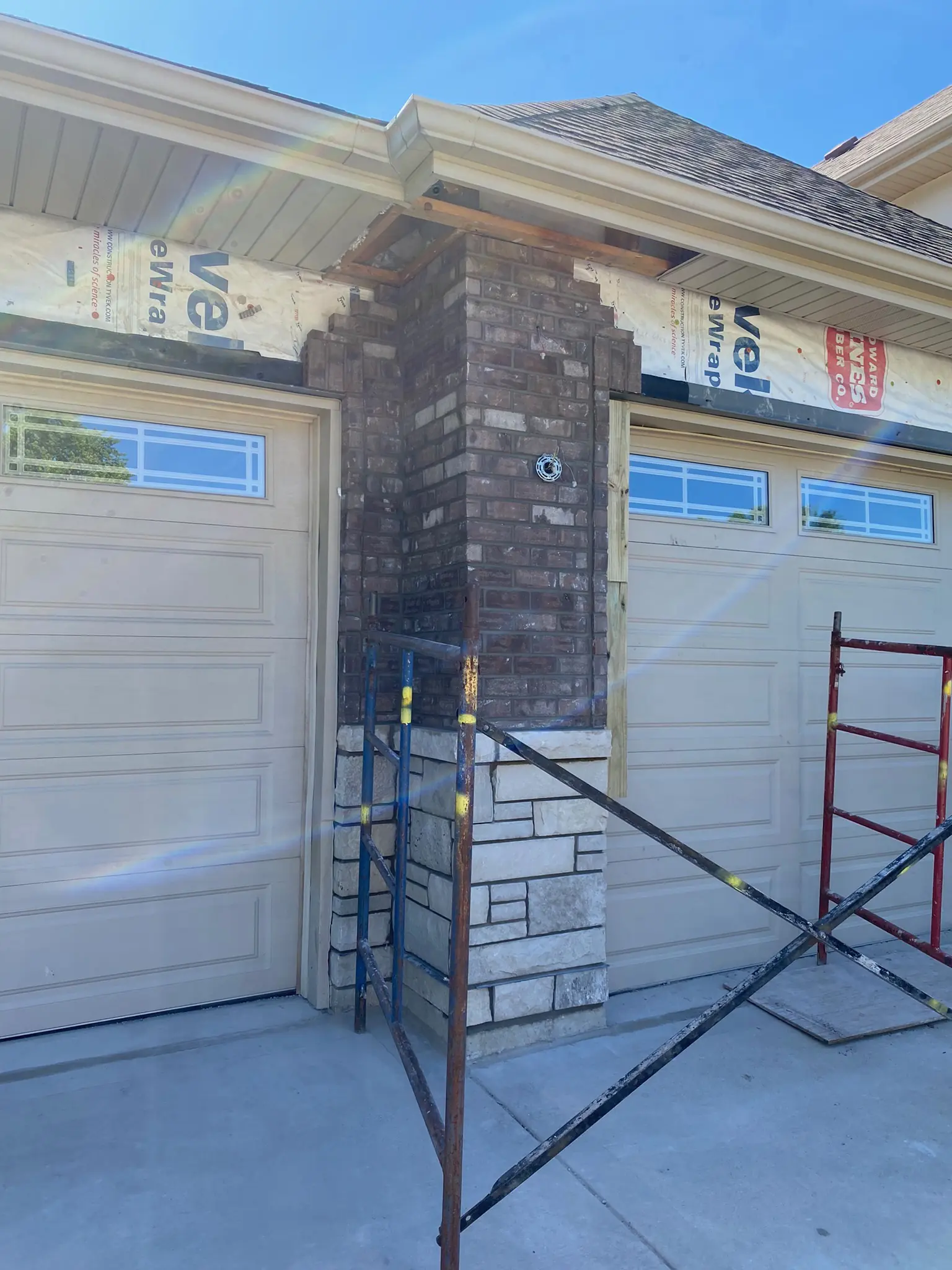
Brick Bonds: Why Your Wall's Pattern Governs Its Repair
The bond pattern in a brick wall — running bond, common bond, Flemish bond, soldier and rowlock courses — is not decoration. It tells a mason whether the wall is solid multi-wythe masonry or a veneer skin, where its structural ties are, and how a repair has to be rebuilt so it disappears. In older Chicagoland walls, header courses are load-carrying, not ornamental. Emerald Masonry LLC matches bond, coursing and joint profile on every repair across Chicago and the Chicagoland suburbs — family-owned, licensed and insured, career masons with decades of experience, free on-site estimates. Call (708) 288-1696.
Homeowners rarely think about this until they see a finished repair that is technically sound and visually obvious — right color, right mortar, wrong pattern. Once the coursing breaks, the eye finds it every time.
The Vocabulary, Briefly
Bricks are named for how they sit in the wall.
- Stretcher — laid flat, long face showing. The default.
- Header — laid flat, short end showing. In solid masonry these run back into the wall.
- Soldier — standing on end, long narrow face showing. Common above openings and as banding.
- Rowlock — on its long edge, short end showing. Sills, caps, wall tops.
- Sailor — standing on end, broad face showing. Decorative.
- Shiner — laid on its long edge, broad face showing. Decorative.
Two of these do real work in older buildings: headers tie the wall together, and rowlocks shed water. The rest are mostly about appearance.
The Bonds You'll See in Chicagoland
| Bond | What it looks like | What it tells you | |---|---|---| | Running bond | All stretchers, each course offset by half a brick | Usually veneer — a single decorative layer over framing or block | | Common (American) bond | Stretchers with a full header course every 5th–7th row | Solid multi-wythe masonry — headers tie the wythes together | | Flemish bond | Stretcher and header alternating within every course | Higher-end solid masonry, often on prominent facades | | English bond | Full courses of stretchers alternating with full courses of headers | Strong, older, less common residentially here | | Stack bond | Bricks stacked with joints aligned vertically | Modern, decorative, non-structural — needs reinforcement |
The single most useful diagnostic on this page: if you see header courses at regular intervals, you are almost certainly looking at a solid multi-wythe wall. If you see nothing but long stretcher faces from grade to roofline, it is very likely brick veneer.
That one observation changes almost everything about how the wall is repaired.
Why Solid vs. Veneer Changes the Repair
| | Solid multi-wythe masonry | Brick veneer | |---|---|---| | Typical era here | Pre-1940 | 1950s onward | | Bond | Common or Flemish, with headers | Running bond, stretchers only | | Structure | The wall is structural | Decorative skin over backup | | Held together by | Header courses bonding the wythes | Metal ties into the backup wall | | Water strategy | Absorbs, dries outward | Drains down a cavity through flashing and weep holes | | Hidden failure points | Inner-wythe deterioration | Corroded ties, blocked weeps, bad flashing | | Behind the face | More brick — often soft Chicago common brick | An air cavity |
A repair on solid masonry that ignores the header coursing severs the tie between wythes in that area. A repair on veneer that mortars the weep holes shut converts a drained wall into one that holds water. Different walls, different mistakes.
Reading Your Own Wall
Take five minutes outside.
- Scan for headers. Short brick ends at regular intervals → solid masonry. All long faces → likely veneer.
- Check a window reveal. Deep reveal → usually solid. Shallow → usually veneer.
- Look above the openings. A soldier course? A flat arch? Either way, something is carrying that load — normally a steel lintel.
- Look at the sills. Rowlock brick, or stone? Rowlock sills are common and commonly failing.
- Look at the bottom course. Small gaps or open head joints at the base are weep holes — a veneer signature, and they should stay open.
- Look at the top. Corbelling, banding or decorative coursing near the roofline or on the chimney?
- Look at the joints themselves — concave, weathered, raked, grapevine? That profile has to be matched too.
Where Patterns Fail
Rowlock sills. A rowlock sill is a row of bricks doing a stone's job — shedding water off a horizontal surface. The joints between them are numerous and they sit where water stands, so they open early. Once a rowlock sill stops shedding, the brick below streaks and spalls, and water reaches the wall cavity. This is one of the most common repairs we do on Chicago bungalows and two-flats.
Soldier courses over openings. The soldier course itself is rarely the problem — the steel lintel behind it is. Corroding steel expands and lifts the course, cracking the joint line above the window. Rust staining below the opening is the earlier tell.
Header courses in old walls. When headers deteriorate, the tie between the face wythe and the brick behind it weakens. Widespread header failure is one contributor to bowing in old solid walls.
Corbelling and decorative coursing. Projecting brickwork creates dozens of horizontal ledges that hold water rather than shedding it. Corbelled chimney tops are a classic Chicagoland failure point.
Stack bond. With no overlap, there is no natural load distribution, so cracking tends to run straight up the aligned joints.
Arches: What's Really Holding Up the Brick Over Your Windows
Before steel lintels became standard, brick spanned openings by arching — and plenty of Chicagoland buildings still do it that way.
Jack arch (flat arch). A row of tapered or angled bricks spanning an opening in what looks like a flat line but is structurally an arch, transferring load sideways into the masonry at each side. Very common on pre-1930 Chicago buildings. They fail when the abutments — the wall on either side — move or deteriorate, letting the arch sag in the middle. A sagging flat arch is a real structural condition, not a cosmetic one.
Segmental arch. A shallow curve over the opening, common on Victorians, greystones and older commercial fronts. More forgiving than a jack arch because the curve carries load more efficiently.
Semicircular arch. A full half-round, mostly on churches, institutional buildings and grander facades.
Soldier course over a steel lintel. The modern equivalent — the soldier course is doing very little structurally and the steel behind it carries the load.
Why this matters for repair: you cannot rebuild an arch as if it were ordinary coursing. The units are often tapered, the joints are wedge-shaped, and the whole assembly needs proper centering and support while it is rebuilt. And critically — if an arch is sagging, the problem is usually the wall beside it, not the arch itself. Repointing the arch while the abutment keeps moving accomplishes nothing.
If your building has arched openings and one has dropped or cracked at the crown, that warrants a proper look rather than a patch.
Matching a Repair So It Disappears
Five things have to line up.
- The bond — coursing and overlap continue correctly through the repaired area, including any header rhythm.
- The unit — size, color, texture, and critically absorption and hardness matched to the original. On pre-1940 walls that usually means salvaged brick.
- The mortar — matched for hardness first, then color and sand. Mortar must be softer than the brick it holds; hard modern mix on soft old brick spalls the faces within a few winters.
- The joint width — old walls often have wider joints than modern coursing; forcing modern spacing throws the pattern.
- The joint profile — tooled to match concave, weathered, raked or grapevine, whichever the wall was built with.
Miss the bond and the repair is permanently visible no matter how good the other four are.
How the Work Is Done
- Assess — read the bond, determine solid or veneer, identify the water source and the extent of failure.
- Fix the water first — gutters, downspouts, sills, flashing, joints.
- Document the pattern before removal, photographing coursing and any decorative rhythm.
- Remove failed units carefully, salvaging sound original brick for reuse in the visible face.
- Rebuild to the original bond, maintaining coursing, overlap and headers, with ties where veneer requires them.
- Repoint in lifts with matched mortar, packed and compacted.
- Tool to the original joint profile at the right firmness.
- Verify weeps are open on veneer work, and clean down gently — never sandblasting or high-pressure washing.
What Drives Cost
- Pattern complexity — plain running bond is faster than Flemish, corbelling or decorative banding.
- Number of units and how widely the damage is spread.
- Match difficulty — salvage sourcing, discontinued sizes, unusual colors.
- Height and access — staging or a lift for upper elevations.
- Underlying cause — a rusting lintel or failed sill adds real scope.
- Wall type — solid masonry and veneer take different approaches.
- Rebuilding decorative detail to the original profile is skilled, slower work.
We assess in person and give a free written scope. Decorative and pattern work belongs in the estimate up front, not discovered halfway through.
Chicagoland Context
The region's building stock reads like a timeline in brick. Pre-1940 — bungalows, two-flats, greystones, worker cottages and courtyard buildings in solid multi-wythe common bond, with soft Chicago common brick behind the face brick and rowlock sills throughout. Post-war — ranches, Georgians and Cape Cods, increasingly running bond veneer with steel lintels and soldier courses over the wide picture windows and garage openings of the era. Modern — veneer over framing or block, running or stack bond, entirely dependent on ties, flashing and weeps.
And over all of it: dozens of freeze-thaw cycles a winter, lake-effect moisture keeping north elevations damp, and road salt at grade.
Maintenance
- Photograph your walls while they are sound — a reference for any future repair.
- Watch the rowlock sills; they usually fail first.
- Treat rust staining below an opening as urgent — it means the lintel is going.
- Keep weep holes open on veneer and never let anyone seal them.
- Keep water off the wall — gutters, downspouts, grade, splash.
- Repoint on schedule with matched mortar and matched joint profile.
Related Services
Brick repair, brick replacement, tuckpointing and repointing, lintel repair, limestone and sill repair and historic masonry restoration.
The Bottom Line
Your wall's pattern is a set of instructions written by whoever built it. Header courses say this wall is bonded through its thickness. Nothing but stretchers says there is a cavity behind me and my ties are doing the work. A rowlock sill says water is meant to run off here. A soldier course says something structural is spanning this opening.
A mason who reads those instructions produces a repair you cannot find afterward. One who does not produces a patch you will notice every time you pull into the driveway.
Emerald Masonry LLC is a family-owned, licensed and insured masonry contractor serving Chicago and the Chicagoland suburbs led by career masons with decades of hands-on experience in tuckpointing, chimney repair, brick repair and replacement, lintel and parapet repair, foundation and limestone/sill repair, caulking, sealing, and commercial, residential and historic masonry restoration.
Free on-site estimates. Call (708) 288-1696 or request an estimate.
Frequently Asked Questions
What is a brick bond?
A bond is the repeating pattern in which bricks are laid and overlapped in a wall. It affects how the wall carries load, whether the courses are tied together through the wall's thickness, and how the finished face looks. Reading the bond is one of the first things a mason does on site, because it reveals how the wall is actually built.
What is the difference between a stretcher and a header?
A stretcher is a brick laid with its long face showing, and a header is one laid with its short end showing. Headers matter because in traditional solid masonry they run back into the wall and tie the outer layer to the layers behind it. A wall showing regular header courses is telling you it is structurally bonded, not a veneer.
How can I tell if my house is solid brick or brick veneer?
Look for header courses — short brick ends appearing at regular intervals — which indicate a solid multi-wythe wall. A wall of nothing but long stretcher faces is usually veneer over a framed or block backup. Window and door reveals help too: a deep reveal generally means solid masonry, a shallow one usually means veneer.
What is a soldier course?
A soldier course is a row of bricks standing on end with the long narrow face showing, most often used above windows and doors or as a decorative band. Above an opening it usually sits on a steel lintel doing the actual work. When you see a soldier course cracking or lifting, the lintel behind it is the thing to check.
What is a rowlock and why do they fail?
A rowlock is a brick laid on its long edge with the short end showing, commonly used for window sills, wall caps and garden wall tops. They fail often because they are horizontal or sloped surfaces that take standing water directly, so the joints between them open and water gets into the wall below. Rowlock sills are a very common repair.
Does the bond pattern have to be matched when replacing brick?
Yes, or the repair will always be visible. Coursing, overlap and any header or decorative courses have to continue correctly through the repaired area, and joint width and profile need to match as well. A patch that breaks the pattern draws the eye far more than a slight color difference does.
Why do some old Chicago walls have a header course every sixth row?
That is common bond, and the headers are structural — they tie the face wythe to the brick behind it. It was the standard way of building solid masonry walls in the region for decades. Those header courses are one of the clearest signals that you are looking at a genuine multi-wythe wall rather than veneer.
Can a mason rebuild a decorative brick pattern?
Yes, and it is a normal part of restoration work — corbelling, banding, diaper patterns, soldier and rowlock detailing can all be rebuilt to the original profile. It takes more time and more skill than plain coursing, which is why it belongs in the scope and the estimate rather than being discovered midway.
Does the mortar joint profile matter as much as the bond?
For appearance, yes. Concave, weathered, raked, grapevine and struck joints all read differently in light and shadow, and a repair tooled to the wrong profile stands out even when the brick and mortar color match. Matching the profile is one of the cheapest ways to make a repair disappear.