
Tuckpointing & Repointing · Chicagoland, IL
Why Two Identical Houses on the Same Block Age Completely Differently
Same builder, same year, same brick, same weather — and one house needs repointing while the one next door doesn't. It isn't luck. Six specific variables decide how fast masonry deteriorates, and most of them are things you can actually see from the sidewalk once you know to look.
2026-08-08
Quick Answer
Two identical houses age differently because of six variables: how much sun each elevation gets and therefore how fast it dries, gutter and downspout condition, grade and splash exposure, tree canopy, prior repair history including wrong mortar, and small detail failures like a sill or chimney crown. Drying time is the dominant factor. Emerald Masonry LLC assesses these across Chicagoland. Family-owned, career masons, licensed and insured. Call (708) 288-1696.
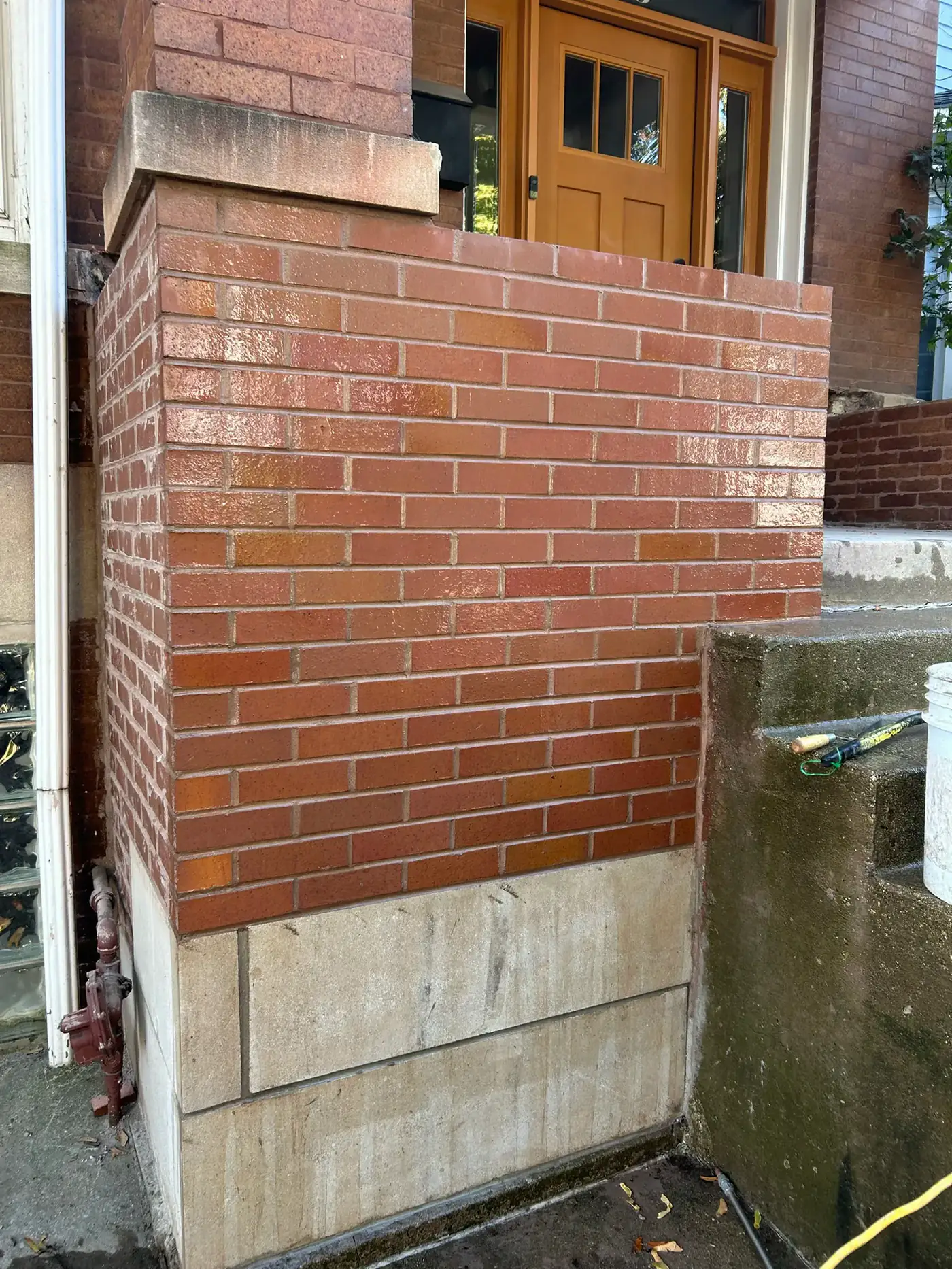
Same Block, Same Builder, Different Outcome
Two identical houses age differently because of six variables — and drying time is the dominant one. How much sun an elevation gets, whether the gutters work, how water behaves at grade, how much tree canopy is overhead, what previous contractors did to the mortar, and whether small details like a sill or chimney crown have failed. None of it is luck, and most of it is visible from the sidewalk once you know what to look at. Emerald Masonry LLC assesses these factors on every job across Chicago and the Chicagoland suburbs — family-owned, licensed and insured, career masons with decades of experience, free on-site estimates. Call (708) 288-1696.
Homeowners bring this up constantly. The house next door is the same age, same builder, same brick — why does mine look like this?
Fair question, and the answer is genuinely useful, because five of the six factors are things you can do something about.
The One That Matters Most: Drying Time
Here is the piece of building science that explains most of it.
Masonry damage is not caused by cold. It is caused by water being present in the wall when the temperature crosses freezing. Water expands roughly nine percent as it freezes, and in a saturated joint or brick that expansion breaks things apart from inside. Chicagoland delivers dozens of those crossings each winter, plus more in the shoulder seasons.
So the question is not how much rain a wall gets — both houses get the same rain. The question is how fast the wall dries afterward.
A south-facing elevation in direct sun dries within hours. A north or east elevation in shade can stay damp for days. Same storm, same brick, same freeze that night — one wall is dry and one is loaded.
Run that difference across sixty winters and the two walls are simply not in the same condition.
The Six Variables
| Factor | How it shows up | Fixable? | |---|---|---| | 1. Orientation and sun | North/east elevations fail first; south side looks fine | No — but tells you where to look | | 2. Gutters and downspouts | A vertical stripe of damage under one seam | Yes, cheaply | | 3. Grade and splash | Bottom two or three courses spalling | Yes, cheaply | | 4. Tree canopy | Slow drying, green film, clogged gutters | Partly | | 5. Prior repair history | A band of spalling matching a past repointing | Only by redoing it | | 6. Small detail failures | Damage below one sill; chimney far worse than walls | Yes |
1. Orientation
Free diagnostic: walk all four sides of your house. The elevation with the worst joints is usually the one that gets the least sun. If your neighbor's house sits at a slightly different angle, or a garage or mature tree shades your north wall and not theirs, that alone can account for the difference.
2. Gutters and downspouts
The single most common water source behind local masonry damage. One leaking gutter seam delivers concentrated water down the same band of wall every storm for years — which is why so much damage appears as a vertical stripe rather than spread across the elevation.
A downspout discharging at the foundation instead of well away from it does the same thing at grade.
3. Grade and splash
The bottom courses take splash-back off hard surfaces, snow banked against the wall for weeks, and road salt carried in by spray. Grade sloping toward the house keeps soil saturated against the foundation. Two houses with different driveway pitch or different landscaping have genuinely different conditions at the base of the wall.
4. Tree canopy
Beloved, and hard on masonry. Canopy shades walls so they dry slowly, drops leaf load that overwhelms gutters, and encourages algae and moss that hold moisture against brick. The green film itself is mostly cosmetic — what it tells you is that the wall stays wet.
5. Prior repair history
This one surprises people. A past repair can make a wall worse than no repair at all.
The governing rule is that mortar must be softer than the brick it holds. Mortar is the sacrificial layer — it absorbs movement and moisture stress and wears out first, because replacing mortar is cheap and replacing brick is not.
Repoint soft older brick with hard Portland-heavy mortar and the relationship inverts: the joints become the strong element and every freeze-thaw cycle drives stress into the brick faces instead. Three to eight winters later the faces begin spalling.
The signature is a band of damage corresponding exactly to where somebody repointed. If your house was worked on in the 1990s and your neighbor's was not, that can be the entire difference.
The same applies to painted brick and film-forming sealers, which trap moisture in masonry that needs to dry outward, and to sandblasting or high-pressure washing, which strips the fired face off brick and permanently increases how much water it absorbs.
6. Small detail failures
A single failed sill delivers concentrated runoff down the wall below it for years. A cracked chimney crown wets the entire stack. A blocked weep hole on veneer converts a drained wall into one that holds water. A corroding steel lintel expands and cracks the masonry above an opening.
One small failed detail on your house that is still sound on theirs explains a lot.
Why the Chimney Always Looks Worst
Worth naming separately, because it holds on every house.
Every other masonry wall has a roof above it and a heated interior behind it. A chimney has neither — exposed on four sides above the roofline, with an unheated shaft inside. It is doing a substantially harder job than any wall on the property, which is why it is almost always the first masonry to need work regardless of anything else.
Two More Variables Worth Knowing About
The six above cover most cases. Two others explain the stubborn outliers.
The brick itself was never identical. Even on a builder's row where every house went up the same season, brick arrived in lots, and lots vary. Firing temperature differs between kilns and even within a kiln, which changes how vitrified the outer skin is and therefore how much water each unit absorbs. Two houses can be laid from the same order and still have measurably different absorption. This is also why one section of a single wall sometimes spalls while the courses above and below it are fine — that band came off a different pallet.
Adjacent structures change exposure. A neighbor's garage, an addition, a fence line or a mature tree that went in thirty years ago all alter how much sun and wind reach a given elevation. A wall that was originally exposed and drying well can become a shaded, slow-drying wall the year something goes up next to it — and it will begin failing on a completely different timeline from that point forward. This is a common and genuinely invisible cause: nothing changed about your house, but its microclimate did.
Neither of these is fixable. They are worth knowing because they explain the cases where you have done everything right — gutters clear, grade correct, good prior repairs — and the wall still went first.
What to Actually Check
- Walk all four elevations, not just the front.
- Press a screwdriver into the mortar joints on each side. Sound mortar resists; failed mortar gives way like packed sand.
- Look for vertical stripes of damage and trace them upward to the gutter.
- Look at the bottom three courses for spalling and salt residue.
- Look under every window for streaking or spalled brick — that is a sill telling you something.
- Look above every opening for rust staining and horizontal cracks.
- Look up at the chimney for white staining, flaking faces and a cracked crown.
- Look for a band of damage matching any past repair.
- Walk the perimeter during a heavy rain once a year. Ten minutes will teach you more than any inspection report.
The Timing Illusion
One more thing worth naming, because it distorts how homeowners judge their own house.
Masonry does not fail gradually in a way you can perceive. Joints recede a fraction of an inch a year for two decades and look basically unchanged, then a couple of hard winters push several units past the point where the face lets go — and suddenly the wall looks dramatically worse than it did last spring.
Nothing accelerated. You simply crossed a visible threshold that had been approaching invisibly for twenty years.
This produces two predictable errors. The first: "it was fine last year, so this must be sudden damage" — which sends people looking for a storm or an event to blame, and occasionally into a fruitless insurance conversation. The second, more costly: "my neighbor's wall looks fine, so mine must have a specific problem." Their wall may simply be four winters behind yours on the same curve.
The practical takeaway is that the screwdriver test beats the eyeball test by years. A joint that rakes out under light pressure is failed regardless of how the wall photographs, and catching it at that stage is the difference between repointing and replacing brick. Check the joints on a schedule rather than waiting for the wall to announce itself.
What to Fix, in Order
- Gutters, downspout extensions and grade. Cheapest work available and the highest return, because most masonry damage is a water-management failure.
- Failed details — sills, chimney crown and flashing, caulking, blocked weeps.
- Corroding steel — lintels showing rust staining.
- Repointing, with mortar matched softer than the brick.
- Brick replacement for units already spalled.
- Breathable protection only, if any — never paint, never a film-forming sealer.
What It Means for Cost
The variables above are exactly what a mason is reading during an assessment, and they are why two identical houses get genuinely different estimates. Extent of failure, how many elevations are involved, whether a past bad repair has to be undone, whether spalled units need matching, height and access, and whether the water source needs correcting first.
That is also why a price quoted without seeing the house means very little — the house next door is not a comparable.
Related Services
Tuckpointing and repointing, brick repair, brick replacement, chimney repair, lintel repair, limestone and sill repair and masonry sealing.
The Bottom Line
Your neighbor's wall is not a control group. Their orientation, gutters, grade, canopy, repair history and detail condition are all different from yours, and any one of those can account for a decade of divergence.
Use the comparison as a prompt, not a verdict: go check your own joints, on the shaded side, with a screwdriver. Then go look at your gutters. Between those two, you will have most of the answer for free.
Emerald Masonry LLC is a family-owned, licensed and insured masonry contractor serving Chicago and the Chicagoland suburbs led by career masons with decades of hands-on experience in tuckpointing, chimney repair, brick repair and replacement, lintel and parapet repair, foundation and limestone/sill repair, caulking, sealing, and commercial, residential and historic masonry restoration. We tell homeowners when their masonry is genuinely fine.
Free on-site estimates. Call (708) 288-1696 or request an estimate.
Frequently Asked Questions
Why is my brick worse than my neighbor's identical house?
Usually drying time. The elevation that gets less sun stays wet longer after every rain, so it enters each freeze-thaw cycle saturated while the sunny side has already dried. Add a leaking gutter, heavier tree cover or a past repair done with the wrong mortar and two identical houses diverge quickly.
Does which way my house faces really matter?
Substantially. North and east elevations get the least direct sun and dry slowest, so they hold moisture going into freeze cycles and typically show joint failure and spalling first. It is common to find one wall of a house needing work while the opposite wall is genuinely fine.
Why is the damage concentrated in one vertical stripe?
That is almost always a gutter seam or downspout above it. A single overflowing section delivers concentrated water down the same band of wall every storm for years, which is why the damage forms a stripe rather than spreading evenly across the elevation.
Do trees damage masonry?
Indirectly, and significantly. Canopy shades walls so they dry slowly, drops leaf load that clogs gutters and causes overflow, and encourages algae and moss that hold moisture against the brick. The trees are not attacking the wall — they are keeping it wet.
Can a previous repair make brick deteriorate faster?
Yes, and it is one of the most common causes we see. Repointing soft older brick with hard Portland-heavy mortar inverts the wall's design so freeze-thaw stress goes into the brick faces rather than the joints, and the faces start spalling within a few winters. A band of damage matching a past repointing is the signature.
Why does the chimney always look worse than the walls?
Because it is exposed on four sides above the roofline with no heated interior drying it from behind. Every other wall on the house has a roof over it and warm air behind it. The chimney is doing a much harder job, which is why it is usually the first masonry on any house to need work.
Should I compare my house to my neighbor's to decide if I need work?
It is a useful prompt but a poor diagnostic. Their exposure, gutters, grade, tree cover and repair history are all different from yours. Use their condition as a reason to check your own joints with a screwdriver rather than as evidence that you are fine.
Which of these factors is cheapest to fix?
Gutters, downspout extensions and grade — by a wide margin. They are also the highest-return items, because most masonry damage is a water-management failure rather than a masonry failure. Fixing them costs little and slows everything else down.
How often should I actually inspect my masonry?
Once a year, ideally in fall before winter, and again after any major storm. Walk all four elevations rather than just the front, and pay particular attention to the shaded side and anything under a gutter run.