
Brick Repair · Tinley Park, IL
Brick Repair in Tinley Park, IL — Damaged Brick and Failed Brick Are Different Problems
Broken brick in Tinley Park usually comes from one of four causes: freeze-thaw failure, physical impact, rusting steel pushing from behind, or structural movement. They look similar from ten feet away and they need completely different repairs — and only one of them is fixed by swapping the brick.
Quick Answer
Emerald Masonry LLC performs brick repair in Tinley Park, IL — replacing spalled and cracked units, rebuilding damaged sections, and repairing garden, garage and subdivision walls, after first identifying whether the brick failed from weather, impact, rusting steel, or structural movement. Family-owned, licensed and insured, career masons with decades of Chicagoland experience, free estimates. Call (708) 288-1696.
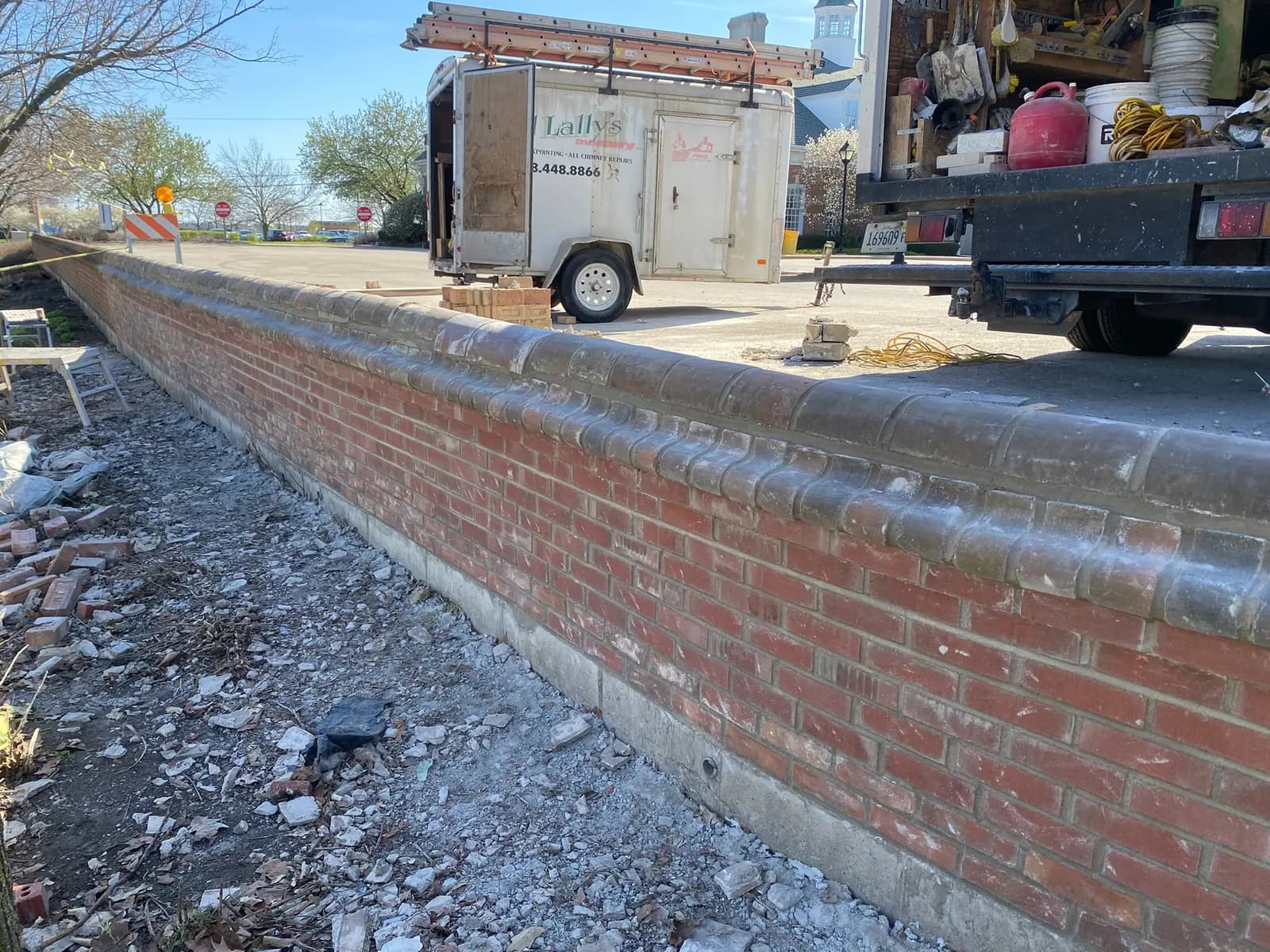
Brick Repair in Tinley Park, IL
Brick repair in Tinley Park, IL starts with a diagnosis, not a demolition hammer. Emerald Masonry LLC repairs and replaces damaged brick on homes, garages, garden walls, entrance monuments and commercial buildings throughout the Southwest suburbs — family-owned, licensed, bonded and insured, career masons with decades of Chicagoland experience, free on-site estimates. Call (708) 288-1696.
Because here is what we find on most Tinley Park calls: the brick is the evidence, not the problem.
Four Causes That Look Identical From the Sidewalk
Stand ten feet back from a damaged wall and broken brick all looks about the same. Get close and it separates cleanly into four categories, and each one is a different job.
1. Weather failure (spalling)
The face of the brick flakes, sheets, or crumbles away, exposing the softer core. This is water plus freeze-thaw. Water soaks into the brick, freezes, expands roughly nine percent, and pops the face off. In Tinley Park it concentrates in specific places: the bottom courses near grade, the driveway-facing side of an attached garage, low garden walls that get soaked from the top, and anywhere a downspout dumps against masonry. Spalled brick cannot be repaired. It is replaced.
2. Impact and mechanical damage
Chipped corners, a single cracked unit, gouges at bumper height, a broken course on a garden wall. Snowplows, snowblower discharge, mowers, ladders, car doors, delivery dollies. This damage is local, it does not spread, and it is the least expensive category — but it still opens the wall to water, so it should not sit for years.
3. Rust jacking
Cracked brick in a horizontal line above a window, garage door or storefront opening, often with orange staining running down the face. That is a steel lintel corroding behind the wall. Rusting steel expands to several times its original thickness and lifts everything above it. Replacing the brick without replacing or treating the steel guarantees the crack comes back. See lintel repair.
4. Structural movement
Diagonal stair-step cracking through the mortar joints, doors and windows out of square, brick displaced out of plane, a wall that bulges when you sight down it. Settlement, foundation movement, deflecting steel, or failed wall ties. This is the one category where the masonry is the messenger. Replace only the brick and you have hidden the symptom.
Why This Matters in Tinley Park Specifically
Tinley Park is really two building stocks stacked on one another.
The historic core around Oak Park Avenue and the Metra station — the nineteenth-century commercial buildings, the old village storefronts, the church and civic masonry — is older, softer brick, often solid masonry, laid in lime-rich mortar. It wants soft mortar and gentle handling, and it spalls badly if someone repoints it with a hard modern mix or cleans it aggressively.
The subdivision build-out from the 1960s through the 2000s, spreading west toward 80th Avenue and south past the Convention Center, is machine-made brick veneer: dense, uniform, laid in colour blends that were specified by the builder and, in many cases, discontinued years ago. That stock rarely fails from age. It fails at the bottom courses from salt and splash, at chimney chases, above rusting lintels, and along the driveway side of the garage.
Add the Southwest suburbs' road salt volume and the fact that a huge share of Tinley Park garages face directly onto a salted driveway, and the pattern in our work log is consistent: the garage wall goes first, the house goes last.
Risks of Waiting
Damaged brick is an open door. A missing face lets the brick take on water faster, which accelerates the next freeze cycle, which takes the neighbouring units. A cracked line above a lintel means the steel is still swelling. A bulging wall is losing its connection to the structure behind it.
The escalation is real and it is expensive: scattered replacement becomes section rebuilding, section rebuilding becomes wall rebuilding, and a wall rebuild on a two-story elevation brings staging costs that dwarf the masonry.
Our Brick Repair Process
- Diagnose the cause — weather, impact, steel, or movement — before touching the wall.
- Sound the surrounding area. Tapping reveals units that have lost bond or are hollow behind an intact-looking face; those come out too.
- Source the match. Size, colour range, texture and face treatment, checked against the wall in daylight rather than from a chart.
- Cut out the damaged units by removing the surrounding mortar and extracting the brick without disturbing the units above.
- Address what caused it — replace corroded steel, restore drainage, open blocked weep holes, correct a downspout, or bring in structural repair where movement is active.
- Set the new brick in matched mortar, keyed to the existing coursing and bond pattern.
- Blend, don't block. Replacements are scattered through the surrounding field where the damage allows, so the eye reads a wall instead of a rectangle.
- Repoint the transition so new and existing joints tool and cure alike.
- Clean down and review the finished work with the owner.
Materials and Matching
Mortar has to be softer than the brick it sits against — mortar is the sacrificial part, and a hard mix on soft older brick pushes the stress into the brick faces. On Tinley Park's historic core we generally work with lime-rich, low-Portland mixes; on modern veneer, a Type N is typical.
Brick matching is the honest limit of this trade. Colour, size, texture and the way a face has weathered for thirty years all matter, and no new brick arrives pre-aged. What separates a good repair from a bad one is not finding a perfect brick — it is blending and placement, plus mortar colour and joint profile that match the field exactly. Related services often run alongside: brick replacement, tuckpointing and repointing, limestone and sill repair, and masonry sealing.
What Drives the Cost
- The cause — impact damage is cheap; rust jacking and movement are not.
- Access and height — ground-level garden wall versus a second-story elevation over landscaping.
- How much has to come out once hollow and debonded units are sounded.
- Match difficulty on discontinued or unusual brick.
- Whether the underlying problem — steel, drainage, settlement — has to be corrected as part of the work.
- Scale and coordination on HOA common areas and commercial buildings.
We never quote brick work over the phone. Estimates are free, on-site, and written.
Serving Tinley Park and the Southwest Suburbs
Emerald Masonry LLC is a family-owned, licensed and insured masonry contractor serving Chicago and the Chicagoland suburbs led by career masons with decades of hands-on experience in tuckpointing, chimney repair, brick repair and replacement, lintel and parapet repair, foundation and limestone/sill repair, caulking, sealing, and commercial, residential, and historic masonry restoration. Free on-site estimates — call (708) 288-1696.
We work throughout Tinley Park and neighbouring Orland Park, Oak Forest, Mokena and Frankfort, for homeowners, property managers, HOAs, churches and insurance companies. $5,000 project minimum.
Get a Free Tinley Park Brick Repair Estimate
If brick faces are flaking, a crack line has opened above a garage door, or a garden wall is coming apart, get the cause identified before another winter drives it further. Call (708) 288-1696 or request a free estimate.
Ready to get started?
Free on-site estimates for commercial and large-scale projects.
Brick Repair in Tinley Park, IL — Frequently Asked Questions
How much does brick repair cost in Tinley Park, IL?
It depends far more on cause than on count. Replacing a dozen spalled faces on an accessible garage wall is a modest job; the same dozen bricks above a rusting lintel means the steel has to come out first, which is a different scope entirely. Emerald Masonry diagnoses the cause on a free on-site visit and prices the actual repair rather than a per-brick rate.
Why is the brick on my garage wall flaking off but the house is fine?
Because the garage wall gets hit with everything the house does not — driveway salt and slush spray, snowblower and plow throw, and constant wetting at the bottom courses with nothing overhead to shed water. Salt-driven and freeze-thaw spalling almost always shows up on the lowest three or four courses first, and on the elevation facing the drive.
Can you match brick on a 1980s or 1990s Tinley Park subdivision home?
Usually very closely, though rarely perfectly. Brick from that era was machine made in specific colour blends and textures, and many of those exact runs are discontinued. We source the nearest available match and blend replacements through the surrounding field rather than patching one solid block, which is what keeps a repair from reading as a patch.
My brick is cracked in a stair-step pattern. Is that serious?
Step cracking that follows the mortar joints diagonally usually means something moved — settlement, a shifting footing, or a lintel or shelf angle deflecting. Replacing the cracked brick without addressing the movement just gives the wall fresh material to crack. The cause has to be identified first.
Do you repair subdivision entrance walls, monuments and garden walls?
Yes, and a large share of our Tinley Park work is exactly that. Freestanding brick walls, entrance monuments, planters and low garden walls weather from both faces and from the top, so they deteriorate faster than a house wall and usually need caps and copings addressed along with the brick.
Should damaged brick be repaired or the wall rebuilt?
Scattered damage is repaired unit by unit. Once a section is substantially deteriorated, has lost its bond, or is bulging away from the structure, rebuilding that section is both safer and less expensive than repeatedly patching it. We give an honest read on which side of that line a wall is on.
Do you work with Tinley Park HOAs and property managers?
Yes. We serve homeowners associations, property managers, churches, commercial owners and insurance companies throughout the Southwest suburbs, and we can scope common-area masonry by element so a board can budget and phase it.
Brick Repair in Nearby Areas
Other Masonry Services in Tinley Park, IL
Learn more about our brick repair services across Chicagoland, or view all service areas.