
Chimney Rebuild vs Repair · Chicagoland, IL
Chimney Rebuild vs. Repair: How to Tell Which One Your Chimney Needs
A chimney with a sound stack but a failed crown, cap, or mortar joints needs repair. A chimney with loose or spalling brick across multiple courses — or one that's leaning — needs a partial or full rebuild. Here's how to tell the difference.
Quick Answer
If the chimney stack is structurally sound and only the crown, cap, or mortar joints have failed, you need a repair. If brick is loose or spalling across multiple courses, or the chimney is leaning, you need a partial or full rebuild. Emerald Masonry inspects it free — call (708) 288-1696.
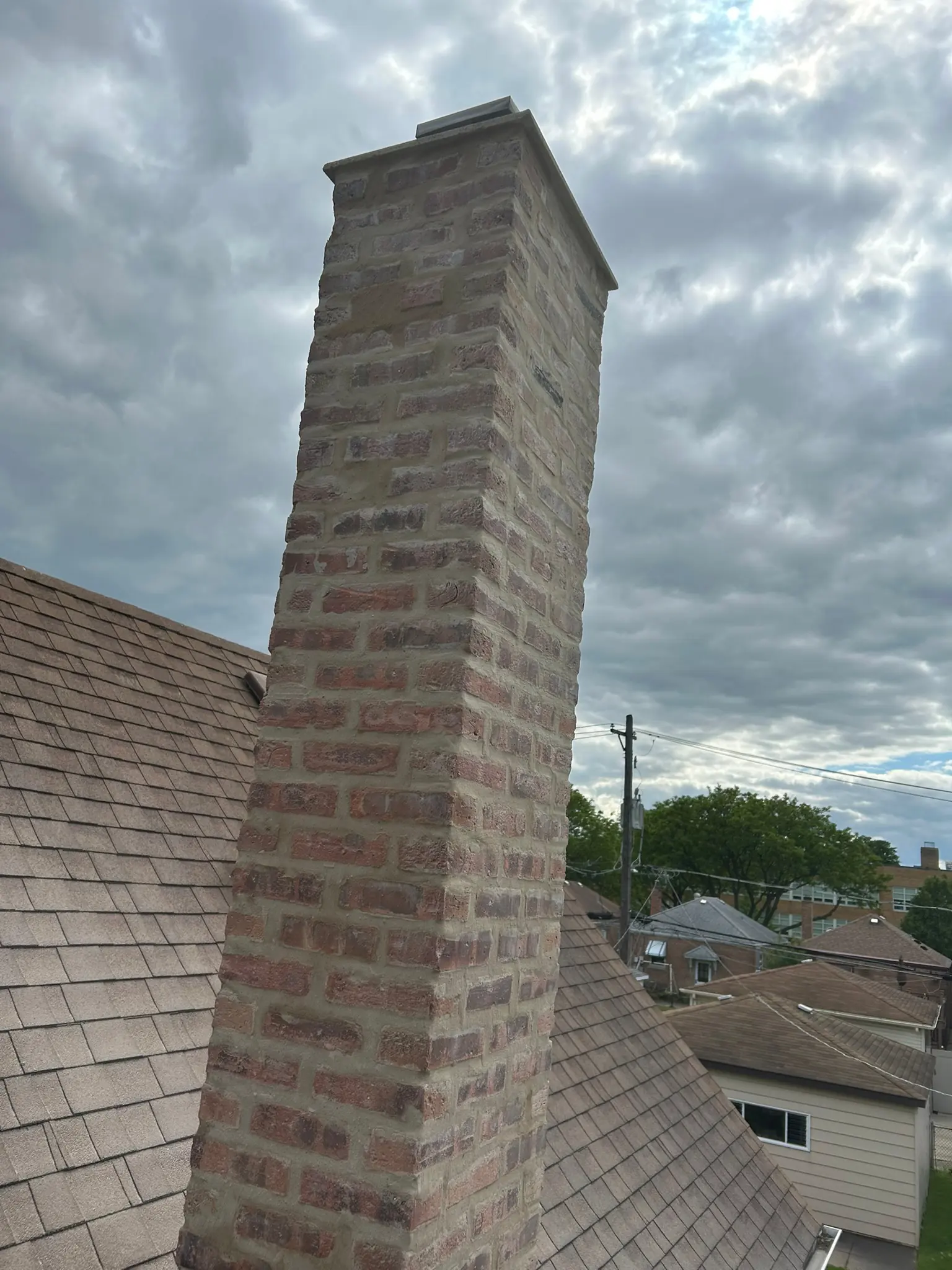
If your chimney stack is structurally sound and the problem is a cracked crown, a missing cap, or deteriorated mortar joints, you need a repair. If the brick is loose or spalling across multiple courses, or the chimney is leaning away from the house, you need a partial or full rebuild. The dividing line is simple: repair fixes what protects a sound stack, while a rebuild replaces a stack that has lost its structural integrity.
A chimney is a masonry tower sitting fully exposed above your roofline, taking weather on all four sides. In Chicagoland's freeze-thaw climate it is almost always the first masonry on a house to deteriorate. Emerald Masonry repairs and rebuilds chimneys across the area, and this page explains how to tell which one yours needs before you spend on the wrong work.
What Chimney Repair Covers
Chimney repair addresses the parts that fail around an otherwise solid stack. The most common repairs are crown repair, cap replacement, and tuckpointing the mortar joints.
The crown is the concrete or mortar cap at the very top that sheds water away from the flue and brick. Thin or poorly sloped crowns crack, and water runs straight into the structure. The cap covers the flue opening and keeps out rain and animals. The mortar joints, like on any brick wall, are sacrificial and wear before the brick does. When the stack itself is sound — brick rings solid, courses are tight, nothing is loose — fixing the crown, cap, and joints stops water intrusion and can add many years to the chimney's life. This is repair territory.
What a Chimney Rebuild Covers
A rebuild means taking the chimney down to sound brick and laying it back up. It is the right call when the brick itself has failed, not just the mortar or the crown.
A partial rebuild addresses the top portion — typically the courses above the roofline, where exposure is worst. If brick up top is spalling (faces popping off), loose, or the joints have washed out so far the units shift, a mason removes the bad section and rebuilds from the last sound course. A full rebuild is needed when deterioration runs deep into the stack or when the chimney is leaning, separating from the house, or visibly out of plumb — all signs the structure itself has lost integrity and cannot be saved with repointing.
How to Tell Which You Need
Inspect the stack and its protective parts separately:
| Factor | Repair | Rebuild | | --- | --- | --- | | Stack condition | Brick solid, courses tight | Loose or spalling brick across courses | | What has failed | Crown, cap, or mortar joints | The brick structure itself | | Plumb | Straight and true | Leaning or pulling from the house | | Tap test | Brick rings solid | Brick sounds dull or sheds flakes | | Typical scope | Crown, cap, tuckpointing | Partial (top courses) or full rebuild | | Relative cost | Lower | Higher | | When it's right | Sound stack, water getting in up top | Structural failure or widespread spalling |
If the stack is sound and water is getting in through the crown, cap, or joints, repair it. If brick is loose or spalling across courses, do a partial rebuild of that section. If the chimney leans or is failing deep into the stack, it needs a full rebuild.
Cost and Longevity Trade-Offs
Repair is the lower-cost path and, on a sound stack, buys many more years of service — a fresh crown and tight joints keep water out, which is what drives nearly all chimney decay. A rebuild costs more because it is structural masonry from the ground up of that section, but it is the only fix that lasts when the brick has failed. The expensive mistake is repointing or recrowning a chimney whose brick is already spalling: the new work fails fast because the underlying structure is gone. Catching problems while they are still repairs is what keeps you out of rebuild costs.
How Emerald Assesses It On-Site
We inspect the chimney up close, not from the ground. On a free on-site estimate we check the crown and cap, tap and examine the brick course by course, probe the mortar joints, and check the stack for plumb and any separation from the house. Then we tell you honestly whether it is a chimney repair — crown, cap, and joints — or whether the brick has failed and a partial or full rebuild is the right call. Where the joints are sound but worn, targeted tuckpointing handles it, and we tie chimney work into broader masonry restoration when the rest of the house needs attention too.
Frequently Asked Questions
Can a chimney be partially rebuilt?
Yes, and it is common. If only the top several courses above the roofline are spalled or loose, a mason can take the chimney down to sound brick and rebuild from there. This costs far less than a full rebuild and is the right call when the lower stack is still solid.
How do I know if my chimney is leaning?
Look at it against a vertical reference like a roof edge or downspout, and check for a gap opening between the chimney and the house. A leaning chimney is a structural problem, not a cosmetic one, and almost always points to a rebuild rather than a repair.
Is repointing enough, or do I need a rebuild?
Repointing works when the brick is sound and only the mortar joints have failed. If brick faces are spalling or units are loose across several courses, new mortar will not hold and a rebuild of that section is needed instead.
Why do chimneys fail before the rest of the house?
A chimney is exposed to weather on all four sides above the roofline, with no protection from sun, rain, or snow. In the Chicago area's freeze-thaw climate it takes far more punishment than your walls, so it usually deteriorates years sooner.
Get Your Chimney Looked At for Free
Do not guess whether you need a crown patch or a rebuild. Emerald Masonry LLC is a family-owned, licensed, bonded, and insured contractor with 40-plus years of Chicagoland experience, and our on-site estimates are free. We will tell you exactly what your chimney needs — repair or rebuild.
Call (708) 288-1696 or request a free on-site estimate today.
Ready to get started?
Free on-site estimates for commercial and large-scale projects.
Chimney Rebuild vs Repair in Chicagoland, IL — Frequently Asked Questions
Can a chimney be partially rebuilt?
Yes, and it is common. If only the top several courses above the roofline are spalled or loose, a mason can take the chimney down to sound brick and rebuild from there. This costs far less than a full rebuild and is the right call when the lower stack is still solid.
How do I know if my chimney is leaning?
Look at it against a vertical reference like a roof edge or downspout, and check for a gap opening between the chimney and the house. A leaning chimney is a structural problem, not a cosmetic one, and almost always points to a rebuild rather than a repair.
Is repointing enough, or do I need a rebuild?
Repointing works when the brick is sound and only the mortar joints have failed. If brick faces are spalling or units are loose across several courses, new mortar will not hold and a rebuild of that section is needed instead.
Why do chimneys fail before the rest of the house?
A chimney is exposed to weather on all four sides above the roofline, with no protection from sun, rain, or snow. In the Chicago area's freeze-thaw climate it takes far more punishment than your walls, so it usually deteriorates years sooner.
Chimney Rebuild vs Repair in Nearby Areas
Learn more about our chimney rebuild vs repair services across Chicagoland, or view all service areas.