
Historic Masonry Restoration · Geneva, IL
Historic Masonry Restoration in Geneva, IL — Lime Mortar Repointing and Landmark-Sensitive Brick & Stone Repair
Emerald Masonry LLC restores historic brick and stone buildings in Geneva, IL using soft, breathable lime mortar matched to the original composition, color, and joint profile. We protect older masonry from the spalling damage that hard modern Portland cement causes.
Quick Answer
Emerald Masonry LLC provides historic masonry restoration in Geneva, IL — lime mortar repointing, mortar matching, and sensitive brick and stone repair. Family-owned, led by career masons with decades of hands-on experience, licensed, bonded and insured, we restore older brick and limestone buildings using breathable lime mortar instead of damaging Portland cement. Free on-site estimates: call (708) 288-1696.
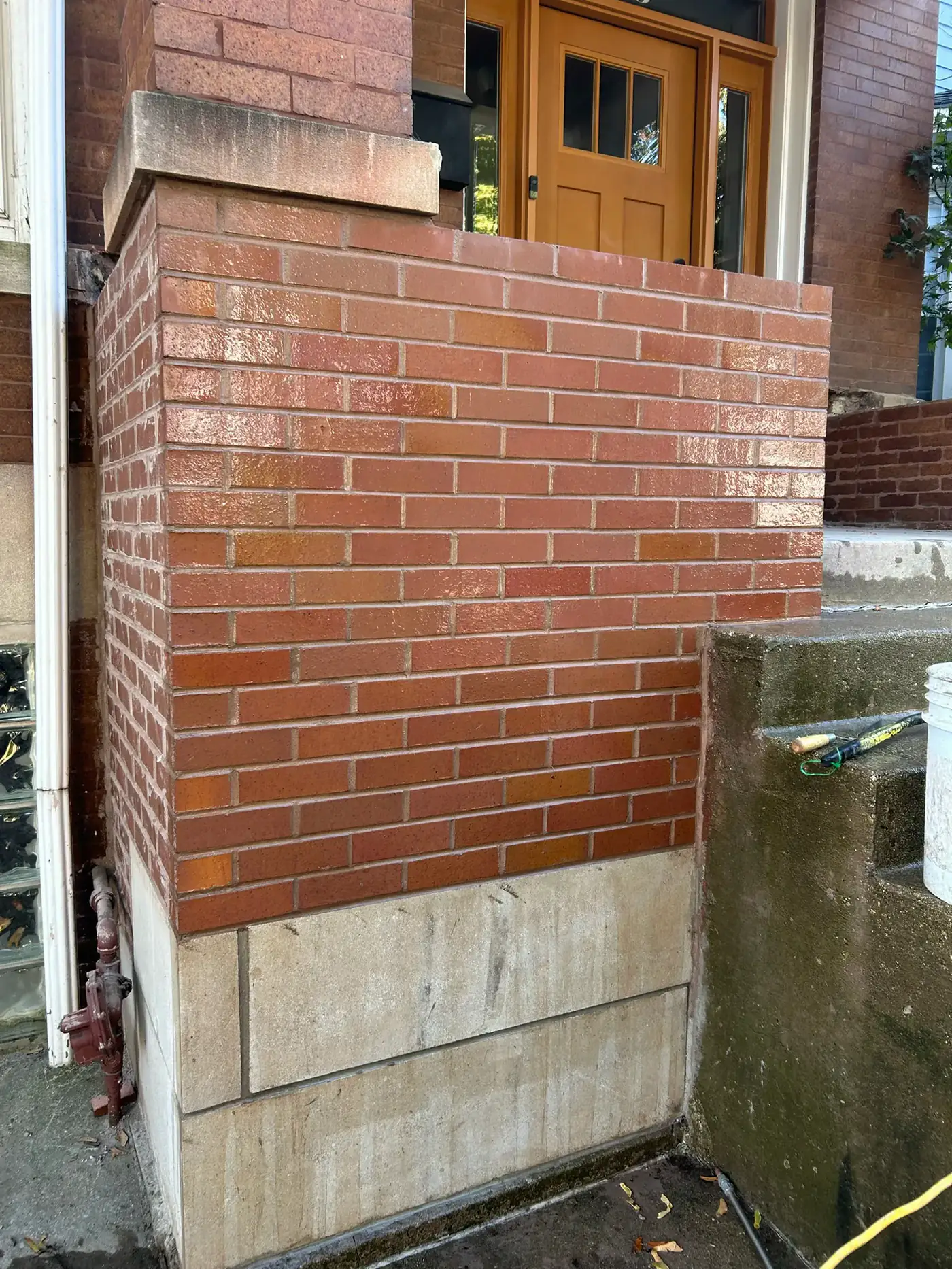
Historic masonry restoration in Geneva, IL
Emerald Masonry LLC provides historic masonry restoration in Geneva, IL — including lime mortar repointing and landmark-sensitive brick and stone repair on older homes and commercial buildings. We restore historic masonry using soft, breathable lime mortar matched to your building's original composition, color, and joint profile, never the hard Portland cement that damages old brick. For a free on-site assessment in Geneva, call (708) 288-1696.
If your historic Geneva building has eroding joints, spalling brick faces, or earlier repairs done with the wrong mortar, the right next step is an in-person evaluation by a contractor who understands how older masonry is built — and what it needs to last.
What historic masonry restoration is — and why it differs from standard repair
Historic masonry restoration is the careful repair and conservation of older brick and stone buildings using materials and methods that match the original construction. It is not the same as standard tuckpointing or brick repair on a modern home.
Buildings from the 19th and early 20th centuries were built with soft, hand-made or early kiln-fired brick and soft lime-based mortars. These materials work together as a flexible, breathable system. Modern repair products — especially hard, high-strength Portland cement mortars — were never designed for that system. Used on a historic wall, they create more problems than they solve.
That is why historic restoration calls for mortar analysis, hand work, in-kind stone repair, and gentle cleaning rather than the fast, aggressive methods used on newer masonry.
The core principle: soft brick needs soft, breathable lime mortar
Here is the single most important rule in historic masonry: the mortar should always be softer than the brick.
Soft historic brick needs soft, breathable lime mortar that matches the original in composition, color, and joint profile. Lime mortar flexes with seasonal movement and lets moisture wick out through the joints — the part of the wall that is meant to fail first and be renewed over time.
When hard modern Portland cement mortar is used instead, it becomes stronger than the surrounding brick. Now the wall can no longer breathe through its joints, so trapped moisture is forced out through the brick face. Each freeze-thaw cycle pops off thin layers of the brick — a process called spalling — until the original brick is permanently lost. The mortar survives; the irreplaceable historic brick does not.
On a historic wall, the mortar is supposed to be the sacrificial part. If your mortar is harder than your brick, the brick becomes the thing that wears away.
This is why matching the original mortar is not a cosmetic detail. It is the difference between a repair that protects the building and one that quietly destroys it.
Signs your historic Geneva building needs restoration
Older brick and limestone buildings give clear warnings. Watch for:
- Eroded, sandy, or recessed mortar joints that you can rake out with a key or screwdriver
- Spalling brick — faces flaking, cracking, or crumbling, often worst near the ground or under windows
- Previous hard-mortar repairs that sit proud of the wall, are a different color, or have visibly damaged the brick around them
- Failing stone sills and lintels — cracked, delaminating, or shifted limestone over windows and doors
- Water entry — interior staining, efflorescence (white powder), damp plaster, or musty smells
Any one of these is reason for an inspection. Several together usually mean water is already moving through the wall.
The risk of waiting — and the bigger risk of the wrong repair
Waiting lets water keep working. Open joints and spalled faces let moisture deeper into the wall, where Geneva's freeze-thaw winters expand it and accelerate the damage. What starts as surface erosion becomes lost brick, failed stone, and eventually structural concern.
But on a historic building, the wrong repair can be worse than waiting. A well-meaning crew that repoints a soft brick wall with hard Portland cement, grinds the joints with an angle grinder, or sandblasts the facade can cause more permanent damage in a week than decades of weather would. Historic restoration is one job where doing it correctly matters more than doing it fast.
Our historic restoration process
We follow a conservation-minded process built for older masonry:
- Assess and document. We inspect the brick, stone, joints, and existing repairs, and document conditions before we touch the wall.
- Analyze and match the original mortar. We evaluate the original mortar's composition, sand, and color so the new lime mortar matches the historic work.
- Rake joints by hand. We carefully cut out failed mortar by hand to avoid chipping or widening the soft brick — no aggressive grinding.
- Repoint with matched lime mortar. We repoint with the matched lime mortar and tool the joints to the correct historic profile so the repair blends in.
- Repair stone, including Dutchman repairs. Where limestone is damaged, we repair or piece in matching stone (a Dutchman repair) rather than replacing whole units when we can save them.
- Clean gently — never sandblast. We use the gentlest effective cleaning method. We do not sandblast or high-pressure blast historic brick, which strips the protective fired surface.
Materials we use
For historic work we use lime-based mortars matched to the original, sand and aggregate selected to match color and texture, and natural or matching stone for sill, lintel, and Dutchman repairs. The materials are chosen to be compatible with the existing wall — soft, breathable, and visually consistent with the original — so the restoration performs and reads as part of the historic building.
What affects the price
Historic restoration is priced by the building, not by a flat rate. The main factors are:
- Mortar analysis and matching — getting the lime mortar right takes more work than a standard mix
- Hand work — careful hand raking and tooling is slower than modern grinding
- Access — height, scaffolding needs, and tight downtown sites
- Stone repair scope — how many sills, lintels, or stone units need Dutchman or in-kind repair
Because every historic wall is different, we never quote exact prices sight unseen. We provide a free on-site assessment and a clear written estimate.
Serving Geneva and the Fox River Valley
Geneva is one of the most architecturally rich towns in the Fox River Valley, with a historic downtown and neighborhoods full of older brick and limestone homes and commercial buildings. Those buildings face Kane County's hard freeze-thaw cycles every winter, which is exactly the condition that punishes failed joints, the wrong mortar, and spalling brick.
We serve Geneva and the surrounding Fox Valley and Kane County communities with restoration that respects how these buildings were built. Whether it is a historic downtown storefront or an older residential facade, our goal is in-kind repair that protects the original brick and stone for the long term.
Emerald Masonry LLC is a family-owned, licensed, bonded and insured masonry contractor serving Chicago and the Chicagoland suburbs led by career masons with decades of hands-on experience in tuckpointing, chimney repair, brick repair and replacement, lintel and parapet repair, foundation and limestone/sill repair, caulking, power washing, sealing, and commercial, residential, and historic masonry restoration. Free on-site estimates — call (708) 288-1696.
Learn more about our historic masonry restoration services, tuckpointing and repointing, limestone and sill repair, and brick repair and replacement. It's also worth reading why sandblasting and power-washing ruin brick and the difference between lime mortar vs. Portland cement mortar before any work on an older building.
Frequently Asked Questions
How much does historic masonry restoration cost in Geneva, IL?
Cost depends on scope, the level of lime mortar analysis and matching, the amount of stone repair, and access to the work area. Historic repointing is done by hand to protect soft brick, so it takes longer than standard tuckpointing. We give a free on-site assessment and a written estimate before any work begins — no exact price over the phone.
Why can't you use regular Portland cement mortar on my historic Geneva home?
Soft historic brick needs a soft, breathable lime mortar that flexes and lets moisture escape. Hard modern Portland cement mortar is stronger than the old brick, so it traps water and forces moisture out through the brick face, causing spalling and permanent loss of the original brick. Matching the original soft mortar protects the building.
Do you match historic mortar color and joint profile?
Yes. We analyze the original mortar to match its composition, sand, and color, and we tool the new joints to the same profile as the historic work. The goal is a repair that blends in and reads as original, not a modern patch.
Do you work on landmark or historic-district properties?
Yes. We restore older brick and limestone homes and commercial buildings throughout Geneva and Kane County, including properties where sensitive, in-kind repair matters. We use lime mortar matching, hand raking, and gentle cleaning to keep the work appropriate for historic and landmark-sensitive buildings.
Get a free historic masonry assessment in Geneva, IL
If you own an older brick or stone building in Geneva, protect it with restoration done the right way. Contact Emerald Masonry LLC for a free on-site assessment, or call (708) 288-1696 today.
Ready to get started?
Free on-site estimates for commercial and large-scale projects.
Historic Masonry Restoration in Geneva, IL — Frequently Asked Questions
How much does historic masonry restoration cost in Geneva, IL?
Cost depends on scope, the level of lime mortar analysis and matching, the amount of stone repair, and access to the work area. Historic repointing is done by hand to protect soft brick, so it takes longer than standard tuckpointing. We give a free on-site assessment and a written estimate before any work begins — no exact price over the phone.
Why can't you use regular Portland cement mortar on my historic Geneva home?
Soft historic brick needs a soft, breathable lime mortar that flexes and lets moisture escape. Hard modern Portland cement mortar is stronger than the old brick, so it traps water and forces moisture out through the brick face, causing spalling and permanent loss of the original brick. Matching the original soft mortar protects the building.
Do you match historic mortar color and joint profile?
Yes. We analyze the original mortar to match its composition, sand, and color, and we tool the new joints to the same profile as the historic work. The goal is a repair that blends in and reads as original, not a modern patch.
Do you work on landmark or historic-district properties?
Yes. We restore older brick and limestone homes and commercial buildings throughout Geneva and Kane County, including properties where sensitive, in-kind repair matters. We use lime mortar matching, hand raking, and gentle cleaning to keep the work appropriate for historic and landmark-sensitive buildings.
Historic Masonry Restoration in Nearby Areas
Other Masonry Services in Geneva, IL
Learn more about our historic masonry restoration services across Chicagoland, or view all service areas.