
Residential Masonry Restoration · Chicagoland, IL
Chicago Georgian Brick Homes: A Masonry Repair Guide for the House Built to Last a Century
The Chicago Georgian — the square, symmetrical brick house with a hip roof, limestone sills and a centred front door — was built of solid masonry and soft lime mortar. Most of its problems come from the last fifty years of repairs, not the first fifty years of weather.
2026-10-06
Quick Answer
Chicago Georgian brick homes, built mostly from the 1920s to the 1950s in Beverly, Mount Greenwood, Evergreen Park and Oak Lawn, have solid brick walls laid in soft lime-rich mortar. They need compatible, softer repointing mortar, careful limestone and lintel repair and chimney maintenance — not hard Portland patching. Emerald Masonry LLC repairs them across Chicagoland: (708) 288-1696.
Chicago Georgian Brick Homes: A Masonry Repair Guide
Chicago Georgian brick home masonry repair comes down to one principle: respect how the house was built. Most Georgians on Chicago's south side and in the near suburbs went up between the 1920s and the 1950s with solid brick walls and soft, lime-rich mortar. They need repointing with a compatible mortar that is softer than the brick, careful repair of limestone sills and lintels, and regular chimney maintenance. What they do not need — and what causes most of the damage we see — is hard Portland cement patching. Emerald Masonry LLC repairs Georgian and other older brick homes across Chicagoland. Free on-site assessments: (708) 288-1696.
If you live in Beverly, Mount Greenwood, Evergreen Park or Oak Lawn, you know the house: square, symmetrical, two storeys of brick under a hip roof, a centred front door with a limestone or brick surround, limestone sills under every window, a chimney on one end wall, and glass block in the basement. It is one of the best-built house types in the region. It is also the one most often damaged by well-meaning repairs.
A Chicago Georgian rarely fails from age alone. It fails from fifty years of repairs made with materials harder than the house.
How a Chicago Georgian brick home is built
Understanding the wall is the first step in repairing it properly.
Solid masonry, not veneer (usually)
Most pre-war Georgians are solid masonry. The outer layer is face brick — hard, dense, fired for appearance — and behind it sits a second wythe of Chicago common brick or structural clay tile. Every few courses a row of bricks laid end-on (a header course), or metal ties, binds the two layers together. The wall itself carries the floors and roof.
That matters because a solid wall handles water differently from modern brick veneer. There is no air cavity, no flashing system and often no weep holes. The wall absorbs rain, holds it, and dries it back out through the brick and — critically — through the mortar joints. Some later 1950s Georgians are brick veneer over block or frame; they look nearly identical from the sidewalk, so the wall type should be confirmed before anything is specified.
Lime-rich mortar was the design, not a weakness
The original mortar in most of these homes is lime-rich: softer and more porous than the brick. That is deliberate. Mortar is supposed to be the sacrificial, replaceable part of the wall. It flexes slightly as the house moves, lets moisture escape, and wears away over decades so the brick does not have to. For a deeper explanation, see our guide to lime vs Portland mortar.
Face brick in front, common brick out of sight
Face brick on the street and side elevations is durable. The softer common brick that shows up on rear walls, chimney interiors, garages and the back wythe is far more vulnerable once exposed — we cover it in detail in why Chicago common brick crumbles.
Common problems on Georgian brick homes
| Component | Common failure | Proper fix | |---|---|---| | Mortar joints | Receding, sandy or cracked joints; earlier hard-mortar patches | Grind or rake joints to depth, repoint with compatible lime-rich or Type N mortar matched for colour and texture | | Face brick | Spalling at the edges next to hard-mortar repairs | Replace spalled units with matched brick; correct the mortar so it does not recur | | Limestone sills | Cracks, spalling, open end joints, lost slope | Patch with restoration mortar, pin or reset; replace only when broken through | | Lintels over windows | Rusted steel lintels jacking brick; cracked limestone lintels | Replace or treat steel and add flashing; repair or replace stone lintel | | Brick arches | Sagging or dropped keystone; cracked joints | Reset and repoint arch; rebuild when units have shifted — see brick arch repair | | End-wall chimney | Cracked crown, eroded joints at the top, failed flashing, leaning | Rebuild crown, repoint or rebuild top courses, new flashing and cap | | Glass block basement windows | Cracked block, failed mortar, leaks | Reset or replace panels; repair surrounding brick and sill | | Front stoop | Settled or cracked brick steps, loose limestone treads | Reset treads, repoint or rebuild the stoop on a sound base |
Warning signs to look for
- Receding mortar joints you can scratch out with a key or screwdriver.
- Spalling or flaking brick faces, especially beside grey, glossy, obviously newer mortar.
- Stair-step cracks running diagonally from window corners.
- Rust stains or bulging brick above windows — a sign of rusting steel lintels.
- Cracked or tilted limestone sills, or open joints where the sill meets the brick.
- White efflorescence below sills, at the chimney or low on the foundation.
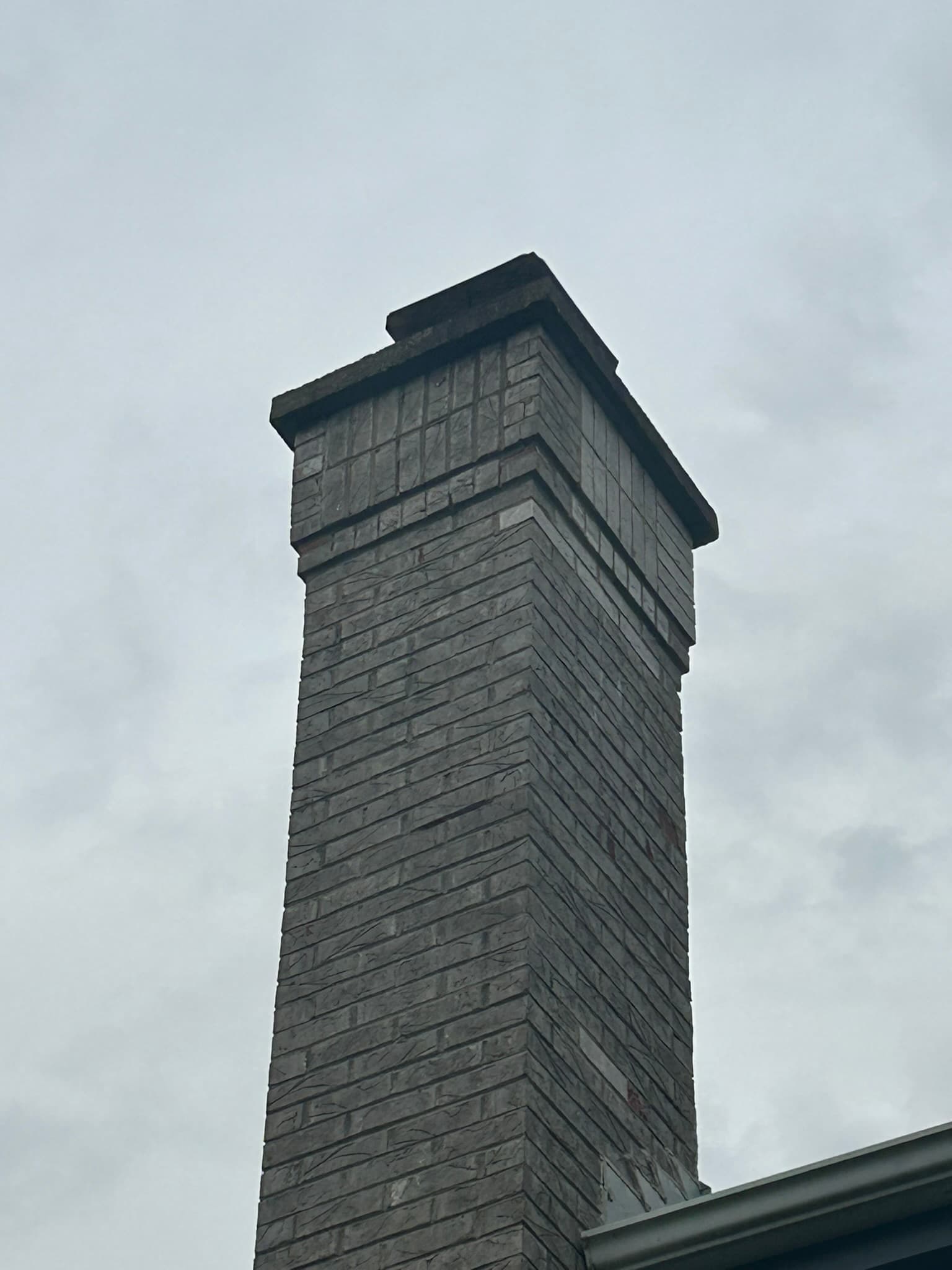
- Loose bricks or eroded joints at the top of the chimney, or a crumbling crown.
- Water stains on interior plaster along exterior walls or around the chimney breast.
Why hard Portland repairs damage these homes
This is the single most important point in this guide. From the 1960s onward, many Georgian homes were patched with straight Portland cement or a hard Type S mix. Hard mortar is stronger and less permeable than the original brick. When the wall gets wet and freezes, the stress and moisture no longer escape through the joint — they move into the brick. The edges of the bricks crack and pop off while the hard mortar stays intact. The result is a wall of rounded, shrinking bricks framed by proud grey joints.
If the mortar is harder than the brick, the brick becomes the sacrificial part of the wall. Every proper repair on a Georgian brick home puts that relationship back the right way round.
Tuckpointing vs repointing on an older home
In everyday use the words overlap. Strictly, repointing means removing deteriorated mortar to a consistent depth and replacing it; tuckpointing traditionally adds a fine contrasting line for appearance. On a Georgian home what matters is the method:
- Assess the wall, mortar hardness, brick condition and earlier repairs.
- Match the mortar — test colour, sand and texture against cleaned original joints, and choose a strength softer than the brick.
- Remove mortar to roughly two and a half times the joint width with grinders and hand tools, without widening the joints or chipping brick arrises.
- Clean and dampen the joints.
- Repoint in lifts, compacting each layer.
- Tool the joints to match the original profile.
- Cure the work slowly and protect it from sun, wind and frost.
- Replace damaged units with matched or salvaged brick.
Not every Georgian needs the whole house repointed at once — compare spot repointing vs full tuckpointing before you commit.
Materials and techniques that suit Georgian homes
- Lime-rich or Type N mortar, matched for colour, sand and joint profile. Type S is reserved for below-grade or very exposed applications where the brick can take it.
- Matched or salvaged face brick for replacements; new brick is chosen for size, colour and texture.
- Restoration mortars for limestone sills, lintels and trim, compatible with the stone.
- Galvanized or properly primed steel lintels with flashing where old lintels have failed.
- Breathable, vapour-permeable sealers only where a specific exposure calls for them. Film-forming sealers on a solid brick wall trap moisture and accelerate spalling.
What drives the cost of masonry repair on a Georgian home
- Area to be repointed — one chimney, one elevation, or the whole house.
- Depth and hardness of earlier repairs — removing hard Portland patches is slower.
- Brick replacement quantity and how hard the face brick is to match.
- Limestone sills, lintels and trim — patching, resetting or replacing.
- Chimney condition — repointing, top-course rebuild or full rebuild.
- Height and access — scaffolding on two-storey walls, tight gangways between houses.
- Mortar matching — test panels and custom mixes on visible elevations.
We do not promise prices over the phone. Emerald provides a free on-site assessment and a written scope so you can see exactly what is included.
DIY vs hiring a professional mason
Most homeowners can clean out a gutter or reseal a hose bib. Repointing a solid brick wall is different. The two most common DIY outcomes — hard bagged mortar from the hardware store, and joints widened by an angle grinder — both cause permanent damage to face brick that cannot be replaced like-for-like. Limestone work, lintel replacement and chimney rebuilds also involve heights, structural loads and flashing details best left to experienced masons.
The Chicago and near-suburban context
Chicago's freeze-thaw cycles are the main driver of masonry deterioration: water enters a joint, freezes, expands, and opens the joint a little further each winter. Georgian homes in Beverly and Mount Greenwood often sit on narrow lots with gangways only a few feet wide, which slows drying on side walls and complicates scaffolding. Many in Evergreen Park and Oak Lawn have end-wall chimneys fully exposed to west and north winds. And because the neighbourhoods are so consistent, a well-matched repair is very visible — and so is a bad one. We also restore older homes through our residential masonry restoration work in Beverly and chimney repair in Mount Greenwood.
Buying or inheriting a Georgian: what to check first
Many Georgians change hands only once a generation, so a new owner often inherits several decades of deferred and mismatched repairs at once. Before you plan a kitchen or a roof, spend an hour on the masonry:
- Look at the mortar colour across each elevation. Patches of grey, glossy, smooth mortar among softer buff or tan joints mark earlier hard repairs — and the bricks beside them are usually the ones already spalling.
- Check the chimney from the street with binoculars. Missing joints in the top few courses, a cracked crown or a slight lean are the most common urgent items on these houses.
- Look up under every window head. A horizontal crack, a bulge or rust staining above a window means a steel lintel is expanding as it rusts.
- Run a hand along the limestone sills. Cracks, flaking and open end joints let water straight into the wall below.
- Go to the basement. Damp patches, white powder and loose mortar on the inside face of the foundation, or leaking glass block, point to water management problems outside.
- Check the front stoop. Settled steps and loose limestone treads are a safety issue as well as a masonry one.
Home inspectors note many of these items in passing, but they rarely distinguish a cosmetic patch from an active failure. A mason's assessment ranks them, so the first year's budget goes to water entry and anything that could fall, and the cosmetic items wait.
Maintenance that keeps a Georgian sound
- Walk the house every spring and fall. Look at joints, sills, lintels and the chimney top with binoculars.
- Keep gutters and downspouts working. Overflowing gutters soak the top of the wall and the sill line below.
- Seal sill ends and window perimeters with compatible sealant where they meet the brick.
- Cap the chimney and keep the crown sound.
- Avoid power washing and sandblasting, which strip the brick's fired face.
- Fix small areas promptly rather than waiting for a whole-house repointing.
Related services
- Tuckpointing and repointing
- Residential masonry restoration
- Historic masonry restoration
- Limestone and sill repair
- Lintel repair
- Chimney repair
- Brick repair and brick replacement
Keep your Georgian standing another century
A Chicago Georgian brick home was built to outlast its owners. Keeping it that way means compatible mortar, careful limestone and lintel work, and fixing small problems before freeze-thaw makes them big ones.
Emerald Masonry LLC is a family-owned masonry contractor serving Chicago and the Chicagoland suburbs, led by career masons with decades of hands-on Chicagoland experience, in tuckpointing, brick repair and replacement, chimney repair and rebuilds, lintel and limestone/sill repair, caulking, sealing, and residential, commercial and historic masonry restoration. Free on-site assessments — call (708) 288-1696.
Established 2024, licensed, bonded and insured. Call (708) 288-1696 or request a free on-site assessment.
Frequently Asked Questions
What is a Chicago Georgian house?
It is a square or rectangular two-storey brick house with a hip roof, a symmetrical front with a centred entrance, and limestone or brick trim, built mainly from the 1920s through the 1950s. Large numbers survive in Beverly, Mount Greenwood, Evergreen Park, Oak Lawn and other south-side and near-suburban neighbourhoods.
Are Georgian brick homes solid brick or brick veneer?
Most pre-war Chicago Georgians are solid masonry — two wythes of brick, or face brick backed by clay tile or common brick — tied together with header courses or metal ties. Many later 1950s examples are brick veneer over a frame or block wall, which changes how they handle water, so the wall type should be confirmed before any repair is specified.
What mortar should be used to tuckpoint a Georgian brick home?
A mortar that is softer and more vapour-permeable than the brick — typically a lime-rich mix or a Type N matched to the original — never a hard Type S or straight Portland patch. The mortar is meant to be the sacrificial part of the wall; if it is harder than the brick, the brick faces crack off instead.
Why are the bricks next to newer mortar crumbling?
Because an earlier repair used mortar harder than the original brick. Hard mortar does not flex or breathe, so moisture and freeze-thaw stress concentrate in the brick edges, which spall away while the repaired joint stays intact.
How often does a Georgian brick home need tuckpointing?
Well-matched repointing on a solid brick house typically lasts several decades, with exposed areas such as chimneys, parapets of porches and the weather-facing elevation needing attention sooner. An inspection every few years lets you repoint the worst areas before the whole wall needs it.
Can limestone sills be repaired instead of replaced?
Often, yes. Cracked or spalled limestone sills can be patched with compatible restoration mortar, pinned, or reset on a new bed, and only replaced when the stone has broken through or lost its slope. Sills should also be checked for a failed joint at each end, where water enters the wall below.
How much does masonry repair cost on a Georgian brick home?
It depends on the area to be repointed, how much brick needs replacing, chimney condition, limestone and lintel work, access and scaffolding, and how closely mortar and brick must be matched. Emerald Masonry LLC provides a free on-site assessment and a written scope — call (708) 288-1696.
Who repairs Georgian brick homes near Beverly and Evergreen Park?
Emerald Masonry LLC, a family-owned masonry contractor based in Palos Heights, repairs Georgian and other older brick homes in Beverly, Mount Greenwood, Evergreen Park, Oak Lawn and across Chicagoland. Call (708) 288-1696 for a free on-site assessment.