
Brick Repair · Chicagoland, IL
Why the Bottom Three Courses of Brick Always Fail First
Walk any older Chicagoland block in March and the damage is at ankle height — spalled faces, crusty white deposits, crumbling joints in the lowest courses while the wall above looks fine. Five separate forces converge in that eighteen inches, and four of them are things you can actually do something about.
2026-08-13
Quick Answer
The lowest courses of a brick wall fail first because five forces converge there — splash-back from hard surfaces, snow banked against the wall for weeks, road salt and de-icer crystallizing inside the masonry, moisture wicking up from wet soil, and grade or mulch holding water against the brick. Four of the five are correctable. Emerald Masonry LLC repairs at-grade masonry across Chicagoland. Family-owned, career masons, licensed and insured. Call (708) 288-1696.
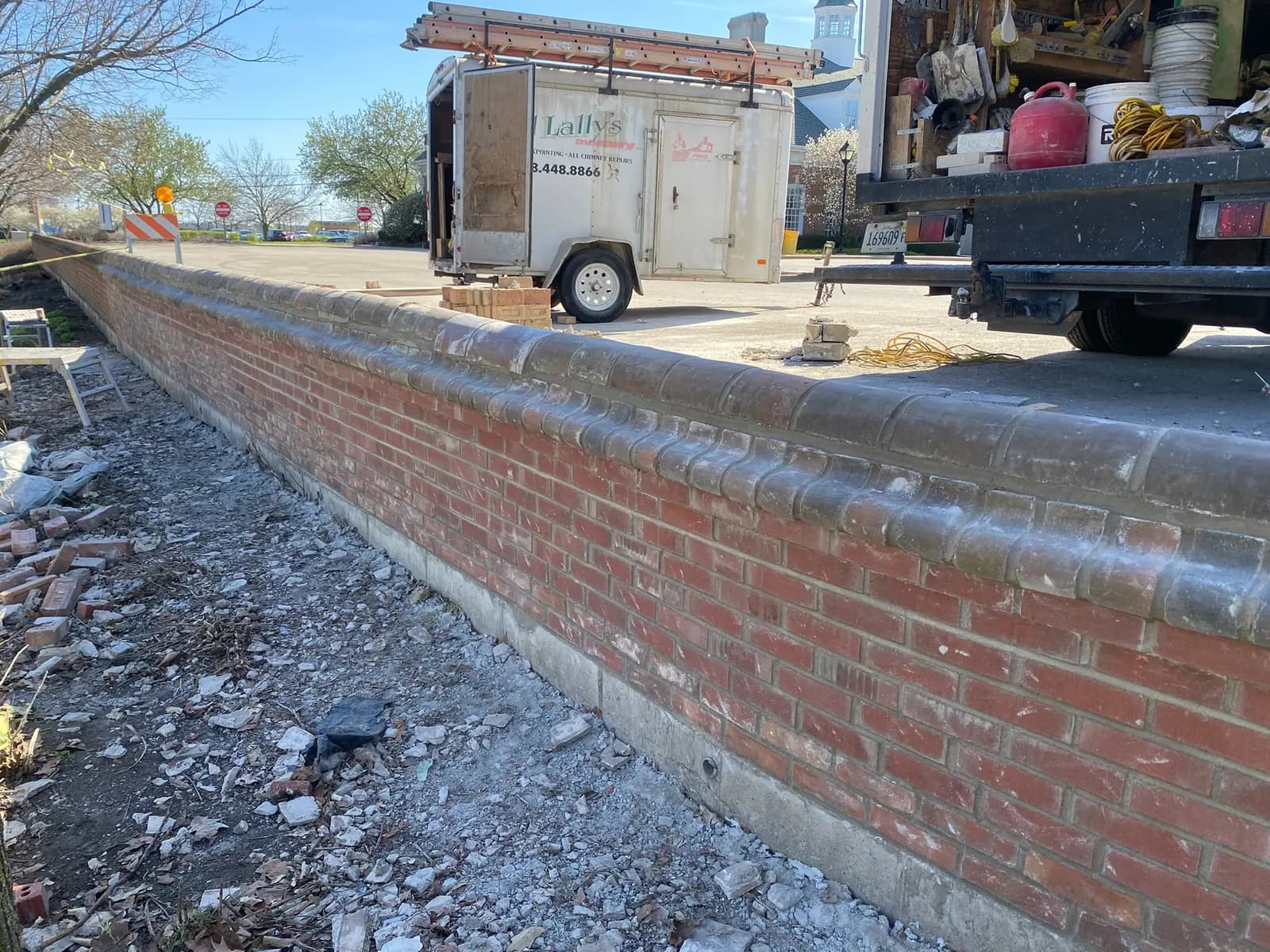
Why the Damage Is Always at Ankle Height
Because five separate forces converge in the lowest eighteen inches of a masonry wall — splash-back off hard surfaces, snow banked against the wall for weeks, road salt crystallizing inside the pores, moisture wicking up from wet soil, and grade or mulch holding water directly against the brick. Four of those five are correctable. Emerald Masonry LLC repairs at-grade masonry across Chicago and the Chicagoland suburbs — family-owned, licensed and insured, career masons with decades of experience, free on-site estimates. Call (708) 288-1696.
Walk any older Chicagoland block in March and you will see the same thing on house after house: sound brick from the windows up, and a band of spalled faces, crumbling joints and crusty white deposits at the bottom.
That is not coincidence and it is not bad brick. It is the wettest, saltiest, slowest-drying zone on the entire building.
The Five Forces
1. Splash-back
Rain hitting a driveway, walkway, patio or even packed soil bounces upward and strikes the wall — typically in the lowest twelve to eighteen inches. Every storm delivers water to that band that never reaches the rest of the elevation.
Hard surfaces make it worse than soft ones. A concrete walk directly against the house is a splash generator.
2. Snow banked against the wall
This is the one people underestimate. Shoveled and plowed snow piled against a foundation sits there for weeks, slowly melting into the masonry and keeping it saturated through repeated freeze cycles. A wall that would dry in a day is instead wet continuously from December to March.
3. Road salt and de-icer
Salt damages masonry by two mechanisms, and both concentrate at grade.
Crystallization pressure. Salt-laden water is drawn into the pores, then crystallizes as the masonry dries. Growing salt crystals exert real pressure inside a porous material — mechanically similar to freezing water, and it happens even when it is not cold.
More wet-freeze cycles. Salt lowers the freezing point, which means the water at the base of your wall spends more time cycling across the phase change rather than staying frozen solid.
The crusty white deposits low on a wall in late winter are usually a combination of efflorescence and salt residue.
4. Moisture from the soil
Masonry below and near grade is in contact with soil that holds water long after a storm. That moisture moves upward through the porous material, keeping the base courses damp from underneath while everything else dries from the face.
5. Grade, mulch and landscaping
The correctable one people create themselves. Soil, mulch or landscape beds piled against the brick hold water directly against the wall permanently and stop it drying. Add grade sloping toward the house and the soil in that zone never drains.
Why All Five Add Up to Spalling
The mechanism is the same one that governs every masonry failure in this climate, just concentrated.
Damage is caused by water being present in the masonry when the temperature crosses freezing. Water expands roughly nine percent as it freezes, and in a saturated brick or joint that expansion breaks the material apart from inside. Chicagoland delivers dozens of those crossings each winter, plus more in the shoulder seasons.
The base courses are simply wetter, more often, for longer, with salt crystallization added on top. Same brick as the rest of the wall — completely different service conditions.
And once the fired face spalls off, it accelerates. The porous body underneath absorbs far more water than the intact face did, so that unit deteriorates faster and starts wetting its neighbors.
Chicago Common Brick Makes It Worse
Worth naming, because it explains why some walls are much worse than others.
An enormous quantity of pre-1940 Chicagoland masonry used Chicago common brick — soft, low-fired, highly absorbent utility brick — behind the face brick and on side and rear elevations. Where it is exposed near grade, it takes on water freely and has very little fired skin to lose.
Bungalow and two-flat water tables are a common casualty: the projecting course at the top of the foundation catches and holds water, and the courses just below it take everything that splashes.
The Same Zone on Other Building Types
The forces are identical; what varies is what they land on.
Concrete block foundations and walls. Block is absorbent through its whole face rather than protected by a fired skin, so it takes on far more water than brick in the same position. At-grade block spalls broadly across the face instead of at the joints, and painted block is worse again because the coating traps what gets in.
Stone foundations. On pre-1940 Chicagoland homes with quarried limestone foundations, the base zone is where mortar washes out of the joints entirely. The stone itself usually survives — the joints do not.
Brick steps, stoops and porch piers. These get everything the wall gets plus direct salting and foot traffic, which is why front steps are frequently the most deteriorated masonry on an otherwise sound house.
Commercial and industrial walls at truck courts. Loading dock aprons and drive aisles take the heaviest de-icer application of any surface on a property, plus impact damage that opens the face and lets everything else in.
Detached garages. No heated interior drying them from behind, minimal roof overhang, and an apron that gets salted all winter. Garages routinely fail at the base years ahead of the house they sit behind.
The One Force You Cannot Remove
Four of the five are correctable. Moisture from the soil is not — the ground next to your foundation holds water after every storm and every thaw, and no amount of drainage work changes that entirely.
What that means practically is that the goal at grade is never a dry wall. It is a wall that dries faster than it wets. Every intervention on the list — extending downspouts, pulling mulch back, regrading, keeping snow off the wall, choosing a vapor-permeable product if any product at all — is aimed at that ratio rather than at eliminating water.
It is also why the single worst thing you can do at grade is apply a film-forming sealer. It slows the wetting slightly and slows the drying enormously, and on the wettest masonry on the building that trade is badly one-sided. Faces spall from behind, which looks exactly like the damage the coating was bought to prevent.
What This Costs Over Time
Worth spelling out, because at-grade damage is chronically deferred as cosmetic.
Year one: a handful of spalled faces and some sandy joints. Repointing plus a dozen replacement units — the cheapest masonry repair available, done from the ground with no staging.
Year five, untreated: the spalled units have been absorbing freely for four more winters, so they have lost depth and started wetting their neighbors. The count has grown, and the joints behind them have opened.
Year ten: loss of section in the lowest courses on a bearing wall stops being a surface repair. On a foundation, this is where masonry work becomes structural work — and structural work at grade means excavation, which is the single largest cost multiplier in this trade.
Meanwhile the same water has been reaching what you cannot see — steel ties in veneer, the inner wythe of solid masonry, and the interior face where efflorescence shows up on the basement wall.
The forces are cheap to interrupt and expensive to ignore, and the gap between those two widens every winter.
What to Look For
- Spalling faces in the lowest two or three courses — flaking, shelling, popping.
- Crumbling or receded mortar joints at the base while joints higher up are sound.
- White crusty deposits, heaviest in late winter and early spring.
- A visible line where damage stops, usually twelve to eighteen inches up.
- Soil, mulch or landscaping sitting against the brick.
- A downspout discharging at the foundation rather than well away.
- Standing water or a low spot along the wall after rain.
- Damaged or eroded parging on a foundation.
- Efflorescence on the interior basement wall in the same area.
What to Fix, in Order
Start with the four you control. They are cheap, and they slow everything else down.
- Move the snow. Shovel away from the foundation rather than against it. This single habit change is free.
- Cut back the soil and mulch. Get them below the top of the foundation with a visible gap of exposed masonry above.
- Extend the downspouts well clear of the wall, and keep gutters clear so they are not overflowing into that zone.
- Correct the grade so it slopes away from the house for the first several feet.
- Use less salt near masonry. Shovel promptly instead, or switch de-icer on walks immediately adjacent to brick.
- Then repair the masonry — repointing, unit replacement, parging — once the water has somewhere else to go.
Doing step six first is how people end up paying for it twice.
How the Repair Is Done
- Free on-site assessment. We identify which of the five forces are active on your wall, and distinguish surface deterioration from foundation movement.
- Correct the water sources, or tell you what to correct.
- Rake out failed joints to sound depth.
- Cut out spalled units, freeing them by cutting the surrounding mortar rather than attacking the brick, so neighbors stay intact.
- Set matched replacements — matched for size, color, texture and, critically, absorption and hardness.
- Repoint with mortar matched to the wall. The governing rule is that mortar must be softer than the brick it holds, so joints take the stress instead of the faces. Type N for most above-grade work, Type S where at-grade and below-grade conditions warrant.
- Parge the exposed foundation where appropriate, to shed water and protect the masonry.
- Breathable protection only, if anything — never a film-forming coating at grade, which traps moisture in the wettest masonry on the building.
Cost Drivers
- Number of units needing replacement and length of joint work.
- Match difficulty, including salvage sourcing on pre-1940 brick.
- Whether parging or drainage correction is part of the scope.
- Access — generally the cheapest zone to work in, since staging is rarely needed.
- Whether the foundation itself needs attention beyond the brick above it.
At-grade work is one of the more affordable masonry repairs precisely because it is reachable from the ground — which makes deferring it a poor trade.
When It Is Not Just Wetting
Distinguish two things, because they need different responses.
Surface deterioration — spalled faces and eroded joints in the courses above grade — is a wetting problem, addressed as above.
Movement — stair-step cracking, horizontal cracking, bowing, or mortar washing out of the foundation itself — indicates soil pressure or settlement and needs proper evaluation before any cosmetic repair. See foundation masonry repair.
Related Services
Brick repair, brick replacement, tuckpointing and repointing, foundation masonry repair and masonry sealing.
The Bottom Line
Your bottom courses are not defective. They are doing the hardest job on the building — wettest, saltiest, slowest to dry, and hit by every storm twice.
Four of the five forces damaging them are things you can change this weekend: where the snow goes, where the mulch sits, where the downspout ends, and which way the ground slopes. Do those, and then repair the masonry knowing the repair will actually last.
Emerald Masonry LLC is a family-owned, licensed and insured masonry contractor serving Chicago and the Chicagoland suburbs led by career masons with decades of hands-on experience in tuckpointing, chimney repair, brick repair and replacement, lintel and parapet repair, foundation and limestone/sill repair, caulking, sealing, and commercial, residential and historic masonry restoration.
Free on-site estimates. Call (708) 288-1696 or request an estimate.
Frequently Asked Questions
Why is only the bottom of my brick wall crumbling?
Because that zone gets wet more often and stays wet longer than anything above it. Splash-back, snow banked against the wall, salt spray, and moisture from the soil all concentrate in the lowest courses, so they enter every freeze-thaw cycle saturated while the wall above has already dried.
Does road salt really damage brick?
Yes, and by two mechanisms. Salt-laden water is drawn into the masonry and then crystallizes as it dries, and those growing crystals exert pressure inside the pores much like freezing water does. It also lowers the freezing point in a way that increases the number of damaging wet-freeze cycles at the base of the wall.
What are the white crusty deposits at the bottom of my wall?
Usually a mix of efflorescence and de-icing salt residue. Efflorescence is mineral salt carried out of the masonry by water and left behind as it evaporates, which proves water is moving through. Heavy crusty deposits low on a wall in late winter typically point to road salt as well.
How high should soil or mulch be against my brick?
Below the top of the foundation, with a visible gap so the masonry above grade stays clear. Soil and mulch piled against brick hold moisture directly against it continuously and prevent the wall from drying — one of the most common and easiest-to-fix causes of base-course damage.
Can I just replace the damaged bricks at the bottom?
You can, and often should, but only after correcting what is keeping that zone wet. Replacing units while splash, salt and standing water keep arriving means the new brick starts on the same clock. Fix the water first, then replace.
Should I seal the bottom of my wall?
Only with a breathable, vapor-permeable product, and only after joints are sound and the water sources are corrected. A film-forming coating at grade traps moisture in the wettest masonry on the building and spalls the faces from behind, which is the opposite of what you wanted.
Is damage at grade a foundation problem?
Sometimes, and it is worth distinguishing. Spalling faces and eroded joints in the courses above grade are usually a wetting problem; stair-step or horizontal cracking, bowing, or mortar washing out of the foundation itself indicate movement or a different water issue that needs proper assessment.
Why does it look worse in late winter?
Because that is when the cumulative damage from the season becomes visible — weeks of snow banked against the wall, repeated salting, and dozens of freeze-thaw crossings all land in those bottom courses. March is when most homeowners first notice it, though the damage accrued all winter.
What does repair at grade cost?
It depends on how many units need replacing, how much joint work is involved, whether parging or drainage correction is needed, and access. Work at grade is generally cheaper than upper-elevation repair because no staging is required. Emerald Masonry gives free on-site estimates.