
Parapet Wall Repair · Blue Island, IL
Parapet Wall Repair in Blue Island, IL — The Only Wall That Gets Wet From Both Sides
A parapet is the only masonry on a building that weathers from the front, the back, and the top at once — and on Blue Island's century-old Western Avenue storefronts it is also the wall nobody has looked at in forty years. That combination is why parapets fail first and fail hardest.
Quick Answer
Emerald Masonry LLC repairs and rebuilds parapet walls in Blue Island, IL — resetting coping, installing through-wall flashing, repointing and rebuilding deteriorated roof-edge masonry on historic storefronts, commercial buildings, churches and multi-unit properties. Family-owned, licensed and insured, career masons with decades of Chicagoland experience. Free estimates: (708) 288-1696.
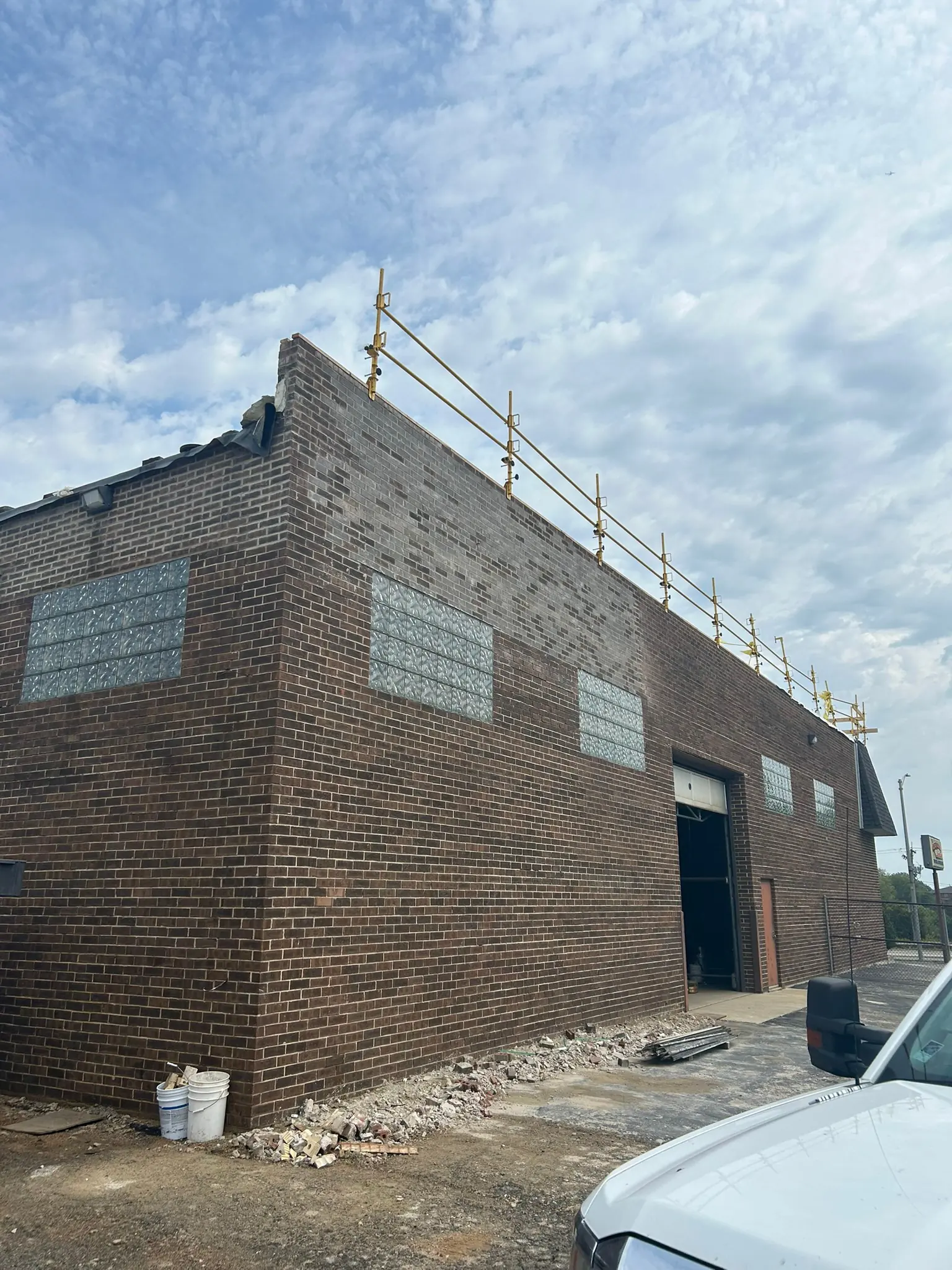
Parapet Wall Repair in Blue Island, IL
Parapet wall repair in Blue Island, IL is the single highest-value masonry repair on most older commercial buildings — and the most neglected. Emerald Masonry LLC repoints, resets and rebuilds parapet walls, coping and roof-edge masonry on storefronts, churches, multi-unit buildings and commercial properties across the south suburbs. Family-owned, licensed, bonded and insured, career masons with decades of Chicagoland experience. Free on-site assessments — call (708) 288-1696.
Why the Parapet Always Fails First
Every other wall on a building has an advantage the parapet does not.
A normal wall has a roof over it, warm building behind it, and one face exposed to weather. It sheds water down and it dries out from behind.
A parapet has nothing over it, nothing behind it, and weather on every surface. It gets wet on the street face, wet on the roof face, and soaked on the top. There is no heated interior to drive moisture out. It sits above the roofline in full wind exposure, freezes harder and thaws slower than the wall below it, and cycles through freeze-thaw dozens of times each Chicagoland winter while the rest of the building barely notices.
Then add the thing that makes it worse: nobody looks at it. A parapet is invisible from the sidewalk and out of mind from inside. On a Blue Island storefront that has changed hands two or three times since 1960, the parapet is frequently the oldest untouched masonry on the property.
Blue Island's Specific Exposure
Blue Island's building stock is unusually parapet-heavy. The Western Avenue commercial corridor and the surrounding historic district are lined with late-nineteenth and early-twentieth-century masonry storefronts — flat roofs, attached party walls, decorative brick cornices, stone and terra cotta trim, and tall street-facing parapets built as much for appearance as for fire separation.
Several factors compound there:
- Age. Much of this masonry predates 1930, which means soft brick, lime mortar, and in many cases no through-wall flashing at all, because it was not standard practice.
- Attached construction. Party-wall and firewall parapets between adjoining storefronts belong to two owners and get maintained by neither.
- Cornices and decorative work. Corbelled brick, projecting bands and stone caps create dozens of horizontal ledges that hold water.
- The rail and industrial corridor. Blue Island grew as a rail town along the Rock Island line and near the Cal-Sag Channel, and decades of that atmosphere sit in the face of a lot of this brick.
- Moisture. Proximity to the Cal-Sag and the low ground along it keeps humidity and ground moisture high.
Signs Your Parapet Needs Work
- Coping joints open, cracked, or with sealant that has pulled loose
- Coping stones or caps loose, rocking, or shifted out of line
- The wall visibly leaning toward the street or toward the roof
- A horizontal crack near the roof line running the length of the wall
- Displaced or missing brick at the top courses
- Spalling and washed-out mortar on the roof-side face — always check this face; it is usually worse than the street face
- Rust staining or a bulge where a steel angle, cornice bracket or tie-back is corroding
- White efflorescence streaking down the interior top-floor wall
- Interior water staining near the roof line that returns after a new roof
Risks of Waiting
Parapet failure is a life-safety issue before it is a maintenance issue. This is masonry standing free, above a public sidewalk, with nothing bracing its top. When a parapet loses cohesion, it does not sag quietly — brick and coping come off the top of the building.
Short of that, the cost curve is steep. An open coping joint lets water into the core of the wall. That water freezes, opens the joint further, saturates the brick, and starts corroding any embedded steel. Corroding steel expands and pushes the wall out of plumb. A leaning parapet cannot be repointed back into position; it has to be taken down and rebuilt. What began as resetting coping and repointing becomes a rebuild with full staging.
And through all of it, water is running down inside the wall into the top floor — where owners often pay for a new roof that does not fix it.
Our Parapet Repair Process
- Inspect both faces and the top, from the roof and from staging, plus the top-floor interior.
- Check plumb and document lean, displacement, and cracking.
- Determine repair versus rebuild for each section, and say so plainly.
- Set up access and protection — staging, sidewalk protection, roof membrane protection, and permits where required.
- Remove and salvage coping, cataloguing original stone or cap units worth resetting.
- Take down deteriorated courses to sound masonry, salvaging usable brick and decorative units.
- Install through-wall flashing at the parapet base with proper end dams and drainage where the rebuild depth allows.
- Rebuild in matched brick and compatible mortar, holding the original coursing, bond and profile.
- Reset coping on a proper bed with correct pitch and joints detailed to shed water rather than hold it.
- Repoint remaining sound masonry, seal the coping joints with an appropriate sealant, and tie the work into the roof membrane and counterflashing.
- Walk the finished work with the owner or manager and document it.
Materials
Compatibility governs. On Blue Island's pre-1930 commercial masonry that generally means a soft, lime-rich mortar rather than a hard Portland mix — a hard mortar in a soft historic wall pushes stress into the brick faces and spalls them. Coping is limestone, cast stone, precast concrete or clay units depending on the building; salvaged original coping is almost always preferable to a modern substitute. Flashing should be a durable metal or membrane detailed with end dams. Sealants at coping joints are a wear item and should be specified as such.
Parapet work rarely travels alone. It commonly runs with commercial masonry restoration, tuckpointing, lintel repair at storefront openings, limestone and sill repair on trim and cornice stone, and caulking and joint sealant.
What Drives the Cost
- Access — this is usually the largest line item, especially over a public sidewalk
- Height and linear footage of parapet
- Repair versus rebuild, and how many courses come down
- Coping — salvage and reset, or replace
- Flashing installation, which requires opening the wall
- Decorative masonry and matching of corbelled or ornamental work
- Permits, protection and pedestrian control
- Roof coordination with the membrane and counterflashing
We provide free written assessments and can phase work by elevation so an owner or board can budget it.
Serving Blue Island and the South Suburbs
Emerald Masonry LLC is a family-owned, licensed and insured masonry contractor serving Chicago and the Chicagoland suburbs led by career masons with decades of hands-on experience in tuckpointing, chimney repair, brick repair and replacement, lintel and parapet repair, foundation and limestone/sill repair, caulking, sealing, and commercial, residential, and historic masonry restoration. Free on-site estimates — call (708) 288-1696.
We work throughout Blue Island and neighbouring Alsip, Midlothian, Oak Forest and Evergreen Park, for property managers, building owners, HOAs, churches and insurance companies. $5,000 project minimum.
Get a Free Blue Island Parapet Assessment
If your coping is loose, your top-floor ceiling stains after every hard rain, or your parapet is out of plumb, have it assessed now rather than after a piece of it lands on the sidewalk. Call (708) 288-1696 or request a free estimate.
Ready to get started?
Free on-site estimates for commercial and large-scale projects.
Parapet Wall Repair in Blue Island, IL — Frequently Asked Questions
How much does parapet wall repair cost in Blue Island, IL?
Access usually drives the number more than the masonry does. Reaching a roof-edge wall on a two-story Western Avenue storefront over a public sidewalk means staging, protection and often permitting before a single brick is touched. Emerald Masonry provides a free on-site assessment and a written scope so an owner or board can see what is masonry cost and what is access cost.
How do I know if my parapet needs repair or a full rebuild?
Repointing works while the wall is still plumb, the brick is largely sound, and the coping is intact. Once the wall leans, the top courses have lost bond, or the brick has spalled through, rebuilding the top section is safer and usually cheaper than repointing it twice. A wall that is visibly out of plumb should be evaluated promptly.
What is through-wall flashing and why does my parapet need it?
Through-wall flashing is a continuous waterproof membrane built into the masonry near the base of the parapet, which catches water traveling down inside the wall and directs it back out. Many Blue Island buildings from the early 1900s were built without it. Rebuilding a parapet without installing it means the same water path stays open.
Water is coming into my top floor near the roof edge. Is that the roof or the parapet?
Very often the parapet, not the membrane. Water entering through open coping joints or failed parapet masonry runs down inside the wall and appears well below the roof line, which is why parapet leaks get repeatedly misdiagnosed as roofing problems and re-roofed without ever being fixed.
Do you repair parapets on historic Western Avenue storefronts?
Yes. Blue Island's older commercial masonry is soft brick laid in lime-rich mortar, and it needs a compatible soft mortar rather than a hard modern mix. We also salvage and reset original coping and decorative brick where it is sound, because matching century-old detailing is difficult and the original material is usually better than anything available new.
Who is responsible for a shared parapet between two attached buildings?
On attached storefronts the parapet is often a shared or party wall, and responsibility depends on the deed, any party-wall agreement, and how the wall is actually constructed. We document the condition and the construction so owners have something factual to work from, and we can coordinate work across both properties.
Do you work with property managers and commercial owners in the south suburbs?
Yes. We work with property managers, building owners, HOAs, churches and insurance companies throughout the south and southwest suburbs, and we scope parapet work by elevation so it can be phased across budget years where a full rebuild is not immediately affordable.
Parapet Wall Repair in Nearby Areas
Other Masonry Services in Blue Island, IL
Learn more about our parapet wall repair services across Chicagoland, or view all service areas.