
Commercial Tuckpointing · Lemont, IL
Commercial Tuckpointing in Lemont, IL — Limestone Town, Limestone Rules
Lemont was built out of the stone under it. That makes repointing here a different job than repointing a brick building twenty minutes east — and the wrong mortar does permanent damage.
Quick Answer
Emerald Masonry LLC provides commercial tuckpointing in Lemont, IL — repointing brick and native limestone on downtown storefronts, canal-corridor industrial buildings, and multi-unit properties, using mortar matched in type and softness to the existing masonry. Licensed, bonded and insured; COI, W-9 and lien waivers on request. Call (708) 288-1696.
Most Chicagoland suburbs are brick towns. Lemont is a stone town, and it is stone because the stone was directly underneath it.
The quarries along the canal supplied the pale dolomitic limestone — sold nationally as Athens marble — that built a great deal of nineteenth-century Chicago and most of Lemont's own downtown. Which means commercial tuckpointing in Lemont, IL frequently is not a brick job at all, and treating it like one causes damage that cannot be undone.
Emerald Masonry LLC is a family-owned commercial masonry contractor serving Chicago and the Chicagoland suburbs, led by career masons with decades of hands-on Chicagoland experience, in commercial tuckpointing, façade and parapet repair, lintel replacement, chimney and stack rebuilds, CMU block repair, brick repair and replacement, foundation and limestone/sill repair, caulking, sealing, and commercial, residential and historic masonry restoration. Free on-site assessments — call (708) 288-1696.
The rule that governs every joint in this village
Mortar must always be softer than the units it surrounds.
Mortar is the sacrificial element in a masonry wall. It is designed to take the movement and the weathering so the stone or brick does not have to, and to be renewed periodically — that is what repointing is.
Reverse that relationship and the wall destroys itself. Put a hard, Portland-heavy modern mortar around soft native limestone, and when the building moves, the stress has nowhere to go but into the stone. The faces spall. And unlike a joint, a spalled limestone face does not get renewed — it gets cut out and patched, or the unit gets replaced with stone that will never quite match a hundred and forty years of weathering.
This is the single most common way well-meant repairs ruin historic Lemont buildings, and it is why the mortar specification matters more here than the price per square foot. Our guide to lime versus Portland mortar covers the chemistry.
Where the commercial work is
The downtown historic core. Nineteenth-century limestone and brick commercial buildings along Main and Stephen Street and the blocks around them — storefronts, upper-floor apartments, and civic buildings, many of them with original stone that has been standing since the quarry era. Joint width, tooling profile, mortar colour and sand all read as part of the building's character on these elevations, and the work is slower and more exacting than a modern wall.
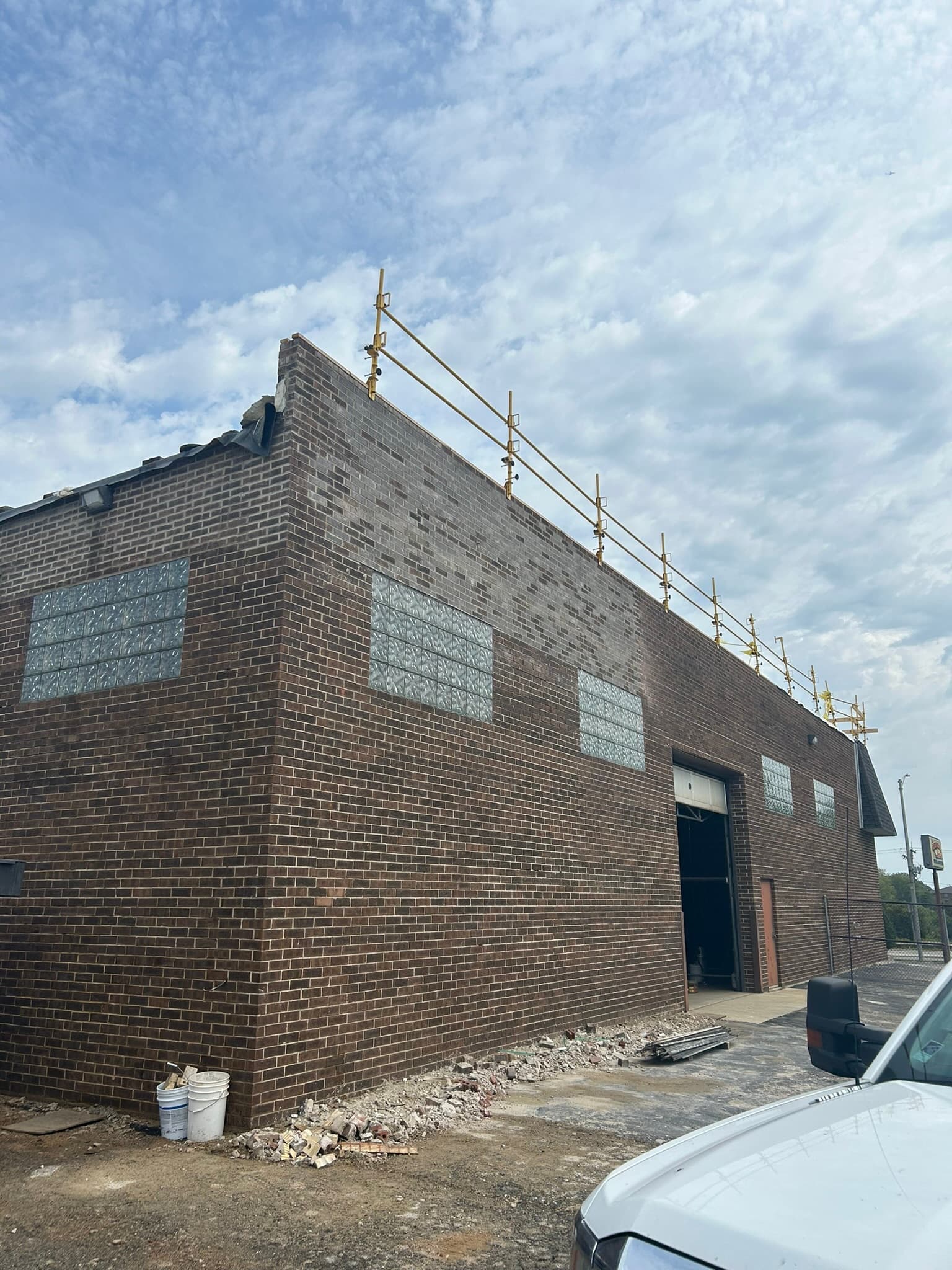
The canal and Sanitary & Ship Canal corridor. Industrial and warehouse buildings along the old I&M alignment and the working canal — long brick and block elevations, loading openings, and the uniform weathering that comes with a hundred feet of unbroken wall facing the same weather.
The Archer Avenue and State Street commercial stretches. Mid-century and later retail and service buildings, storefront returns, and flat roofs with parapets above.
Multi-unit and mixed-use. Upper-floor residential over ground-floor commercial in the downtown, where the board or owner and the tenant have different priorities and the scope has to serve both.
The newer Lemont Road and 127th Street commercial corridor, where the buildings are veneer and the issues are sealant, expansion joints, weeps and flashing rather than wholesale repointing.
Signs a commercial elevation is due
- Joints you can rake out with a key — soft, sandy, or receded well behind the face
- Missing mortar leaving open joints, particularly at the top of the wall and around openings
- Spalling or delaminating stone faces, which on limestone lifts in sheets along the bedding planes
- Efflorescence — white mineral bloom indicating water actively moving through the wall
- Step cracking through the joints
- Rust staining below a window or door head, meaning a steel lintel is corroding
- Damp interior walls or tenant complaints on the weather elevation
- Previous repairs in obviously hard grey mortar, which is often the reason the stone beside them is failing
How we do the work
- Assess elevation by elevation and state square footages separately — deterioration is never uniform, and one elevation is usually years ahead of the rest.
- Establish the existing mortar — type, softness, colour, sand — before proposing a replacement.
- Cut the joints back to a depth that lets the new mortar key in, cleanly and without over-cutting into the units. Depth is invisible in a proposal and decisive in the result.
- Build a mock-up panel and let it cure and dry before approval, so colour, profile and match are agreed as a physical standard. See mock-ups and test panels.
- Repoint with matched mortar, tooled to the existing profile.
- Repair or replace failed units — brick or stone — matched in size, colour and texture.
- Address the water sources feeding the wall: coping, flashing, sealant, downspouts.
- Clean down with the gentlest effective method. No sandblasting and no high-pressure washing on historic stone — both strip the weather-resistant outer skin permanently. See why sandblasting damages brick.
What drives the cost
Elevation area and height. Access — ground reach, lift, or scaffolding. Whether the masonry is brick or native limestone, since stone work is slower and the matching harder. Joint condition and how much has to be cut. Unit repair and replacement volume. Whether the building is in the historic downtown and the work is subject to review. Overhead protection where the public passes beneath. Whether work must happen outside trading hours. Weather windows, since mortar needs workable temperatures to cure properly.
Free on-site assessment and a written scope with the work broken out per elevation — call (708) 288-1696.
Working with Emerald
Emerald Masonry LLC is family-owned, established 2024 and led by career masons with decades of hands-on Chicagoland experience. Licensed, bonded and insured, non-union, with COI, W-9 and lien waivers on request. We work with owners and facility teams through our commercial masonry practice, with managed portfolios through property manager services, and alongside builders through our general contractor partnerships.
Related services: tuckpointing and repointing, historic masonry restoration, limestone and sill repair, brick repair, and commercial masonry restoration.
For the material itself, see our guide to Athens marble and Chicagoland limestone.
Get the mortar specified before the price
On a Lemont building, the mortar decision outlives everyone who makes it.
Request a free on-site assessment — or call (708) 288-1696.
Ready to get started?
Free on-site estimates for commercial and large-scale projects.
Commercial Tuckpointing in Lemont, IL — Frequently Asked Questions
How much does commercial tuckpointing cost in Lemont, IL?
It is priced by scope. The drivers are elevation area and height, access and staging, the ratio of repointing to unit repair, whether the masonry is brick or native limestone, and whether the building sits in the historic downtown where the work is more exacting. Emerald Masonry provides a free on-site assessment and a written scope.
Why does limestone need different mortar than brick?
Because mortar must always stay softer than the units around it. Lemont's native limestone is set in soft, lime-rich historic mortar, and a hard modern Portland mix will not flex with the wall — so the stress goes into the stone instead, spalling faces that cannot be replaced.
Is repointing a historic downtown building different?
Materially, yes. Joint width, tooling profile, mortar colour and sand all read as part of the building's character on a nineteenth-century storefront, and they are frequently subject to review. The work is slower, more exacting, and should be approved against a mock-up panel before production starts.
Can you work while our tenants stay open?
Yes — occupied and trading is the normal condition on commercial work here. Staging, access and noisy operations are planned around business hours and customer entrances, with overhead protection wherever the public passes beneath, and the sequence agreed in writing before mobilisation.
How do we know whether our building needs spot repointing or a full elevation?
An assessment, not a guess. Deterioration is rarely uniform — one elevation is usually years ahead of the others — so a good scope states square footages per elevation and separates what is due now from what can reasonably wait a cycle.
Do you provide a COI and lien waivers?
Yes. Emerald Masonry LLC is licensed, bonded and insured, and provides a certificate of insurance, W-9 and lien waivers on request before work begins — which is what most owners and managers need in the vendor file anyway.
Commercial Tuckpointing in Nearby Areas
Other Masonry Services in Lemont, IL
Learn more about our commercial tuckpointing services across Chicagoland, or view all service areas.