
Commercial Masonry Restoration · Chicagoland, IL
Storm Damage or Wear and Tear? How Masonry Actually Tells You Which One It Is
Insurance pays for sudden events and excludes things wearing out — so on a masonry claim, everything turns on which one the wall is showing. The good news is that masonry keeps a fairly honest record.
2026-08-27
Quick Answer
Storm damage to masonry and long-term deterioration leave physically different evidence. Sudden damage shows fresh clean fracture faces, displaced units, directional and elevation-specific patterns, and debris consistent with a single event; weathering shows rounded eroded joints, sandy mortar, spalled faces, efflorescence and uniform distribution by exposure. Documenting which is present, and where they overlap, is what supports an accurate claim. Emerald Masonry LLC documents masonry damage for Chicagoland owners and carriers — (708) 288-1696.
Property insurance is built on a single distinction: it pays for things that happen and excludes things that wear out. On a roof that distinction is often obvious. On masonry it is not — which is why so many masonry claims turn into an argument, and why the argument is usually settled by physical evidence rather than opinion.
The useful news for owners, managers and adjusters is that masonry keeps a fairly honest record. A wall that failed in an hour looks materially different from a wall that failed over thirty winters, and the differences are readable if somebody gets close enough to read them.
Emerald Masonry LLC documents and repairs masonry damage for owners, property managers, associations and insurance carriers across Chicago and the Chicagoland suburbs, led by career masons with decades of hands-on Chicagoland experience. Licensed, bonded and insured; COI, W-9 and lien waivers on request. Free on-site assessments — call (708) 288-1696.
To be clear about roles: we establish what failed, by what mechanism, and where. Coverage is determined by your policy and your insurer. We do not promise claim outcomes, and a contractor who does should worry you.
The Physical Tells
Fracture faces
The single most useful indicator. A brick or stone broken by sudden force leaves a clean, sharp, unweathered fracture face — often a different colour from the exposed surface, because it has never seen weather. A unit that failed through freeze-thaw shows rounded, dirty, weathered break edges that have been exposed for seasons.
Mortar condition at the failure
Impact and wind break the bond while frequently leaving the mortar itself hard. Deterioration leaves mortar sandy, powdery and receded — you can rake it out with a key. Hard mortar with a broken bond points to an event; soft mortar points to time.
Pattern and direction
Storm damage is directional. It concentrates on the elevation and roof slope facing the wind, aligns with a debris path, and often shows a strike point. Weathering is exposure-driven — worst on south and west faces, at parapets, chimneys and base courses, distributed across the whole building rather than concentrated along a line.
Displacement vs. erosion
Sudden events move masonry: units displaced, coping shifted, a stack toppled or rotated. Deterioration removes material gradually — joints recede, faces spall, profiles round off. A displaced coping stone with sound bedding mortar underneath is a very different finding from one sitting on crumbled mortar.
Efflorescence and staining
White salt bloom and established staining tracks take time to develop. Their presence at a failure point indicates water has been moving through that masonry well before the event in question. Their absence at a fresh break supports a sudden cause.
Biological growth and dirt
Moss, algae and accumulated soiling in a crack or on a fracture face mean the opening predates the storm by a long way.
Debris and where it landed
Fresh debris in a distinct pattern — on a roof slope, in a valley, across a walkway — is event evidence. Mortar crumbs accumulated in a gutter over years are not.
Side by Side
| Evidence | Points to a sudden event | Points to deterioration | |---|---|---| | Fracture face | Clean, sharp, unweathered | Rounded, dirty, weathered | | Mortar at the break | Hard, bond broken | Sandy, receded, crumbling | | Pattern | Directional, localised, follows a strike or wind path | Exposure-driven, distributed, worst at parapet/base | | Masonry position | Displaced, rotated, missing | In place but eroded and spalled | | Efflorescence | Absent at the break | Present, established | | Growth/soiling in cracks | Absent | Present | | Debris | Fresh, patterned, dated to the event | Accumulated over seasons | | Interior symptoms | New, sudden onset | Recurring, historically reported |
Most Buildings Show Both
This is the part that gets flattened in adversarial claims, and it should not be. The common real-world case is a building with long-standing deterioration on which a storm caused specific, identifiable damage — a weakened chimney that a wind event finally brought down, or a parapet with eroded joints that lost three courses in a gust.
A competent assessment separates them by location and mechanism rather than characterising an entire elevation one way. That produces an accurate scope, which serves the owner, the adjuster and the eventual repair better than an all-or-nothing characterisation that neither side can defend.
It is also why maintenance matters to claims. An insurer examining whether pre-existing condition contributed has a much harder argument against a building with documented upkeep than one with a decade of visible neglect.
Element by Element: What the Evidence Usually Looks Like
Chimneys and stacks
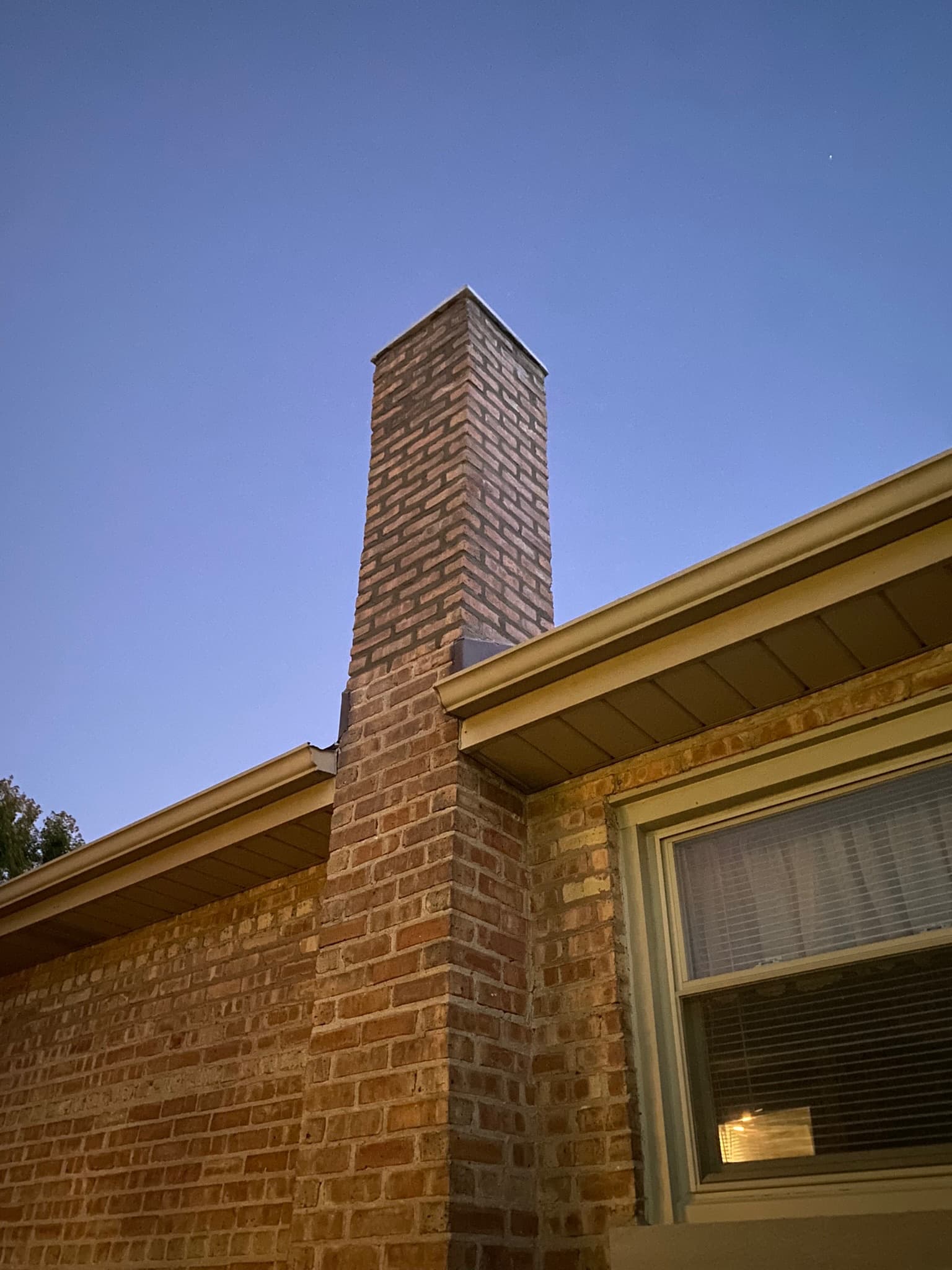
The most common masonry claim in this region. A wind-toppled stack shows displacement or rotation, clean breaks at the failure course, and debris in a directional pattern on the roof or ground. A stack that failed by deterioration shows sandy joints throughout, spalled faces, a cracked crown that has been feeding water down the flue for years, and material loss without displacement. Many real cases show a deteriorated stack that a storm finished — and the assessment should say exactly that.
Parapets and coping
Storm evidence is shifted or missing coping units with sound bedding mortar underneath, or a section pushed out of plane along the wind path. Deterioration evidence is open coping joints, eroded bedding mortar, efflorescence on the back face, and a wall that has gone gradually out of plumb.
Brick faces
Hail and impact leave fresh, localised, directional damage on exposed elevations, with clean fracture faces and dust rather than weathered residue. Freeze-thaw spalling is distributed by exposure, concentrated in the base courses and on wet elevations, with faces that have clearly been off for some time.
Lintels and openings
Almost always deterioration. Rust jacking — corroding steel expanding and lifting the masonry above it — is a multi-year process, and the orange staining, opened horizontal joint and lifted course all develop slowly. A storm rarely damages a lintel; it may expose one that had already failed.
Interior symptoms
New and sudden water intrusion after a documented event supports a claim. Recurring intrusion, historic stains, and previously reported complaints indicate an existing path — and property management records frequently settle this question faster than the wall does.
What Drives the Cost of the Repair
Separate from coverage, the repair itself is priced on the usual masonry variables:
- How far the compromised area extends beyond what is visible — always the largest unknown
- Whether an element must be rebuilt rather than repaired, and how far down it reaches
- Access — chimney and parapet work means staging or a lift
- Emergency stabilisation and temporary protection carried out before permanent repair
- Match difficulty for brick, stone and mortar on older buildings
- Overhead protection where the element stands over a walkway or entrance
- Season, since mortar needs above-freezing conditions and an open wall cannot always wait
We do not price storm damage from photographs. The on-site assessment is free and the written scope is formatted to go straight to ownership or an adjuster.
What to Do in the First 48 Hours
- Make it safe. Cordon anything that could fall — over a sidewalk, entrance, patio or parking stall. This precedes everything.
- Photograph before anything moves. Multiple distances and angles, debris where it landed, the direction of fall, interior damage, timestamps. Cleanup destroys evidence permanently.
- Protect against further damage. Temporary tarping and covering of open masonry. Most policies expect reasonable steps to prevent additional loss, and in this climate an open wall deteriorates fast.
- Keep receipts for emergency work and materials.
- Notify the insurer promptly — policies contain notice requirements.
- Get a masonry assessment, from staging or a lift rather than the ground.
- Do not start permanent repairs before the claim position is established, beyond what safety and mitigation require.
- Read anything before signing it, particularly documents that assign claim benefits.
What Our Documentation Package Contains
- What failed, specifically and by location, mapped to elevations
- The mechanism — sudden, gradual, or both, with the physical evidence for each
- Photographs tied to locations, at multiple scales
- What is unstable and requires immediate stabilisation
- The correct repair — repair, partial rebuild or full rebuild — and why
- A written scope with quantities and stated assumptions, priceable and comparable
- Where deterioration and event damage overlap, stated plainly rather than blurred
That last line is the one adjusters tell us they see least often, and value most.
Build the Baseline Before You Need It
The cheapest thing an owner or board can do for a future claim costs nothing but an afternoon:
- Dated photographs of every elevation, the parapet and the chimneys, every year or two
- Written inspection reports kept with the property records
- Invoices and scopes from prior masonry work, including the mortar specification
- A record of maintenance — tuckpointing cycles, sealant renewal, gutter clearing
That file is what turns "the wall was fine before the storm" from an assertion into evidence. For associations it also supports the reserve conversation, as covered in HOA masonry maintenance budgets.
Chicagoland Context
The region produces both halves of this problem generously. Straight-line wind events, derechos, spring and summer hail, and severe thunderstorm gusts supply the sudden causes, and they hit chimneys and parapets hardest because those are the most exposed, least supported masonry on any building.
Meanwhile the climate supplies the gradual cause continuously: dozens of freeze-thaw cycles each winter, water entering a joint, freezing, expanding roughly nine percent, and forcing the masonry apart — the mechanism set out in freeze-thaw masonry damage in Chicago. Add a century of soft common brick and lime mortar across the older stock, plus heavy de-icing salt at grade, and most Chicagoland buildings carry real deterioration before any storm arrives.
Which is precisely why the separation has to be done building by building, on evidence.
Related Reading and Services
- Masonry insurance claims in Illinois — coverage categories and working through a claim
- Post-storm masonry inspection checklist — what to walk immediately
- Emergency masonry: brick fell off the house — first response
- Commercial masonry restoration and insurance restoration work
- Chimney repair and parapet wall repair — the two elements most claims involve
The Short Version
Insurance separates events from wearing out, and masonry records the difference honestly if you look closely enough. Clean fracture faces, hard mortar with broken bond, directional patterns and displaced units point to an event. Rounded erosion, sandy mortar, efflorescence, growth in cracks and exposure-driven distribution point to time.
Most buildings show both. The job of an assessment is not to pick a side — it is to say precisely which is where, and let the policy and the adjuster do the rest.
Emerald Masonry LLC is a family-owned commercial masonry contractor serving Chicago and the Chicagoland suburbs, led by career masons with decades of hands-on Chicagoland experience, in commercial tuckpointing, façade and parapet repair, lintel replacement, chimney and stack rebuilds, CMU block repair, brick repair and replacement, foundation and limestone/sill repair, caulking, sealing, and commercial, residential and historic masonry restoration. Free on-site assessments — call (708) 288-1696.
Dealing with storm-damaged masonry, or a claim where the cause is disputed? We will document what actually failed and put it in writing. Request a free on-site assessment or call (708) 288-1696.
Frequently Asked Questions
How do you tell storm damage from ordinary deterioration on masonry?
By the physical evidence. Sudden damage leaves clean, sharp fracture faces, displaced or missing units, and a pattern that follows the storm's direction; deterioration leaves rounded, eroded joints, sandy mortar, spalled faces and efflorescence, distributed by exposure rather than by direction.
Will insurance cover my chimney if it came down in a storm?
Windstorm is a covered peril under most property policies, so a chimney toppled in a documented storm is commonly a payable claim. Insurers may still examine whether pre-existing deterioration contributed, which is why maintained masonry and dated photographs strengthen a claim considerably.
Why was our masonry claim denied as wear and tear?
Because the evidence read as gradual. Eroded joints, spalled brick faces and freeze-thaw damage accumulate over many seasons, and standard policies exclude wear, deterioration and inherent vice — so those findings generally fall outside coverage regardless of when they were noticed.
Can a building have both storm damage and pre-existing deterioration?
Very often, and that is the normal case rather than the exception. A competent assessment separates them by location and mechanism instead of characterising the whole elevation one way, which is what allows an accurate scope and a defensible claim.
What should we photograph after a storm?
Everything, before anything is moved — the damage from multiple distances and angles, debris where it landed, the direction it fell, interior damage, and the date. Once cleanup starts that evidence is unrecoverable.
Does a contractor decide whether our claim is covered?
No. Coverage is determined by your policy and your insurer. A contractor's role is to establish and document what physically failed, by what mechanism and where, and to price the repair — anyone promising a claim outcome is out over their skis.
How quickly should we act after storm damage to masonry?
Immediately for safety and temporary protection, and promptly on notice to the insurer. Damaged masonry with an open water path deteriorates fast in Chicagoland's freeze-thaw cycling, so delay converts a contained claim into a much larger repair.
Do baseline photos really help?
Considerably. Dated photographs and prior inspection reports showing sound masonry before an event are the cleanest way to establish that the damage was not pre-existing, and they cost nothing to take.
What is 'ensuing damage' on a masonry claim?
It is damage that follows from a covered event even where the initial cause is excluded — for example, interior water damage after a storm opens a wall. Whether it applies depends on your specific policy language, so it is a question for your insurer or adjuster rather than a contractor.