
Commercial Masonry Restoration · Chicagoland, IL
Struck Masonry: Loading Docks, Bollards, Garage Corners, and the Repairs That Actually Hold
Weather damages masonry slowly and predictably. A truck damages it in one second — and the repair is a different job, because the wall will be hit again.
2026-08-26
Quick Answer
Vehicle impact damage to masonry differs from weather damage because the force is instantaneous and will recur, so a repair that only replaces broken units fails again. Correct repair means assessing displacement beyond the visible break, rebuilding to sound bonded masonry, and adding protection — bollards, corner guards, dock bumpers — so the same strike does not repeat. Emerald Masonry LLC repairs struck masonry across Chicagoland — (708) 288-1696.
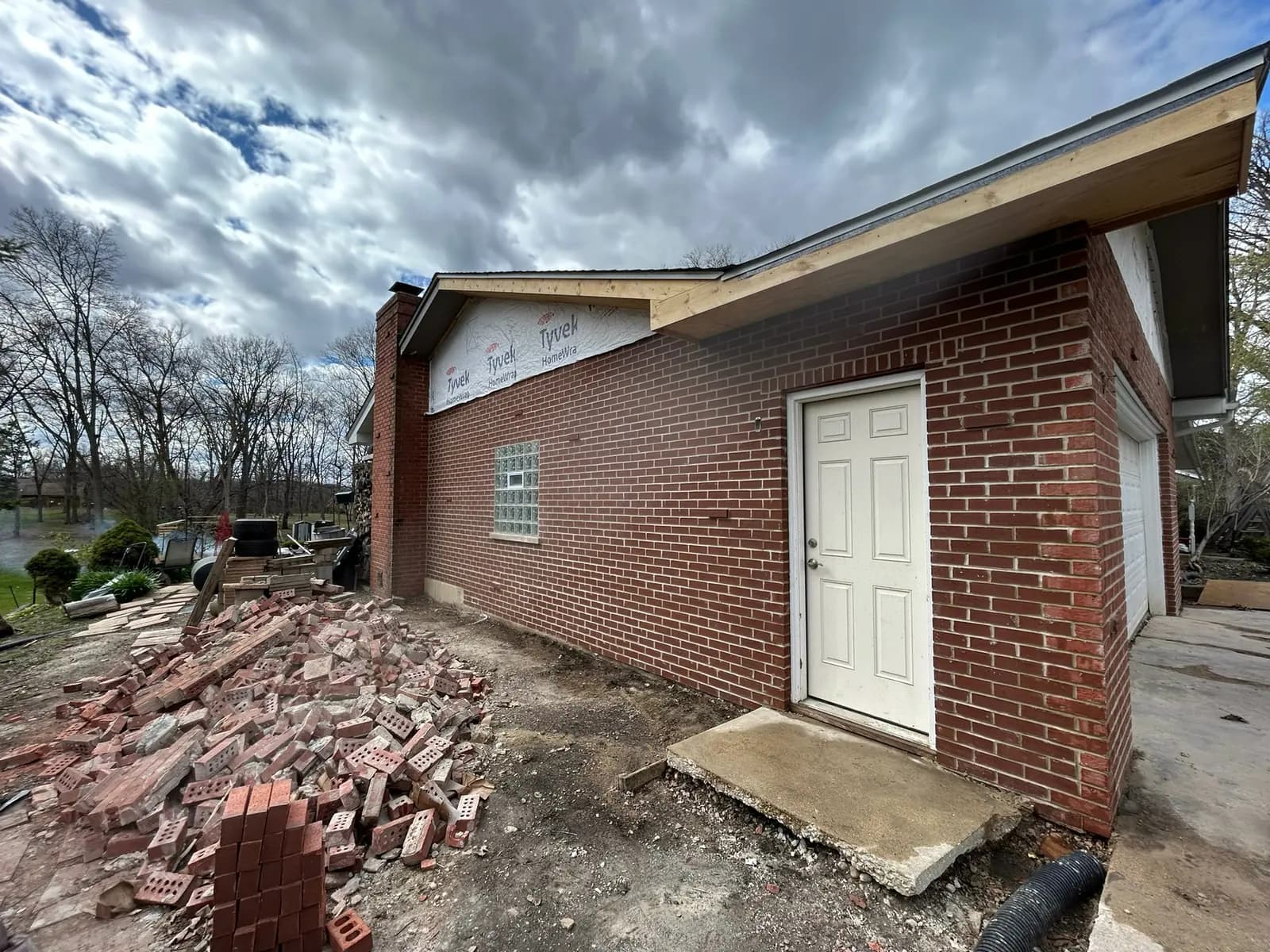
Most masonry damage arrives slowly. Water gets into a joint, freezes, expands about nine percent, and does a fraction of a millimetre of harm — a few dozen times a winter, for decades.
Vehicle impact does not work that way. It delivers everything at once, into one spot, in a direction masonry was never designed to resist. And it has a property that weather damage does not: it is going to happen again, in the same place, for the same reason.
Emerald Masonry LLC repairs struck and impact-damaged masonry on commercial, industrial and multi-tenant properties across Chicago and the Chicagoland suburbs, for owners, property managers and insurance carriers. Family-owned, licensed, bonded and insured, career masons with decades of experience, free written on-site assessments. Call (708) 288-1696.
Why Impact Damage Behaves Differently
Masonry is strong in compression and weak in almost everything else. It handles the steady vertical load of a building beautifully and resists lateral shock poorly.
When a vehicle strikes a wall, three things happen at once:
Units break at the point of contact. Obvious, visible, and the part everyone photographs.
The force travels outward through the assembly. Mortar bonds are broken well beyond the break — sometimes several feet, sometimes into the course above or the wythe behind — leaving units that look perfectly intact and are no longer bonded to anything.
The wall may move. Even a small permanent displacement changes how load transfers, and a section pushed out of plane does not go back on its own.
That third item is why "just replace the broken bricks" is the wrong instinct. You would be rebuilding the visible part of a larger problem, and leaving loose masonry in a wall over a door people walk through.
Where It Happens
Loading docks
The highest-frequency location by a distance. Trailers back in dozens of times a week against a fixed masonry edge, guided by mirrors and a spotter who may or may not be there. Dock walls, bumper mounts, the masonry between doors, and the corners at the approach all take repeated contact.
Overhead door jambs
Forklifts, box trucks and delivery vehicles clip the jamb going in or out. Damage concentrates at the strike height and works outward, and repeated minor contact does cumulative harm that nobody logs until a course is loose.
Building corners and pilasters
Drive aisles that turn tight against a building produce corner damage that is both structural and highly visible from the street.
Garage entries and parking structures
Columns, wing walls and the masonry flanking an entry, hit by drivers misjudging clearance.
Freestanding masonry
Piers, entrance monuments, planters, trash enclosure walls and bollard-less bumpers in parking fields. These take the most damage per strike because there is no building mass behind them to absorb it.
Storefronts
Vehicle-into-storefront incidents damage masonry piers, the sill and knee wall, and frequently the lintel or header above the opening.
Telling Impact Damage From Weather Damage
This matters more than it sounds, because the two need different repairs — and on an insurance claim they fall on opposite sides of the covered-peril line. Weather deterioration is generally excluded as wear and tear; a documented vehicle strike generally is not.
| | Impact damage | Weather deterioration | |---|---|---| | Pattern | Concentrated at one point, radiating outward | Distributed across an elevation | | Height | Clustered at bumper or trailer height | Worst at the base course, parapet and chimney | | Brick condition | Units cracked clean through, sometimes displaced | Faces spalled and flaking, units softened | | Mortar | Bond broken, joints fractured, mortar often still hard | Mortar sandy, receded, crumbling to powder | | Cracking | Radiates from a point; often stepped and sudden | Follows joints gradually, widens over years | | Onset | Between one inspection and the next | Progresses over seasons | | Exposure logic | Matches the drive aisle, not the weather | Worst on south and west faces |
Two practical tells. Hard mortar with broken bond is the signature of impact — weather leaves mortar soft, impact leaves it intact but no longer stuck to anything. And damage that ignores exposure — a battered north-facing dock wall while the west elevation above it is fine — is telling you the cause is on the ground, not in the sky.
Buildings often have both, layered. A dock wall gets struck, the opening admits water, and freeze-thaw then works on the same area for two winters. The scope has to name which is which.
Assessing a Strike Properly
- Make it safe first. Cordon off anything overhead or unstable. Displaced masonry above a dock, door or walkway is a falling hazard, not a scheduling item.
- Document before anything is touched — photographs from multiple distances and angles, with scale, plus the strike height and direction. On an insurance claim this record is the whole conversation, as covered in masonry insurance claims in Illinois.
- Sound the wall well beyond the break. Tapping finds the drummy, hollow note of debonded units that look fine. This step defines the real scope.
- Sight along the wall for displacement, bowing or a course pushed out of plane.
- Look for radiating cracks — step cracks running up and away from the impact point.
- Check the openings. A strike near a door or window can shift bearing or deflect the lintel above it.
- Check the inside face where accessible, and any attached structure.
- Involve a structural engineer where the wall is load-bearing, has moved, or where a column or pilaster was struck.
The Repair
- Shore where required, particularly at openings and load-bearing elements.
- Remove to sound, bonded masonry — the boundary established by sounding, not by what looked broken.
- Assess and address embedded steel — lintels, shelf angles, ties, reinforcement in block.
- Rebuild with matched units. Modern block and current-production brick usually match well; older or discontinued brick may need reclaimed stock, and salvage from a concealed elevation remains an option on some buildings.
- Match the mortar for colour, sand, texture and joint profile — and for hardness relative to the units, since a mix harder than the brick makes the brick the sacrificial element.
- Restore control joints and movement joints correctly rather than mortaring across them.
- Restore flashing and drainage disturbed by the removal.
- Then add protection — which is the step that decides whether you do this again.
Protection: The Part That Makes the Repair Permanent
Rebuilding struck masonry without addressing why it was struck is buying the same repair twice.
- Bollards — properly embedded pipe bollards at the vulnerable points. Depth and footing matter enormously; a shallow-set bollard transfers the impact into the slab and becomes its own repair.
- Dock bumpers — replaced when compressed or torn. They are consumable, and a worn bumper is the cheapest thing on the property to renew and the most expensive to ignore.
- Corner guards — steel angle or formed guards at building corners and door jambs, anchored into masonry correctly rather than into the brick face. Anchoring rules are covered in anchoring into brick.
- Guide posts at overhead doors so vehicles contact steel instead of the jamb.
- Wheel stops and striping to change the approach geometry that caused the strike.
- Lighting and mirrors at blind approaches — sometimes the cheapest fix on the list.
For a property manager, the honest framing is straightforward: protection hardware is a fraction of a masonry rebuild, and it converts a recurring line item into a one-time one.
What Drives the Cost
- The true extent of debonded masonry, which is larger than the visible break
- Whether the wall moved, and whether an engineer is required
- Shoring, especially at openings and load-bearing elements
- Unit type and match difficulty — modern block versus discontinued brick
- Embedded steel needing replacement
- Height and access, including staging inside an operating dock area
- Operational constraints — whether the dock, door or drive aisle can be taken out of service, and whether work must happen off-hours
- Protection hardware installed as part of the scope
- Season, since mortar needs above-freezing conditions to cure
Emerald Masonry does not price impact damage over the phone. The on-site assessment is free and written, formatted so it can go straight to an adjuster or ownership, with a $5,000 project minimum.
DIY vs. Hiring a Mason
The tempting move after a strike is to have maintenance mortar the broken units back. It looks resolved and it is not, for three reasons.
The boundary is wrong. Without sounding, the repair stops at the visible damage and leaves debonded units in the wall.
The steel goes unchecked. Impact near an opening can compromise bearing or the lintel itself, and nothing about the patched face reveals it.
The cause is untouched. No bollard, no guard, no changed approach — so the next delivery repeats it, now into a wall with a patch in it.
Chicagoland Context
Two regional factors turn a contained impact into a larger problem.
Freeze-thaw. An opened or cracked wall admits water, and Chicagoland cycles through freezing and thawing dozens of times each winter. A strike in October that waits until spring is a materially bigger repair by March — the mechanism explained in freeze-thaw masonry damage in Chicago.
De-icing salt at grade. Dock aprons, drive aisles and garage entries get heavily salted, and salt-laden meltwater is absorbed by masonry at exactly the height where impact damage concentrates. Salts crystallise inside the pores and push the units apart from within, on top of everything the truck did — covered in road salt and de-icer brick damage.
Add the density of Chicago's older industrial and commercial stock — tight approaches, alley loading, docks retrofitted into buildings never designed for modern trailers — and the strike frequency is simply higher here than on a modern suburban distribution box.
Maintenance and Prevention
- Inspect dock walls and door jambs quarterly, not after incidents
- Log strikes, even minor ones — patterns identify the geometry problem
- Replace dock bumpers when compressed, torn or missing
- Check bollards for looseness at the base, which means the footing is compromised
- Sound the masonry around known contact points annually
- Re-stripe and re-light approaches where strikes repeat
- Fix small damage early, before winter opens it up
Related Services
- Commercial masonry restoration — dock, industrial and multi-tenant repair
- Brick repair and brick replacement — struck and displaced units
- Lintel repair — openings affected by impact
- Tuckpointing and repointing — joints opened by the strike
- Masonry sealing — protecting repaired masonry at grade
The Short Version
Struck masonry is not weather damage that happened quickly. The force spreads further than the break, the wall may have moved, and — unlike a freeze-thaw problem — the cause is still parked outside and will be back on Tuesday.
Sound the wall to find the real boundary. Rebuild to bonded masonry, not to the edge of what looked broken. Check the steel and the openings. Then put something in front of it.
Emerald Masonry LLC is a family-owned, licensed and insured masonry contractor serving Chicago and the Chicagoland suburbs led by career masons with decades of hands-on experience in tuckpointing, chimney repair, brick repair and replacement, lintel and parapet repair, foundation and limestone/sill repair, caulking, sealing, and commercial, residential, and historic masonry restoration. Free on-site estimates — call (708) 288-1696.
Dealing with a struck wall, a damaged dock, or a jamb that keeps getting hit? We will assess it, document it in writing, and tell you what it takes to stop it recurring. Request a free on-site estimate or call (708) 288-1696.
Frequently Asked Questions
A truck hit our loading dock wall. Is the damage just the broken brick?
Almost never. Impact travels through masonry, so units well beyond the visible break are often debonded even though they look intact — which is why the wall has to be sounded before the repair is scoped. Repairing only what is obviously broken leaves loose masonry in the wall.
How do you find impact damage that isn't visible?
By sounding — tapping the masonry and listening for the hollow, drummy note that means a unit has lost its bond. We also check for displacement by sighting along the wall, look for new cracking radiating from the strike, and inspect the interior face where accessible.
Should we add bollards after a vehicle strike?
In most cases yes, because the conditions that produced one strike usually produce another. Bollards, corner guards and dock bumpers are far cheaper than repeating the masonry repair, and they are the difference between a one-time cost and a recurring one.
Is vehicle impact damage covered by insurance?
Impact by a vehicle is a covered peril under most commercial property policies, and where another party's vehicle caused it their liability coverage may respond first. Coverage is determined by your policy and your insurer; what we provide is an accurate written scope and photographic documentation.
Can damaged block wall be patched, or does the section need rebuilding?
It depends on how far the displacement runs and whether reinforcement or bond has been compromised. Isolated cracked block in an otherwise sound, plumb wall can be cut out and replaced, but a section that has moved, bowed or lost its bond needs rebuilding to sound masonry.
How fast should struck masonry be repaired?
Promptly, for two reasons. Displaced or debonded units above a door, dock or walkway are a falling hazard, and an opened wall admits water — which in Chicagoland's freeze-thaw cycling turns a contained impact repair into a much larger one over a single winter.
Will the repair match the existing wall?
That is the goal, and it depends on the unit. Modern block and current-production brick usually match closely; older or discontinued brick may need reclaimed stock, and mortar is matched for colour, sand, texture, joint profile and hardness.
The overhead door jamb keeps getting damaged. What actually fixes it?
Rebuilding the jamb alone will not, because the strikes will continue. The durable fix combines masonry repair with protection at the point of contact — guide posts, corner guards or bollards positioned so the vehicle contacts steel rather than brick.
Does impact damage affect the lintel above an opening?
It can, and it should always be checked. A strike near an opening can shift bearing, crack the masonry supporting the lintel, or deflect the steel itself, so the head of the opening gets assessed as part of any impact scope.