
Brick Repair · New Lenox, IL
Brick Repair in New Lenox, IL — Spalled Brick, Rust Stains and Veneer Failures
New Lenox grew fast from the 1990s onward, and its brick veneer homes fail at points rather than across the wall — chimneys, lintels over wide openings, sills and wherever flashing was rushed during construction. Emerald Masonry LLC repairs those points and the water path behind them.
Quick Answer
Emerald Masonry LLC provides brick repair in New Lenox, IL — replacing spalled and cracked brick, correcting rust-stained lintel heads, repairing veneer failure points, and matching replacement units and mortar. Family-owned, licensed and insured, career masons with decades of Chicagoland experience, free estimates. Call (708) 288-1696.
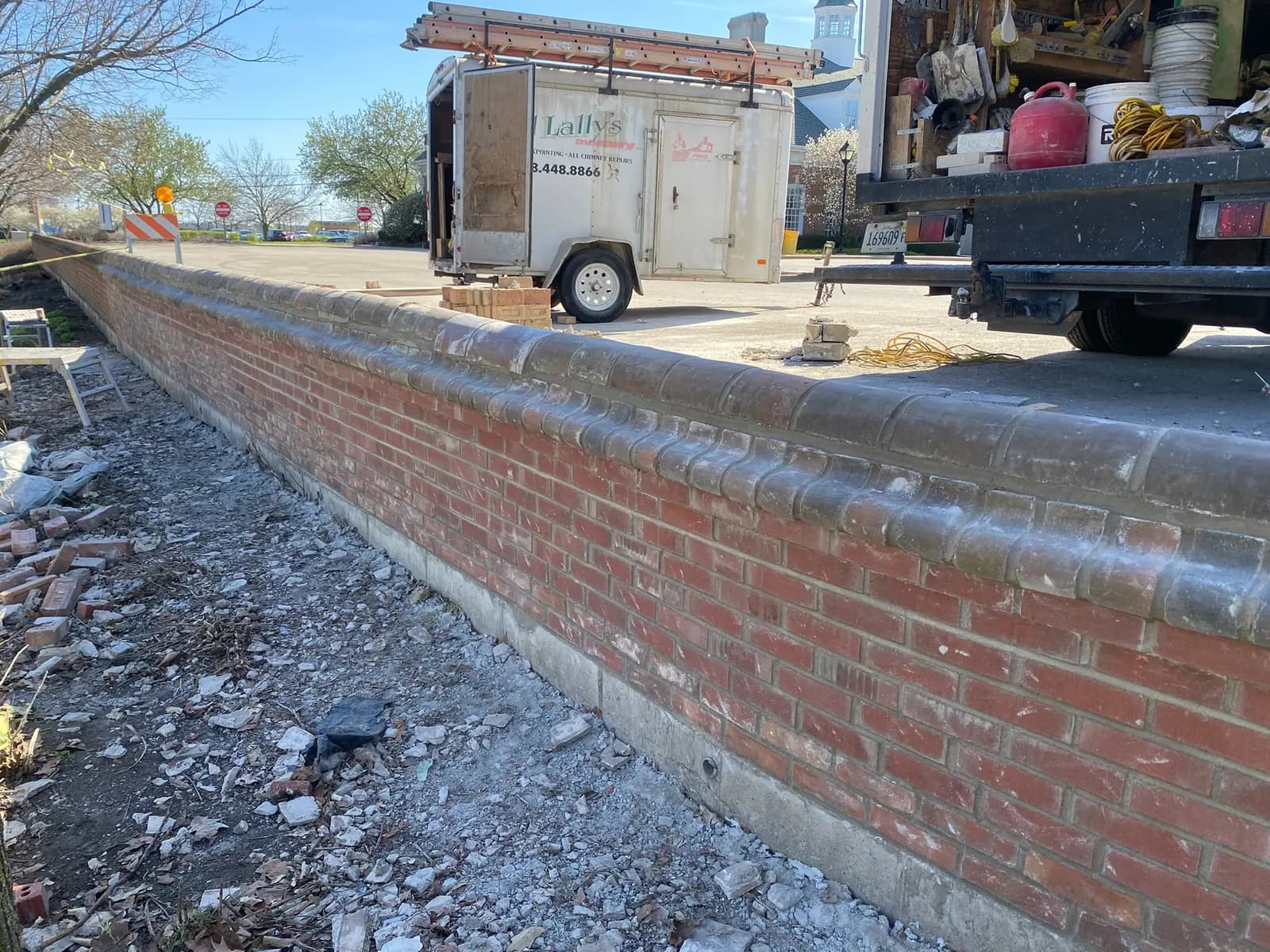
Brick Repair in New Lenox, IL
Brick repair in New Lenox, IL means cutting out spalled and cracked units, replacing them with matched brick, correcting the rust-stained lintel or failed sill that caused the damage, and repairing the joints around it. Emerald Masonry LLC does this work across Will County — family-owned, licensed, bonded and insured, led by career masons with decades of hands-on Chicagoland experience and free on-site estimates. If your brick is flaking, cracking or stained, call (708) 288-1696.
New Lenox is a young masonry environment, and that changes what fails.
The village grew rapidly from the 1990s through the 2000s, and its housing is overwhelmingly brick veneer — subdivisions across 60451, larger homes on the newer edges, plus an older core near the original village center and the Metra line. A 1998 house does not fail the way a 1920s Chicago bungalow fails, and treating it as though it does produces the wrong repair.
Veneer Fails at Points, Not Across the Field
This is the single most useful thing to understand about newer masonry.
Solid multi-wythe masonry — the pre-1940 stuff — is several courses thick and structural. It absorbs water and dries outward, and it deteriorates fairly evenly as its mortar ages out.
Brick veneer is a single decorative layer over a framed or block backup, with an air cavity behind it. It is designed to leak: water gets past the brick, runs down the back face, hits through-wall flashing, and exits through weep holes in the bottom course.
That system works — until one specific detail fails. So on a New Lenox home the field brick is often perfectly sound while these points are not:
| Failure point | Why it goes | What you see | |---|---|---| | Chimney | Exposed on four sides, no interior heat drying it | Staining, spalling, cracked crown | | Lintels over wide openings | 1990s picture windows, sliders, 3-car garages are long spans | Rust stains, horizontal crack above opening | | Sills | Horizontal surfaces that hold water once slope fails | Spalled brick streaking below the window | | Flashing | Rushed or mis-detailed during a fast build | Efflorescence, damp interior walls, no visible cause | | Weep holes | Mortared shut by a crew who thought they were gaps | Trapped moisture, efflorescence at the base | | Isolated joint runs | Under a leaking gutter, shaded elevation | Localized receded joints |
A crew that mortars your weep holes shut has converted a drained wall into a bucket. We leave them open and verify they are draining before we finish.
Signs Your New Lenox Brick Needs Repair
- Spalling faces — brick flaking, shelling or crumbling, worst near grade, below sills and on shaded elevations.
- Orange rust staining running down from a window, door or garage opening.
- A horizontal crack in the joint directly above an opening.
- Cracked brick, particularly cracks running through the units rather than following joints.
- Loose brick that moves under hand pressure.
- Step cracks climbing diagonally through the mortar joints.
- Efflorescence — white chalky bloom proving water is moving through the wall.
- Blocked or missing weep holes at the bottom course.
- A bulge or bow in the wall plane — structural, needing evaluation rather than a patch.
Why Brick Fails Here
Freeze-thaw is the engine. Not extreme cold, but repeated crossings of the freezing point with water present — dozens each Will County winter, plus more in the shoulder seasons. Each cycle expands trapped water about nine percent inside the brick.
Clay soils move. Will County's heavy clay swells and shrinks seasonally, producing step cracking at corners and around openings.
Fast-build detailing. Rapid subdivision construction is not inherently worse work, but flashing, weep spacing and lintel detailing are exactly the items that suffer when schedules compress — and they are invisible until years later.
And the steel is now mature. A 1997 house has thirty-year-old lintels. Steel is entirely reliable until it gets wet, and then it expands to several times its original volume inside a rigid wall.
Our Brick Repair Process
- Free on-site assessment. We read the damage pattern — unit failure, joint failure, movement or steel corrosion — and find where water is entering.
- Fix the cause first. Replacing brick while leaving a rusting lintel, failed sill or overflowing gutter in place guarantees a repeat.
- Careful removal. Damaged units cut out without disturbing sound surrounding brick.
- Source matched replacements — current production where a true match exists, salvage or a blend where a color has been discontinued.
- Match the mortar for hardness, color and sand — Type N for most above-grade veneer, Type S where conditions warrant.
- Set and repoint, packing joints in lifts and tooling to the original profile.
- Verify the drainage path — weep holes open, flashing functioning.
- Related repairs as needed — lintel repair, limestone and sill repair or chimney repair.
Materials We Use
Current-production and salvaged brick matched for size, color, texture and absorption, Type N and Type S mortars, blended sands for accurate color, stainless ties and anchors where veneer work requires them, new steel angle lintels primed and sized to span, and breathable masonry sealers only — never film-forming coatings that trap moisture in a cavity wall.
What Drives Brick Repair Cost
- Number of units and whether damage is localized or spread across an elevation.
- Match difficulty — discontinued 1990s and 2000s colors are a real sourcing challenge.
- Height and access — ground level versus staging or a lift.
- Underlying cause — a rusting lintel or failed sill adds scope beyond the brick.
- Number of openings if lintel work is involved; that is priced per opening.
- Extent of accompanying joint work.
We do not quote brick repair sight unseen. Free on-site estimate, written scope, and an honest read on what needs doing now versus what can wait.
Serving New Lenox and Will County
New Lenox sits in Will County with no lake buffer, taking the full regional freeze-thaw swing. We work throughout 60451 — the subdivisions off Route 30, Cedar Road and Laraway, the older homes near the original village center and the Metra station, the newer construction on the south and west edges, and the churches, schools and commercial properties along the main corridors.
We also serve neighboring Mokena, Frankfort, Homer Glen and Manhattan. New Lenox owners frequently pair brick work with chimney repair or masonry restoration.
Emerald Masonry LLC is a family-owned, licensed and insured masonry contractor serving Chicago and the Chicagoland suburbs led by career masons with decades of hands-on experience in tuckpointing, chimney repair, brick repair and replacement, lintel and parapet repair, foundation and limestone/sill repair, caulking, sealing, and commercial, residential and historic masonry restoration. Free on-site estimates — call (708) 288-1696.
What Waiting Costs
On veneer specifically there is a hidden risk worth naming. The ties holding the brick skin to the building are steel, and they are corroding on the same timeline as your lintels — driven by the same water. You cannot see them, which is precisely why the visible symptoms are worth acting on early.
Spalling is also progressive: once a brick loses its fired face, the porous body underneath absorbs water far faster, deteriorates more quickly, and starts wetting its neighbors.
Get a Free Brick Repair Estimate in New Lenox
If you have rust stains below a window, flaking brick, or efflorescence at the base of a wall, have it assessed before another freeze-thaw season.
Call (708) 288-1696 or request your free estimate.
Ready to get started?
Free on-site estimates for commercial and large-scale projects.
Brick Repair in New Lenox, IL — Frequently Asked Questions
How much does brick repair cost in New Lenox, IL?
Cost tracks how many units need replacing, how difficult the match is, the height and access, and whether the underlying water source also needs correcting. A dozen spalled brick at grade is a different job from an upper-elevation section needing staging. Emerald Masonry gives free on-site estimates with a written scope.
My house is only 25 years old — why is the brick failing already?
Because brick veneer fails at points rather than across the field. The usual culprits on newer New Lenox homes are chimneys, lintels over wide openings, sills, and flashing that was poorly detailed during a fast build. The field brick can be perfectly sound while three specific spots are letting water in.
What are weep holes and why do they matter?
Weep holes are the small openings in the bottom course of a brick veneer wall that let water which got behind the brick drain back out. They are not missing mortar and they must never be sealed. Blocked weeps are one of the most common causes of trapped moisture, efflorescence and spalling on newer homes.
What causes rust stains running down from my windows?
A corroding steel lintel above the opening. Water reaching the steel rusts it, the rust bleeds down the brick face, and — more seriously — corroding steel expands and lifts the masonry above, cracking the joint line. The staining is the early warning worth acting on.
Do I need brick repair or brick replacement?
If brick faces are flaking, popping or crumbling, those units need replacing — a spalled brick cannot be restored. If the brick is intact and only the mortar has failed, repointing is the repair. Most New Lenox jobs are a mix, plus fixing whatever was letting water in.
Can you match brick on a 1990s subdivision home?
Usually yes, though some 1990s and 2000s colors had short production runs and are now discontinued. We match by size, color, texture and absorption, using current production where a true match exists and salvage where it does not. Blending across the repair area often reads better than a single near-miss.
Brick Repair in Nearby Areas
Other Masonry Services in New Lenox, IL
Learn more about our brick repair services across Chicagoland, or view all service areas.