
CMU Block Repair · New Lenox, IL
CMU Block Repair in New Lenox, IL — Control Joints, Split-Face, and the Leak Everyone Blames on the Roof
A damp vertical stripe down the inside of a block wall almost never means the roof failed. It means a control joint did — and that is the cheapest thing on the building.
Quick Answer
Emerald Masonry LLC provides CMU block repair in New Lenox, IL — repointing block joints, repairing failed control joints and cracks, replacing spalled units, and stopping water entry through porous split-face block on commercial, industrial and retail buildings. Licensed, bonded and insured; COI and lien waivers on request. Call (708) 288-1696.
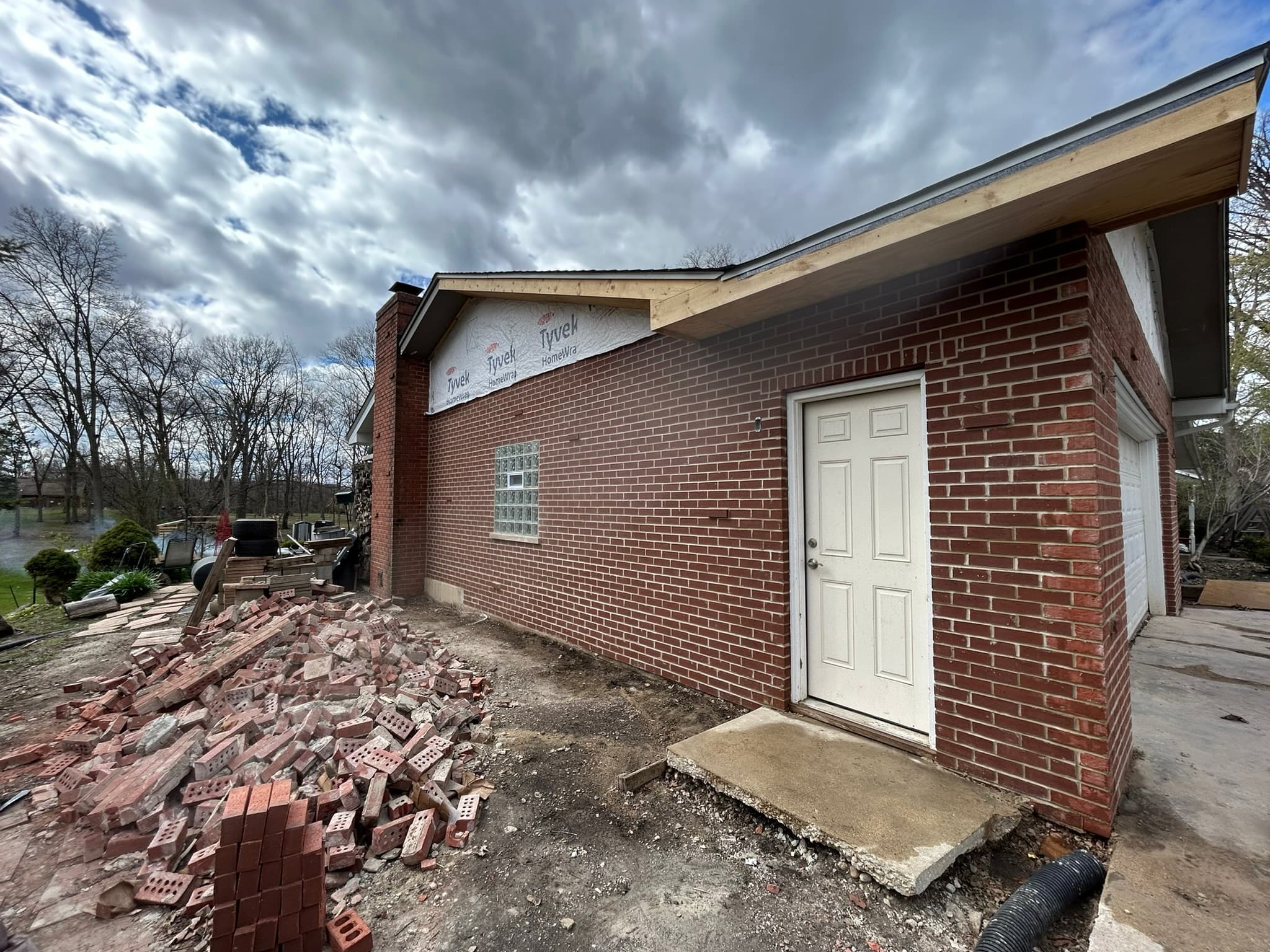
Here is a diagnosis that gets made wrong in Will County every spring.
A tenant reports a damp vertical stripe on the inside face of a block wall. The roofer is called, inspects, finds nothing, and says the membrane is sound. The stripe reappears after the next rain. Somebody eventually recoats the roof anyway.
The stripe is a failed control joint — a full-height water path down the outside of the wall, sealed with a bead that reached the end of its service life several winters ago. It is one of the cheapest items on the building and one of the most common causes of interior water on block construction.
CMU block repair in New Lenox, IL starts with finding the actual path, not the stain.
Emerald Masonry LLC is a family-owned commercial masonry contractor serving Chicago and the Chicagoland suburbs, led by career masons with decades of hands-on Chicagoland experience, in commercial tuckpointing, façade and parapet repair, lintel replacement, chimney and stack rebuilds, CMU block repair, brick repair and replacement, foundation and limestone/sill repair, caulking, sealing, and commercial, residential and historic masonry restoration. Free on-site assessments — call (708) 288-1696.
Block is not brick, and it does not fail like brick
Three properties drive everything.
It is porous. Concrete masonry units absorb far more water than fired face brick. Split-face block — the textured finish on most 1980s-and-later commercial elevations — is worse, because splitting the unit exposes its open aggregate structure to the weather. Water does not need a crack to enter a split-face wall; it moves through the field of the block.
It shrinks. Fired brick expands slightly over its life. Concrete block does the opposite — it shrinks as it cures and dries. That is why block walls are built with control joints: deliberate vertical breaks that let the wall move without cracking wherever it chooses. Brick needs expansion joints, block needs control joints, and they are not interchangeable.
It is frequently structural. On a warehouse or flex building the block is often load-bearing rather than a veneer on a frame. That changes what unit replacement involves and raises the stakes on anything resembling movement.
What fails on New Lenox block buildings
Control joint sealant
The first thing to check, every time. Hardened, torn, or debonded sealant turns a designed movement joint into a designed leak. Cheap to fix, disproportionately damaging when ignored.
Joint deterioration
Bed joints erode on exposed elevations the same way they do on brick, and the south and west faces go first.
Spalling and face loss
Freeze-thaw taking the face off units, concentrated at the base of the wall where splash and de-icing salt collect, and around openings.
Cracking
Vertical or stepped cracking generally points to movement or shrinkage the control joints did not absorb — often because there were too few, or badly placed. Long horizontal cracking running with the coursing is a different signal: the wall is being pushed, and that is a structural question before it is a masonry one.
Coatings that trap moisture
Many block buildings have been painted. A film-forming coating on a porous wall blocks vapour from leaving, so moisture that gets in behind it — and it always does — has nowhere to go but into the freeze-thaw cycle. Blistering paint on a block elevation is a symptom, not a paint problem.
Dock and grade-level damage
Impact from trailers and bumpers, plus salt and plow damage at the bottom courses every winter. Predictable, and far better planned for than reacted to. See vehicle impact and loading dock masonry damage.
New Lenox, specifically
New Lenox has grown a substantial commercial and industrial base alongside its residential expansion, and block is the dominant material across it.
The Route 30 / Lincoln Highway retail corridor. Strip centres and freestanding retail with split-face fronts and side elevations, storefront returns, and parapets above. The front elevation gets attention; the sides and rear — where the water usually enters — do not.
Industrial and flex buildings toward I-80 and the Laraway and Cedar Road corridors. Long unbroken block elevations, dock walls, minimal openings. Deterioration here tends to be uniform, so the plan is a prioritisation and square-footage exercise rather than patching.
Institutional and municipal buildings — schools, village facilities, and recreation properties, where anything overhead sits above places the public walks.
Multi-tenant buildings, where the water complaint arrives from one tenant and the entry point sits above another. That is the classic block diagnostic problem, and it is why the assessment has to look at the whole elevation rather than the unit that called.
How we repair it
- Find the water path before pricing the wall. Control joints, bed joints, the field of the block, penetrations, coping and roof edge above, flashing. On a block building the entry point is frequently above the stain and never inside it.
- Repoint deteriorated joints with mortar matched in type and profile.
- Repair and reseal control joints — remove the failed material entirely, clean the joint faces, install correctly sized backer rod, and tool a new bead. Caulking over an old bead does not adhere and fails within a season.
- Replace spalled and failed units, matched as closely as block allows.
- Repair cracks appropriately to their cause, and escalate to a structural engineer where the pattern indicates movement.
- Address trapped-moisture coatings where that is what is happening.
- Seal the field of the wall with a breathable penetrating product where it genuinely benefits — after the repairs, not instead of them.
Materials
Mortar matched in type and joint profile. Replacement units matched as closely as commercially available block allows, with the honest caveat that a new CMU reads newer than a forty-year-old one for some time. Backer rod and elastomeric sealant selected for movement capability at control joints. Breathable penetrating sealers rather than film-forming coatings on any wall that has to dry.
What drives the cost
Wall area and height. Access. The ratio of repointing to unit replacement. Linear footage of control joint. Whether the block is split-face and needs a water strategy for the field. Dock and grade-level repair volume. Overhead protection. Whether work must happen outside operating hours. Weather windows for mortar and sealant.
Free on-site assessment and a written scope broken out so it can be budgeted or phased — call (708) 288-1696.
Working with Emerald
Emerald Masonry LLC is family-owned, established 2024 and led by career masons with decades of hands-on Chicagoland experience. Licensed, bonded and insured, non-union, with COI, W-9 and lien waivers on request. We work with owners and facility teams through our commercial masonry practice, with managed portfolios through property manager services, and alongside builders through our general contractor partnerships.
Related services: commercial masonry restoration, caulking and joint sealant, masonry sealing, brick replacement, and parapet wall repair.
For the material comparison, see CMU versus brick repair differences.
Check the joints before you recoat the roof
Request a free on-site assessment — or call (708) 288-1696.
Ready to get started?
Free on-site estimates for commercial and large-scale projects.
CMU Block Repair in New Lenox, IL — Frequently Asked Questions
How much does CMU block repair cost in New Lenox, IL?
It is priced by scope. The drivers are wall area, height and access, the ratio of repointing to unit replacement, linear footage of control joint, whether the block is split-face and needs a water strategy, and whether work sits over a dock or walkway needing protection. Emerald Masonry provides a free on-site assessment and a written scope.
We have a damp vertical stripe inside. What is that?
Almost always a failed control joint. When the sealant in a control joint hardens or lets go, the joint becomes a full-height water path straight into the wall, and it presents inside as a vertical damp line that gets blamed on the roof for years.
Why does water come through block that has no visible cracks?
Because concrete block is porous, and split-face block is more porous still — splitting the unit exposes its open aggregate structure directly to weather. On that wall, water moves through the field of the block itself, not through a crack.
Should our block building be sealed?
Often yes, and on split-face it is frequently part of the answer rather than an optional extra — but only after joints, cracks and control joints are repaired. Sealing a wall that still has open water paths slows drying without stopping entry.
Is a horizontal crack in a block wall serious?
It can be. A long horizontal crack running with the coursing suggests the wall is being pushed rather than simply deteriorating, and that needs a structural engineer before a mason. Vertical and stepped cracking more often indicates shrinkage or movement the control joints did not accommodate.
Can the work be done while we stay in operation?
Yes — operating is the normal condition. Access, staging and material handling are planned around dock traffic, tenant entrances and business hours, and agreed in writing before mobilisation.
CMU Block Repair in Nearby Areas
Other Masonry Services in New Lenox, IL
Learn more about our cmu block repair services across Chicagoland, or view all service areas.