
Residential Masonry Restoration · Elmwood Park, IL
Residential Masonry Restoration in Elmwood Park, IL — Why You Probably Shouldn't Do All Four Sides at Once
Your south and west walls are years ahead of your north and east walls in deterioration, because they get different weather. Pricing your house as one number ignores that — and usually means paying for work that didn't need doing yet.
Quick Answer
Emerald Masonry LLC provides residential masonry restoration in Elmwood Park, IL — tuckpointing, brick repair and replacement, lintel and sill work, and chimney restoration on brick homes, bungalows and two-flats, scoped and phased by elevation. Family-owned, licensed and insured, career masons with decades of Chicagoland experience, free estimates. Call (708) 288-1696.
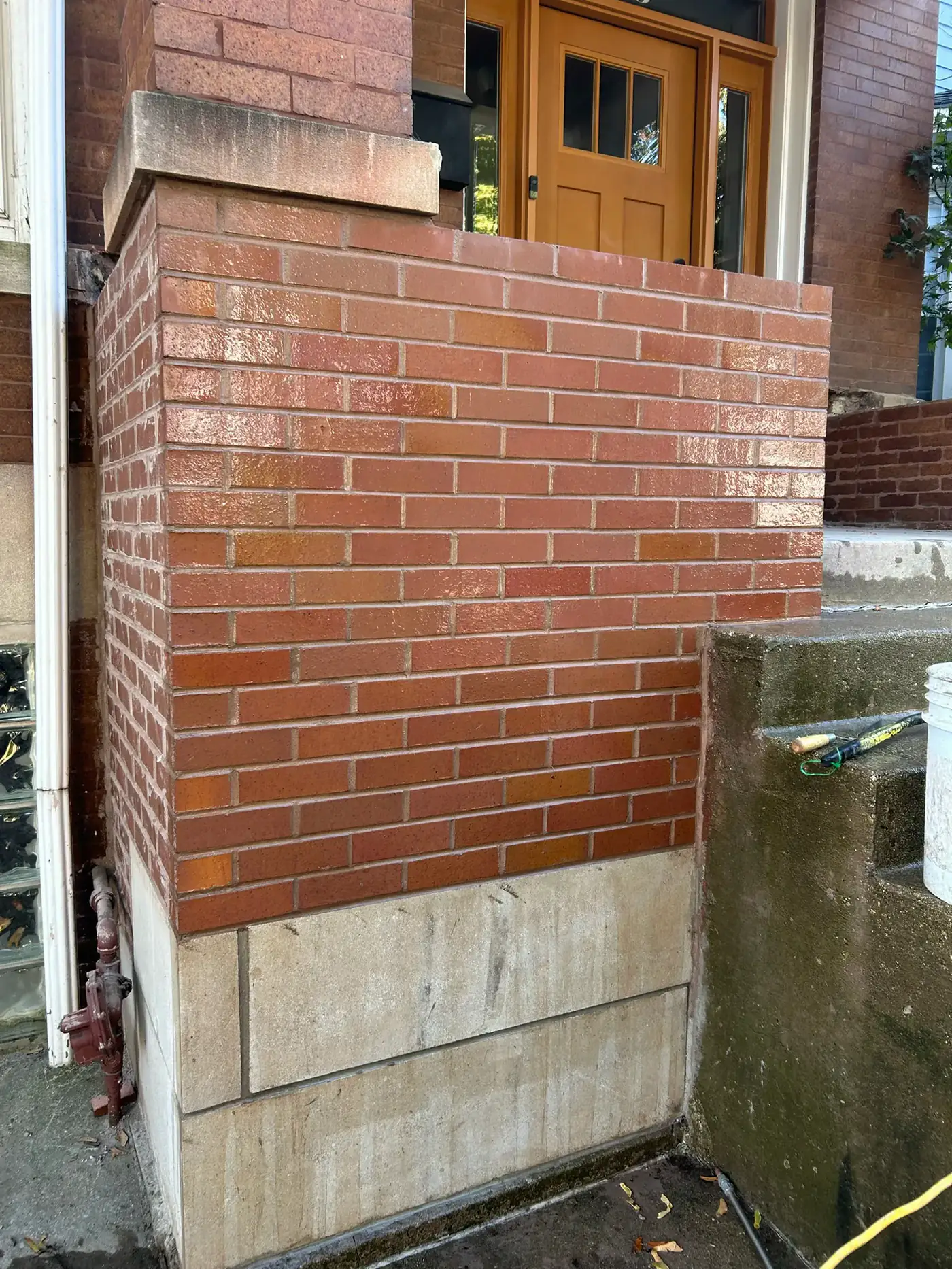
Residential Masonry Restoration in Elmwood Park, IL
Residential masonry restoration in Elmwood Park, IL covers tuckpointing and repointing, brick repair and replacement, lintel and sill work, chimney restoration and water management on brick homes, bungalows and two-flats. Emerald Masonry LLC is family-owned, licensed, bonded and insured, led by career masons with decades of hands-on Chicagoland experience and free on-site estimates. Call (708) 288-1696.
Most homeowners ask what it costs to do the house. That is the wrong unit.
Your house does not weather as one object. It weathers as four walls in four different climates.
The south elevation takes the most sun and the sharpest daily temperature swings. The west elevation takes the driving rain, because most Chicagoland storms arrive from that direction. The north elevation stays shaded and damp and grows algae, but often deteriorates more slowly. The east elevation usually does best of all.
The practical consequence: on a typical Elmwood Park brick home, the south and west walls are frequently several years ahead of the north and east in deterioration. A single number for "the house" either overpays for two walls that were fine, or underscopes two walls that were not.
What Restoration Actually Includes
Restoration is not one service. On a residential envelope it usually means some combination of:
- Repointing deteriorated mortar joints, cut back to sound material and refilled.
- Brick repair and replacement for units that have spalled, cracked or come loose.
- Lintel work where the steel over an opening has corroded and lifted the brick.
- Sill repair on limestone or cast stone that has cracked or eroded.
- Chimney restoration — crown, joints, flashing and cap.
- Sealant renewal at window perimeters and material transitions.
- Water management — the gutter, downspout, sill and grade issues feeding the damage.
Signs an Elmwood Park Home Needs Restoration
- Mortar joints receded behind the brick face, or raking out as sand under a key.
- Spalling brick — faces flaking, shelling or popping off.
- Step cracks running diagonally through joints, especially at corners and openings.
- Rust staining below window and door openings — the steel lintel corroding.
- Cracked or eroded limestone sills, or sills that have dropped at one end.
- Efflorescence — white powder or crust — on the exterior, or on the inside of a basement wall.
- Loose or missing brick, particularly at the chimney and the top courses.
- Damage concentrated at the bottom three courses, where splash, snow and salt collect.
- Hard gray mortar standing proud of the brick — a prior repair with the wrong mix.
Risks of Waiting
Masonry deterioration is not linear. Open joints admit water, water accelerates the damage, and the damage opens more joints. A wall that needed repointing this year needs repointing plus a dozen replacement brick in three years, and repointing plus fifty replacement brick in eight.
The threshold to watch for is spalling. Once faces start coming off the brick, you have crossed from a mortar problem into a unit problem, and unit replacement is several times the cost of repointing the same area. Everything before that point is comparatively cheap.
How We Scope It by Elevation
- Walk all four sides and the chimney, and photograph conditions on each.
- Test the mortar for hardness relative to the brick, which determines the repair mix.
- Grade each elevation — urgent, this season, monitor, or fine.
- Identify the water sources feeding the worst areas: gutters, downspouts, sills, grade, flashing.
- Write the scope elevation by elevation with quantities, so phasing is a real option rather than a guess.
- Sequence by water path — the top and the openings before the field walls, because that is where water enters.
- Document the mortar mix, sand and joint profile so a later phase matches this one.
Our Repair Process
- Cut joints back to sound mortar — generally two to two and a half times the joint width — using hand-raking on softer brick and controlled grinding only where the masonry can take it.
- Mortar matched to the existing in hardness, color, sand and texture, judged on cured samples rather than wet.
- Repoint in lifts, packed and compacted rather than skimmed.
- Tool to the original joint profile so the repair disappears.
- Replace failed units with salvaged or matched brick, cut out through the joints so neighboring brick are not damaged.
- Lintel, sill and chimney work as scoped, with flashing where it belongs.
- Correct the water so the repair is not on a countdown.
- Clean down as we go, before mortar cures onto the faces.
Materials We Use
Type N mortar on most of the pre-1960 brick here, with softer lime-modified mixes where the units call for it and Type S only where the wall genuinely warrants it, matched sands for true color, salvaged and matched face brick, Indiana limestone and matched cast stone for sill work, primed and galvanized steel for lintels, through-wall flashing, stainless anchors, and vapor-permeable sealers only. Related work: tuckpointing, brick repair, brick replacement, lintel repair, limestone and sill repair and chimney repair.
What Drives Cost
- How many elevations are in scope.
- The repointing-to-replacement ratio — replacement is the expensive part.
- Height and access — two-story and dormer work needs staging.
- Chimney condition, which is often the single largest line on an older home.
- Lintels and sills involved, each of which adds shoring, removal and rebuild.
- Mortar matching complexity on older or unusual brick.
- Prior bad repairs that have to be removed before anything correct can go in.
- Water-source correction at gutters, grade and flashing.
Working in Elmwood Park and the Near West Suburbs
Elmwood Park is a dense, almost entirely built-out village in western Cook County with a housing stock that is heavily masonry: Chicago-style brick bungalows and two-flats, 1920s–1940s brick homes, post-war ranches and Georgians, and brick apartment buildings along the main corridors. Lots are narrow, houses sit close together, and gangway access between buildings is the normal working condition — which affects staging and needs to be planned into the estimate rather than discovered on day one.
Exposure is the standard hard Chicagoland pattern: dozens of freeze-thaw crossings each winter landing on whatever is already saturated, heavy winter salting on walks and drives that feeds the bottom courses, and mature street trees that keep north elevations damp well into spring.
We serve 60707 and the surrounding near-west communities, including River Forest, Oak Park, Forest Park and Berwyn. Homeowners here frequently pair restoration with chimney repair on the same visit, since the chimney is usually the most exposed masonry on the house.
Emerald Masonry LLC is a family-owned, licensed and insured masonry contractor serving Chicago and the Chicagoland suburbs led by career masons with decades of hands-on experience in tuckpointing, chimney repair, brick repair and replacement, lintel and parapet repair, foundation and limestone/sill repair, caulking, sealing, and commercial, residential and historic masonry restoration. Free on-site estimates — call (708) 288-1696.
Request a Free Masonry Assessment in Elmwood Park
Get all four elevations graded before anyone quotes you a single number for the house. You may find two of them can wait.
Call (708) 288-1696 or request your free estimate.
Ready to get started?
Free on-site estimates for commercial and large-scale projects.
Residential Masonry Restoration in Elmwood Park, IL — Frequently Asked Questions
Do I have to restore my whole house at once?
Usually not, and often you should not. Elevations weather at different rates depending on sun, prevailing wind and rain exposure, so the south and west sides of an Elmwood Park home are typically years ahead of the north and east. A scope broken out by elevation lets you do what needs doing and defer what does not.
How much does residential masonry restoration cost in Elmwood Park, IL?
It is driven by which elevations are included, how much of the work is repointing versus unit replacement, whether lintels, sills or the chimney are involved, and access. A single elevation and a full envelope are very different projects. Emerald Masonry itemizes by elevation in a free written estimate.
Which side of my house usually needs work first?
In Chicagoland, typically the south and west. South elevations take the most sun and the most thermal cycling; west takes the driving rain that arrives with most storms. North elevations stay damp and grow more organic growth but often deteriorate more slowly.
Will a phased job look mismatched?
Not if the mortar is properly matched and documented. We record the mix, sand and joint profile used so a later phase matches the earlier one. Fresh mortar always cures lighter and darkens over the following months, so a new phase will look brighter for a season before it settles in.
Does my house need repointing or brick replacement?
Usually both, in different proportions. Repointing addresses deteriorated mortar joints; replacement handles individual brick that have spalled or cracked through. A wall where most units are sound and the joints are eroded is a repointing job with scattered replacements, which is the common case.
How long does a residential masonry restoration take?
A single elevation on a typical Elmwood Park home is usually a matter of days rather than weeks; a full envelope with chimney, lintel and sill work runs longer. Weather matters — mortar needs suitable temperatures to cure, so cold snaps and prolonged rain move schedules.
Residential Masonry Restoration in Nearby Areas
- Residential Masonry Restoration in Beverly, Chicago, IL
- Residential Masonry Restoration in Burbank, IL
- Residential Masonry Restoration in Evergreen Park, IL
- Residential Masonry Restoration in La Grange, IL
- Residential Masonry Restoration in Mount Greenwood, Chicago, IL
- Residential Masonry Restoration in New Lenox, IL
Other Masonry Services in Elmwood Park, IL
Learn more about our residential masonry restoration services across Chicagoland, or view all service areas.