
Tuckpointing & Repointing · Elmwood Park, IL
Tuckpointing in Elmwood Park, IL — Why the Front of Your House and the Sides of Your House Need Different Mortar
Most Elmwood Park houses are two different buildings: hard face brick on the front, soft Chicago common brick on the sides and rear. They fail on different schedules and they need different mortar — and pricing the job by the linear foot hides that completely.
Quick Answer
Emerald Masonry LLC provides tuckpointing and repointing in Elmwood Park, IL — grinding out failed mortar joints and repointing face brick and Chicago common brick with separately matched mortars, since the two need different hardness. Family-owned, licensed and insured, career masons with decades of Chicagoland experience, free on-site estimates. Call (708) 288-1696.
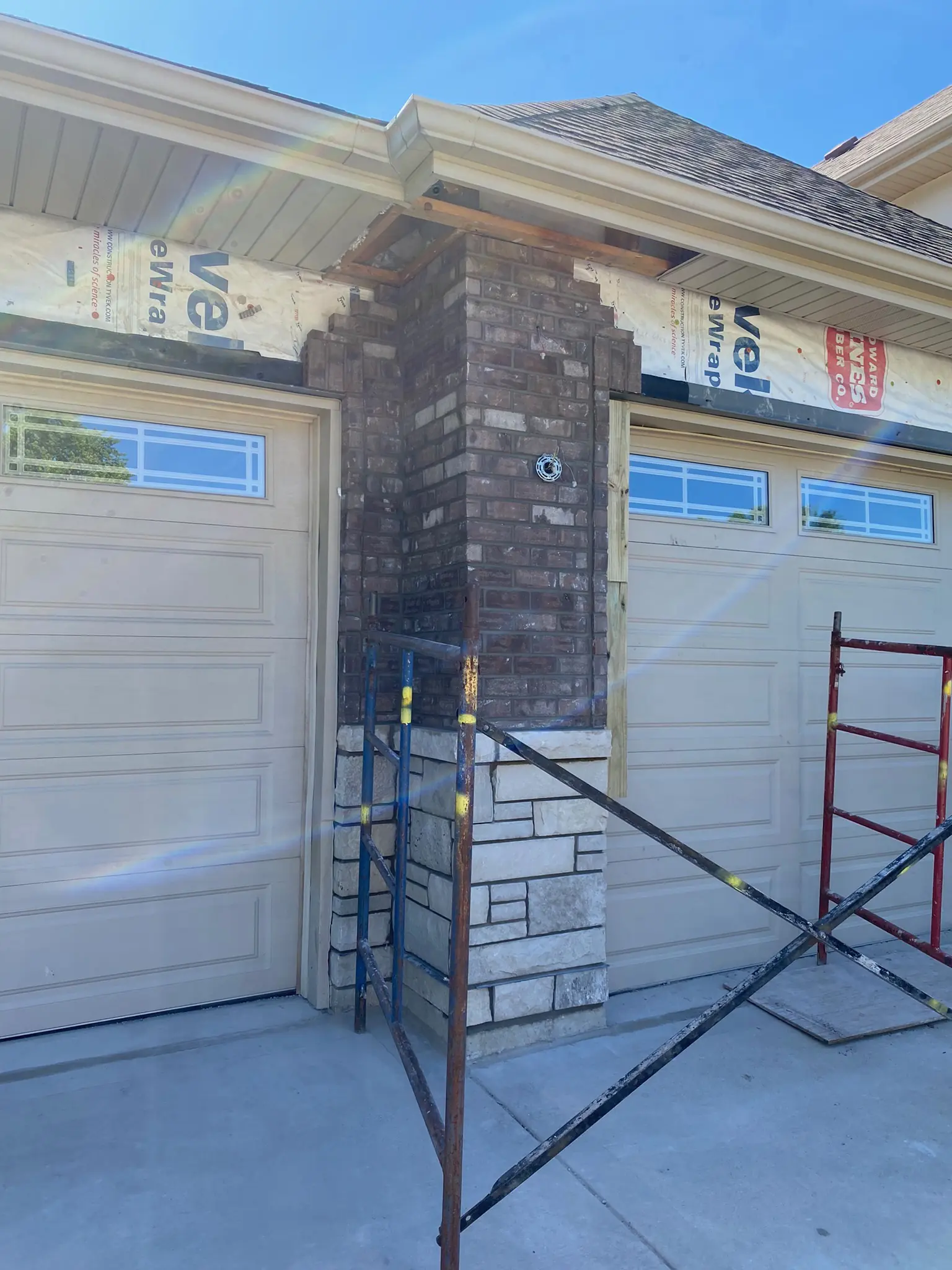
Tuckpointing in Elmwood Park, IL
Tuckpointing in Elmwood Park, IL means grinding out deteriorated mortar joints and repacking them with fresh mortar matched to the brick — and on most village houses, that means two different mortars on one building. Emerald Masonry LLC does this work throughout west Cook County. Family-owned, licensed, bonded and insured, career masons with decades of Chicagoland experience, free on-site estimates. Call (708) 288-1696.
Here is the thing almost nobody tells an Elmwood Park homeowner:
Your house is not made of one kind of brick.
Walk to the curb and look at the front. Hard, dense, uniform face brick, laid with tight tooled joints, chosen to be looked at. Now walk down the gangway and look at the side wall, or go into the alley and look at the back. Different brick entirely — softer, more porous, often salmon or orange, laid quickly, never meant to be seen.
That is Chicago common brick, and it drinks water in a way the front of your house does not.
Two materials. Two failure schedules. Two different mortars. Price the job as one number per linear foot and that distinction disappears — which is exactly how a repointing job ends up destroying the rear wall it was supposed to save.
The Rule That Governs Everything
There is one principle behind every good repointing job, and it is worth memorizing because it lets you evaluate any contractor's answer:
Mortar must be softer than the brick it holds.
Mortar is the sacrificial element. A brick wall moves — it expands in July, contracts in January, takes up water and freezes. Something has to absorb that stress. If the mortar is softer than the brick, the joint takes the damage, and joints are replaceable. If the mortar is harder than the brick, the brick faces take it instead, and they pop, flake and shear off. Brick is not replaceable in the same easy way.
Now apply that to an Elmwood Park house:
- Front face brick — hard, dense, low absorption. Tolerates a firmer mix.
- Side and rear common brick — soft, absorbent, comparatively weak. Needs a distinctly softer mix.
Use the front mortar on the back wall and you have installed something harder than the brick around it. It will look fine for two or three years. Then the salmon faces start flaking off in sheets while the joints between them sit there perfectly intact — the tell-tale signature of mortar that outranked its brick.
If you want the deeper version of this, we wrote it up in why Chicago common brick crumbles and Type N vs. Type S mortar.
Signs Your Elmwood Park House Needs Tuckpointing
- Joints recessed behind the brick face — more than about a quarter inch means water is being held against the wall.
- Mortar you can rake out with a fingernail, or that powders when scratched.
- Sand at the base of the wall after rain — that is your joints, arriving on the ground.
- Step cracks running diagonally through joints, especially near corners and openings.
- Spalling or flaking brick faces, most often low on a common-brick side wall.
- White chalky efflorescence blooming on the brick — salts carried out by water moving through the wall.
- Damp patches or staining on interior walls after a long rain.
- Open joints at the chimney above the roofline, where exposure is worst.
- The rear elevation looking a decade older than the front. Normal here — and diagnostic.
Not sure? Take a key to a joint on the back of the house and then a joint on the front. If the back gives and the front does not, you have just proved the point of this page.
Why Elmwood Park Specifically
The village is roughly two square miles, built out largely between the 1920s and the 1950s, and it is almost entirely masonry.
The housing stock is remarkably consistent. Chicago-style brick bungalows, brick Georgians, two-flats, post-war ranches and raised ranches, and a substantial number of 1950s and 60s courtyard and small apartment buildings. Nearly all of it uses the face-brick-front, common-brick-sides construction described above, because that was simply how Chicago-area builders worked at scale.
The mortar is now the age at which it fails. A 1920s bungalow's original lime-rich mortar and a 1955 ranch's early Portland-cement mortar have both had 70 to 100 Cook County winters — dozens of freeze-thaw crossings each year, water taken up during a February thaw and frozen solid the next night.
The lots are narrow. Village blocks run tight, with gangways between houses and alleys behind. That does not change the repair, but it absolutely changes staging, access and protection of the neighboring property — which is why we look at it in person before quoting.
Exposure is not equal. The north and west elevations weather hardest, and on an Elmwood Park block the north wall is often the one facing a three-foot gangway that never dries out. Our page on why north-facing brick deteriorates faster covers the mechanism.
We work the whole village — the blocks around the Conti Parkway circle and village hall, the residential grid north and south of Grand Avenue, the buildings along Harlem and North Avenue, and the streets running right up against the Chicago line at Mont Clare and Galewood.
Our Tuckpointing Process
- Free on-site assessment. We look at every elevation separately, identify each brick type, and test joint hardness by hand. You get a written scope that says what is happening on each wall.
- Mortar analysis and matching. We match hardness first, then color, sand and texture. Where the front and rear brick differ, we batch two mixes. This is the step that determines whether the job lasts 30 years or 5.
- Joint preparation. Failed mortar is cut back to sound material — generally two to two and a half times the joint width — using the right tool for the brick. Soft common brick gets hand tools or a light touch, not an aggressive grinder that chews the arrises.
- Cleaning and dampening. Joints are cleared of dust and pre-wetted so the brick does not pull water out of the fresh mortar before it can cure.
- Repointing in lifts. Mortar is packed in layers and compacted, not buttered over the surface. A joint filled solid is what stops water; a skim coat is decoration.
- Tooling to match the original profile. Concave, weathered, grapevine, struck — the existing profile is matched so the repair reads as part of the wall, not a stripe across it.
- Cleaning down. Faces cleaned before the mortar sets hard, because removing cured mortar smears later means damaging brick.
- Curing and final walkthrough. Fresh mortar cures lighter and darkens over the following weeks; we tell you that up front so the first week does not alarm you.
Materials We Use
Type N and lime-modified mortars for older soft brick; firmer mixes only where the brick genuinely supports them; custom-blended sand and pigment for color matching; matched replacement brick, with salvaged units reused where possible; breathable penetrating sealers where sealing is appropriate — never a film-forming coating that traps moisture inside a common-brick wall.
Related work Elmwood Park owners commonly pair with tuckpointing: brick repair, chimney repair, lintel repair, limestone and sill repair, caulking and joint sealant and masonry sealing.
What Drives the Cost
We do not publish a per-linear-foot rate, and here is the honest reason: on an Elmwood Park house it is the wrong unit. A rate per foot of joint implies every foot is the same work, and on a building with hard face brick out front and soft common brick behind it, it is not.
What actually drives the number:
- How many elevations need work, and how much of each — spot repointing versus a full wall.
- Brick type per elevation, because soft common brick takes slower, gentler preparation.
- Wall height and staging — ground-floor reach versus scaffolding a three-story rear elevation.
- Access — gangway width, alley access, protecting the neighboring property.
- Joint condition — how deep the erosion goes, and whether previous bad repointing has to come out first.
- Mortar matching complexity, including custom color blending.
- Related repairs found in the same wall — displaced brick, a rusting lintel, a failed sill.
We assess in person and itemize by elevation, so you can see what the front costs, what the rear costs, and phase the work across seasons if you want to.
For Landlords and Multi-Unit Owners
Elmwood Park has a lot of two-flats, six-flats and courtyard buildings, and repointing suits them well.
It is exterior work, staged elevation by elevation, and interior access is rarely required — tenants stay in place, units stay rented. On a courtyard building, the interior court elevations are usually common brick and usually the worst walls on the property, so we scope them separately and honestly rather than averaging them into a street-facing number.
Doing several elevations in one mobilization is meaningfully cheaper than returning across three seasons, because staging and setup are paid for once. We itemize it so the arithmetic is visible to a board or an owner.
The Cost of Waiting
Open joints are not a cosmetic problem — they are an entry point. Water that gets behind the face of a wall freezes, expands, and pushes brick outward. What starts as a joint you can rake with a fingernail becomes spalled brick faces, then displaced units, then a section of wall that needs rebuilding instead of repointing.
Repointing is maintenance. Rebuilding is construction. The gap between those two prices is where the money is, and it is closed by acting while the joints are still just joints. See what happens if you wait too long to tuckpoint.
Emerald Masonry LLC is a family-owned, licensed and insured masonry contractor serving Chicago and the Chicagoland suburbs led by career masons with decades of hands-on experience in tuckpointing, chimney repair, brick repair and replacement, lintel and parapet repair, foundation and limestone/sill repair, caulking, sealing, and commercial, residential and historic masonry restoration. Free on-site estimates — call (708) 288-1696.
Serving Elmwood Park and Neighboring Communities
We serve all of 60707 and the surrounding area, including Oak Park, River Forest, Forest Park, Melrose Park and Cicero. Elmwood Park owners taking on more than joints often start with residential masonry restoration.
Get a Free Tuckpointing Estimate in Elmwood Park
If your joints are receding, your back wall looks a generation older than your front, or you want an estimate that treats those as two different jobs — because they are — have it looked at.
Call (708) 288-1696 or request your free estimate.
Ready to get started?
Free on-site estimates for commercial and large-scale projects.
Tuckpointing & Repointing in Elmwood Park, IL — Frequently Asked Questions
How much does tuckpointing cost in Elmwood Park, IL?
There is no honest per-foot number, because the front elevation and the common-brick sides of an Elmwood Park house are priced differently — different mortar, different joint condition, different access. Cost is driven by how many elevations need work, wall height, staging on a narrow lot, and how much of each wall is failing. Emerald Masonry itemizes by elevation in a free written estimate.
Why does the back of my house look so much worse than the front?
Because it is not the same brick. Elmwood Park builders put hard, dense face brick on the street elevation and soft Chicago common brick on the sides and rear, where it was never meant to be seen. Common brick absorbs far more water, so its joints erode faster and its faces spall sooner.
Can the same mortar be used on the whole house?
It should not be. Mortar has to be softer than the brick it sits against, so a mix appropriate for hard front face brick is often too hard for soft common brick at the rear. Using one mix everywhere is the single most common reason repointing damages an Elmwood Park house.
How do I know if my mortar has actually failed?
Press a key or screwdriver into a joint. Sound mortar resists; failed mortar crumbles, powders, or lets the tool sink in. If joints are recessed more than about a quarter inch behind the brick face, or you can see daylight or sand falling out, the wall is taking water.
Do you tuckpoint apartment buildings and courtyard buildings in Elmwood Park?
Yes. A large share of our west Cook County work is multi-unit — courtyard buildings, six-flats and small apartment blocks. Tuckpointing is exterior work staged by elevation, so tenants stay in place and interior access is generally not needed.
Can you work in the gangway between my house and my neighbor's?
Yes, and on Elmwood Park's narrow lots that is routine. We plan staging, ladder or scaffold placement and protection of the neighboring property before starting, and it is priced up front rather than surfacing as a change order.
How long will tuckpointing last here?
Properly matched and properly packed joints on an Elmwood Park house typically last 25 to 30 years or more. Joints that were skimmed over old mortar rather than cut back to sound material can start failing again within five.
Tuckpointing & Repointing in Nearby Areas
Other Masonry Services in Elmwood Park, IL
Learn more about our tuckpointing & repointing services across Chicagoland, or view all service areas.