
Chimney Repair · Aurora, IL
Chimney Repair in Aurora, IL — One City, Three Completely Different Chimneys
Aurora spans three distinct masonry eras in one city, and a chimney from each fails differently and needs a different mortar. Getting that wrong is how a repair destroys a hundred-year-old stack — or wastes money on a thirty-year-old one that only needed a crown.
Quick Answer
Emerald Masonry LLC provides chimney repair in Aurora, IL — rebuilding deteriorated stacks, repairing crowns and flashing, repointing and installing caps on historic, mid-century and modern chimneys across Kane County. Family-owned, licensed and insured, career masons with decades of Chicagoland experience, free on-site estimates. Call (708) 288-1696.
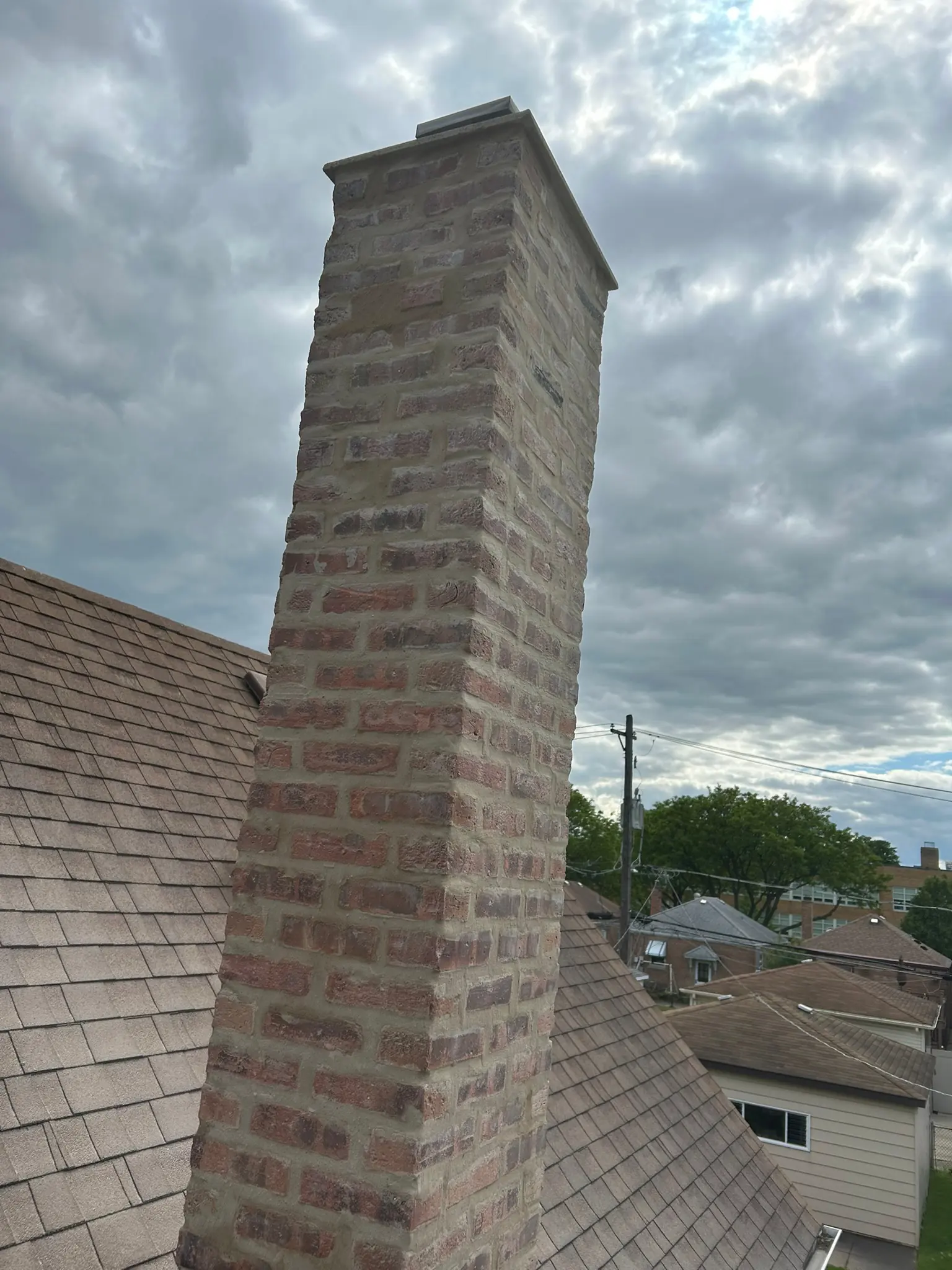
Chimney Repair in Aurora, IL
Chimney repair in Aurora, IL has a wrinkle that most Chicagoland towns do not have: Aurora contains three separate masonry eras, and a chimney from each one needs a different repair. Emerald Masonry LLC repairs and rebuilds chimneys throughout Kane County and the Fox Valley. Family-owned, licensed, bonded and insured, career masons with decades of Chicagoland experience, free on-site estimates. Call (708) 288-1696.
Illinois' second-largest city grew in distinct waves, and its chimneys record them.
Three Chimneys, Three Repairs
The nineteenth-century stack
Aurora's oldest neighbourhoods — the near-downtown blocks on both sides of the Fox River, the historic districts, the churches, the mill-era buildings and the Victorians around them — carry chimneys built with soft, hand-made or early machine-made brick laid in lime-rich mortar. Often they are tall, slender, corbelled at the top, and serving flues built for coal.
These stacks fail from hard mortar and aggressive repair at least as often as from weather. The rule that governs them is absolute: mortar must be softer than the brick it holds. A Portland-heavy Type S mix on 1890s brick does not strengthen the chimney; it makes the brick the sacrificial element and spalls the faces off within a few winters. Repointing and rebuilding here means lime-rich mortar, salvaged brick where possible, and reconstructing corbelled detailing by hand.
The post-war stack
The 1950s through 1970s build-out east and west of the river produced denser, machine-made brick laid in Portland-based mortar on ranches, Cape Cods and Georgians. These chimneys are more weather-tolerant, and they mostly fail from the top down — crown first, then the exposed top courses.
They also carry a specific modern problem. Many were sized for a coal or early gas furnace and now vent nothing but a water heater, or nothing at all, because a high-efficiency furnace was installed and vented out a sidewall. A cooler, wetter, much smaller exhaust in an oversized flue condenses inside the chimney, wetting the masonry from the inside while weather wets it from the outside. That is why an under-used chimney often deteriorates faster than a hard-working one.
The modern chase
Subdivision construction from the 1980s onward brought brick-veneer chimney chases — a framed chase clad in a single wythe of brick, often with a sheet-metal chase cover rather than a masonry crown. These fail at the cover (which rusts and streaks the brick below it), at the bottom courses, at the flashing, and at joints that had drainage sealed shut.
A repair quoted without identifying which of these three you own is a guess.
Why Chimneys Fail Faster Than Walls
Whatever the era, a chimney is the hardest-working masonry on a building. Above the roofline it has four weather faces plus the top, no roof over it, and no heated interior behind it to drive moisture out. It is the most wind-exposed masonry on the property, so it takes more driven rain and loses heat faster than any wall.
Chicagoland freeze-thaw does the rest: water in saturated brick and mortar freezes, expands roughly nine percent, and levers the material apart, dozens of times each winter. That is why deterioration on a chimney is almost never uniform — it is worst at the top and improves on the way down, and that gradient tells a mason how deep the repair has to go.
Signs of Chimney Damage
Use binoculars from the ground:
- A cracked, spalled or missing crown, or a thin mortar wash sloped off the flue instead of a real crown
- Mortar joints receding, dark or open at the top courses
- Spalled brick — faces flaked or sheeted off
- Missing brick or visible gaps in the upper courses
- A missing, rusted or dislodged cap
- Clay flue tile cracked, chipped, or sitting proud of a broken crown
- Dark saturation staining or white efflorescence on the stack
- Rust staining at a chase cover or embedded steel
- A visible lean, or a gap opening between chimney and house
- Debris in the firebox — sand, mortar crumbs or tile fragments
Inside, check the top-floor ceiling and the attic where the chimney passes through, which is usually where a leak shows long before finished ceilings stain.
Risks of Waiting
Chimney damage accelerates itself. Once the crown cracks, water enters the top of the stack directly instead of running off it, saturating the masonry and speeding up freeze-thaw. Open joints admit more water, which opens them further. Meanwhile that water reaches the flashing, the framing and the interior.
Structurally, a chimney that has lost its mortar is loose brick standing several feet above your roof in Fox Valley wind. Functionally, a cracked or spalled flue is no longer safely containing combustion gases from anything still venting into it — a carbon monoxide question that warrants a qualified inspection, not a wait-and-see.
Our Chimney Repair Process
- Inspect from the roof, plus the flue and the interior — not from the driveway.
- Identify the era and the materials, because that sets the mortar and the method.
- Sound the masonry to find where sound material actually begins.
- Establish the rebuild depth and confirm it with the owner before demolition.
- Set up access and protection — staging or roof jacks, roof membrane and ground protection.
- Take down the deteriorated section, salvaging brick worth reusing.
- Inspect the flue and advise where relining is warranted.
- Rebuild in matched brick and compatible mortar, holding original coursing, bond and any corbelled top.
- Form a proper crown — sloped, with a bond break at the flue tile and an overhang with a drip edge past the brick face.
- Repoint the sound masonry below so the whole stack is weather-tight.
- Address flashing and counterflashing, coordinating with roofing where needed.
- Install a cap sized to the flue, and review the finished work.
Materials
- Lime-rich and Type O mixes for pre-1900 Aurora brick
- Type N for most twentieth-century chimney brick
- Type S only where conditions genuinely warrant it
- Salvaged original brick wherever it is sound, since it is a better match than anything new
- A formed concrete crown with overhang and drip edge, not a troweled mortar wash — this is a small part of the cost and most of the service life
Related work often runs alongside: tuckpointing and repointing, brick repair and brick replacement, historic masonry restoration, and caulking and joint sealant at flashing transitions.
What Drives the Cost
- How far down sound masonry is found — the single largest variable
- Roof pitch, height and access, and whether staging or a lift is required
- Chimney size — a tall multi-flue stack is a different job than a single flue
- Crown and cap scope
- Flue condition and whether relining is needed
- Brick matching, especially on historic or unusual material
- Flashing coordination with roofing
- Season, since mortar has curing temperature limits
Nobody can price this honestly over the phone. Expect a free on-site inspection, a written scope naming the expected rebuild depth, and a clear statement of what happens if damage runs deeper than it appears.
Serving Aurora and the Fox Valley
Emerald Masonry LLC is a family-owned, licensed and insured masonry contractor serving Chicago and the Chicagoland suburbs led by career masons with decades of hands-on experience in tuckpointing, chimney repair, brick repair and replacement, lintel and parapet repair, foundation and limestone/sill repair, caulking, sealing, and commercial, residential, and historic masonry restoration. Free on-site estimates — call (708) 288-1696.
We work throughout Aurora and neighbouring North Aurora, Montgomery, Batavia and Oswego, for homeowners, property managers, HOAs, churches and insurance companies. $5,000 project minimum.
Get a Free Aurora Chimney Assessment
If your crown is cracked, your top courses are crumbling, or your ceiling stains after every hard rain, have the stack looked at properly before the freeze season. Call (708) 288-1696 or request a free estimate.
Ready to get started?
Free on-site estimates for commercial and large-scale projects.
Chimney Repair in Aurora, IL — Frequently Asked Questions
How much does chimney repair cost in Aurora, IL?
The dominant variable is how far down sound masonry begins, which nobody can determine from the ground. Beyond that it is roof pitch and access, chimney size, whether the crown and flue need work, and brick matching difficulty. Emerald Masonry inspects from the roof and provides a free written estimate rather than a phone quote.
How do I know if my Aurora chimney needs a rebuild or just repointing?
Repointing works while the brick itself is sound and only the joints have eroded. Once brick faces have spalled through, units have lost bond, or the top courses can be moved by hand, there is nothing solid left to pack mortar against and the deteriorated section has to come down and be rebuilt.
My chimney is on an 1890s house near downtown. Does that change the repair?
Significantly. Pre-1900 Aurora brick is soft and was laid in lime-rich mortar, so it needs a soft, low-Portland mortar. Rebuilding or repointing that chimney with a hard modern mix transfers stress into the brick faces and spalls them, which is the most common way a well-intentioned repair destroys a historic stack.
Water is coming in near my chimney but the roof is new. Why?
Most chimney leaks are not roof leaks. Water enters through a cracked crown, open mortar joints or saturated brick and runs down inside the chimney, surfacing at the ceiling well away from where it got in. Flashing is the third path, and it is the one most often blamed for the other two.
Is a chimney crown the same as a chimney cap?
No. The crown is the sloped slab across the top of the masonry that sheds water off the chimney; the cap is the metal cover over the flue opening that keeps rain, animals and debris out. A chimney needs both, and a proper crown overhangs the brick with a drip edge rather than being troweled flush.
Do you repair chimneys on churches and commercial buildings in Aurora?
Yes. We work on institutional, church and commercial masonry throughout Kane County, including tall stacks and industrial chimneys that require staging. Free written assessments are provided and work can be phased where a congregation or board needs to budget it.
My chimney is leaning away from the house. Is that urgent?
Yes, treat it as urgent. A leaning stack has already lost its mortar bond or has a footing or structural problem beneath it, and it cannot be straightened in place. It should be assessed promptly, because a chimney that separates from the structure is a falling-masonry hazard.
Chimney Repair in Nearby Areas
Other Masonry Services in Aurora, IL
Learn more about our chimney repair services across Chicagoland, or view all service areas.