
CMU Block Repair · Bedford Park, IL
CMU Block Repair in Bedford Park, IL — Block Doesn't Fail Like Brick, So Don't Repair It Like Brick
Brick is a fired ceramic with a hard, relatively sealed skin. Concrete block is porous straight through its face. That one difference changes how block fails, where it fails, and why the coating decision on a block wall is the one most likely to be made wrong.
Quick Answer
Emerald Masonry LLC provides CMU and concrete block repair in Bedford Park, IL — crack and unit repair, repointing, control joint work, dock and impact damage, and coating decisions on warehouse and industrial block walls. Family-owned, licensed and insured, career masons with decades of Chicagoland experience, free estimates. Call (708) 288-1696.
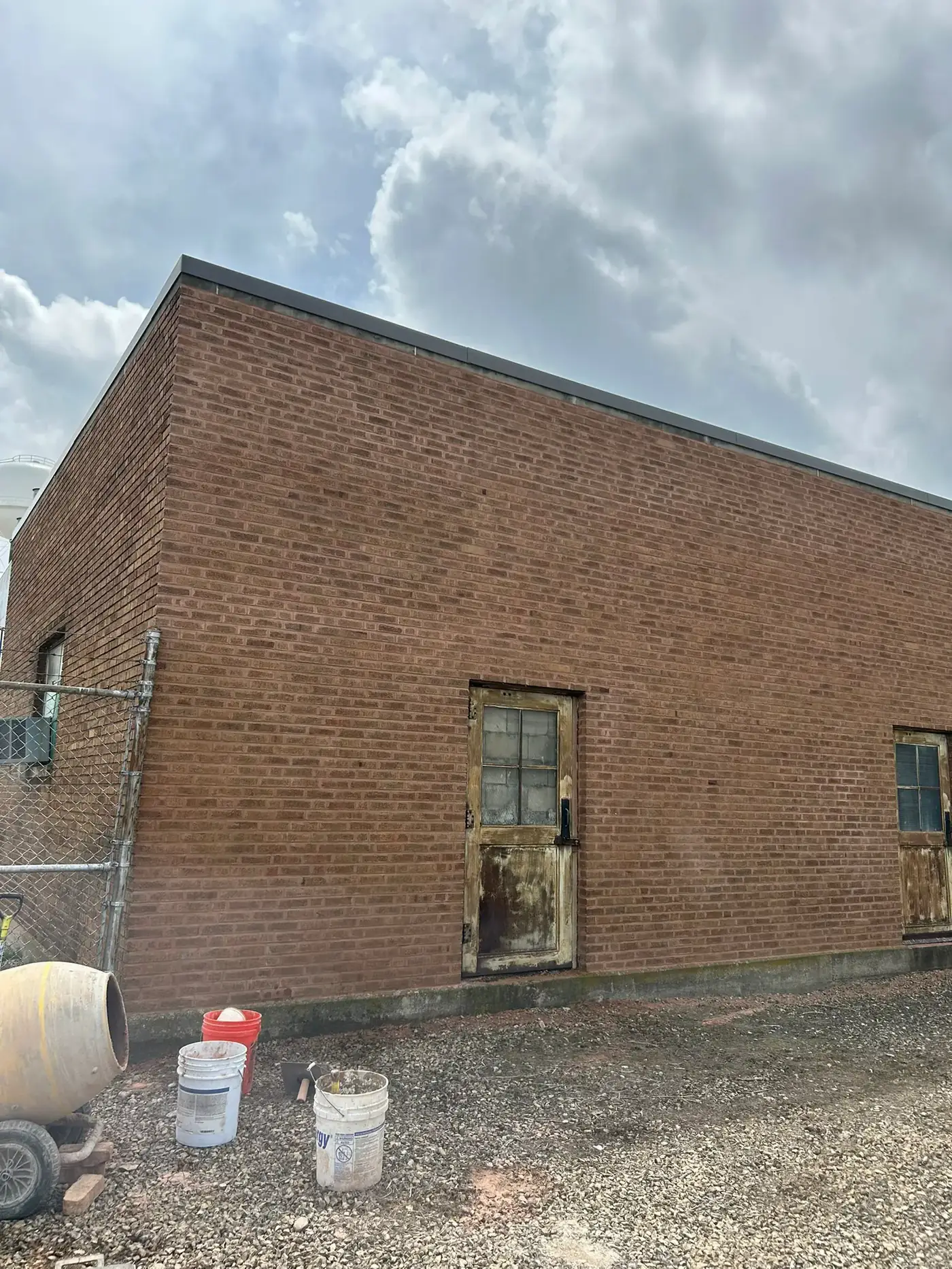
CMU Block Repair in Bedford Park, IL
CMU block repair in Bedford Park, IL covers cracked and spalled concrete block, impact damage at dock and drive-aisle height, joint and control-joint repair, unit replacement, and the coating decisions that determine whether a block wall dries or stays wet. Emerald Masonry LLC serves industrial and commercial property throughout Cook County — family-owned, licensed, bonded and insured, career masons with decades of Chicagoland experience, free on-site assessments. Call (708) 288-1696.
Most masonry advice on the internet is written about brick. Concrete block is a genuinely different material, and the difference is not cosmetic.
Brick is fired clay with a hard, comparatively sealed outer skin. Water gets into a brick wall mainly through the mortar joints, which is why brick fails at the joints first and why repointing is the dominant brick repair.
Concrete block is porous across its whole face. It absorbs broadly, not at the joints. So a block wall wets over its entire surface, holds far more water than an equivalent brick wall, and spalls in patches across the field instead of eroding along the joint lines.
Everything else about repairing block follows from that one fact.
What Actually Fails on a Bedford Park Block Wall
Face spalling
Absorbed water freezes and pops the face off the unit, usually in patches rather than a line. Worst on the lowest courses and on elevations that stay damp.
Coating failure
This is the one we get called for most. Paint on CMU is a moisture trap. It reduces absorption modestly and reduces drying dramatically, so water that gets in — around a penetration, through a crack, from the top — cannot leave. The face spalls from behind the coating, so the first symptom is peeling paint and the real damage is under it.
Impact damage
Forklifts, pallets, dock plates, trailer corners, snow equipment. Dock-height and drive-aisle block on an active facility takes physical damage that a wall on a house never sees, and every impact opens the face for water.
Control joint problems
Concrete block shrinks as it cures and continues moving with temperature. Control joints are the deliberate vertical gaps that let it do that. When a control joint has no sealant left, was never installed, or got mortared solid, the wall cracks where it wants to instead of where it was told to.
Deicer and dock apron damage
Truck courts get the heaviest salt application on any property. Salt-laden water is absorbed and then crystallizes inside the block as it dries, which exerts pressure inside the pores in the same way freezing does.
Water from the top
Open coping joints, failed roof-to-wall flashing and blocked scuppers feed water into the top of a block wall, where it travels down inside the cores.
Block vs. Brick: What Changes in the Repair
| | Brick | Concrete block (CMU) | |---|---|---| | Water entry | Mainly through joints | Across the whole face | | Typical failure | Joint erosion, then spalling | Face spalling in patches | | Movement control | Expansion joints (brick expands) | Control joints (block shrinks) | | Unit matching | Salvaged brick, size and color | Manufacturer, texture and color vary widely | | Coating risk | Real | Much higher — more absorbent, more to trap | | Correct coating | Breathable penetrating | Breathable only, after repair |
The practical takeaway: on block, the coating decision matters more than it does on brick, and it is the decision most often made wrong.
Signs Your Block Building Needs Repair
- Peeling or blistering paint with rough, crumbling block beneath.
- Spalled patches across the face rather than along joint lines.
- Cracked or gouged units at dock height and along drive aisles.
- Open vertical joints running the full height of the wall with no sealant.
- Stepped cracking at corners or near openings.
- Efflorescence — white mineral deposits — blooming across the face.
- Damp or staining on the interior face of an exterior wall.
- Mortar joints receded or washed out, particularly near grade.
Our CMU Repair Process
- Survey and map conditions by elevation, and identify whether cracking is movement, control-joint related, or settlement.
- Find the water. Roof, coping, flashing, penetrations, grade and dock drainage all get checked before anything is patched.
- Remove failed coatings where they are trapping moisture, using methods that do not further damage the face.
- Cut out and replace damaged units with matched block, toothed into the surrounding wall.
- Repoint deteriorated joints, cut to sound mortar and matched to the existing.
- Repair or install control joints where movement needs somewhere to go, sealed correctly with backer rod.
- Patch and resurface spalled faces where full replacement is not warranted.
- Address the water source — flashing, coping, drainage, penetration sealant.
- Recoat only if appropriate, breathable, and only after the wall is sound and dry.
Materials We Use
Matched concrete masonry units sourced for size, texture and color, Type N and Type S mortars selected to the wall, cementitious patching and resurfacing compounds formulated for CMU, backer rod and urethane or hybrid sealants for control joints, through-wall flashing and weep components, stainless anchors and ties, and vapor-permeable coatings only. Related work: commercial masonry restoration, parapet wall repair, masonry sealing, caulking and joint sealant and foundation masonry repair.
What Drives Cost
- Unit count — how many block need cutting out and replacing.
- Coating removal, which is frequently the largest line item on a painted wall.
- Wall area and height, and whether lift or scaffold access is needed.
- Control joint work — repairing existing versus saw-cutting new ones.
- Matching difficulty on older or discontinued block.
- Water-source correction at the roof, coping or grade.
- Operational constraints — phasing around live dock positions and truck traffic.
Working in Bedford Park and the Industrial Southwest
Bedford Park is one of the most concentrated industrial and logistics areas in Cook County — warehouses, distribution facilities, light manufacturing, rail-served property and truck courts, much of it built in concrete block with brick reserved for the office elevation facing the street. That building type puts the masonry under conditions residential walls never see: constant truck traffic, heavy winter salting, forklift and dock-plate impact, and large uninterrupted wall areas with flat roofs above them.
Freeze-thaw exposure here is the standard hard Chicagoland pattern, and it lands on a material that holds substantially more water than brick. That combination is why block walls in this corridor tend to show damage lower and more broadly than brick walls of the same age nearby.
We serve 60638 and the surrounding industrial southwest communities, including Summit, Justice, Bridgeview and Burbank. Facility managers here commonly combine block repair with parapet wall repair and control-joint sealant renewal in one mobilization.
Emerald Masonry LLC is a family-owned, licensed and insured masonry contractor serving Chicago and the Chicagoland suburbs led by career masons with decades of hands-on experience in tuckpointing, chimney repair, brick repair and replacement, lintel and parapet repair, foundation and limestone/sill repair, caulking, sealing, and commercial, residential and historic masonry restoration. We work with property managers, facility managers and insurance companies. Free on-site estimates — call (708) 288-1696.
Request a Free CMU Block Assessment in Bedford Park
If paint is peeling off spalled block, your dock walls are chewed up, or cracks are running where no control joint was ever cut, get it assessed before another winter.
Call (708) 288-1696 or request your free estimate.
Ready to get started?
Free on-site estimates for commercial and large-scale projects.
CMU Block Repair in Bedford Park, IL — Frequently Asked Questions
Why does concrete block fail differently than brick?
Brick is fired clay with a hard, comparatively sealed outer skin, so water mostly enters through the mortar joints. Concrete block is porous across its entire face, so it absorbs broadly rather than at the joints. That is why block spalls in patches across the wall while brick tends to fail at the joints first.
How much does CMU block repair cost in Bedford Park, IL?
It depends on how many units need replacing, how much crack and joint work is involved, whether steel or a control joint is implicated, and access height. Dock-level impact repair and a full elevation of coating removal are very different scopes. Emerald Masonry provides a free written estimate itemized by area.
Should I paint or coat my block wall?
Only with a vapor-permeable product, and only after the wall is sound. Standard paint on CMU slows the wetting a little and slows the drying enormously, which pushes moisture and freeze damage behind the coating. Peeling paint with spalled block underneath is one of the most common conditions we are called out for.
What is the crack running straight up my block wall?
If it is vertical, uniform and roughly evenly spaced along the wall, it is very likely a control joint doing its job — or a place where one should have been. Stepped cracks through the joints, or cracks that widen at one end, indicate movement and need proper assessment rather than a patch.
Can damaged block be replaced individually?
Yes. Individual units are cut out and replaced with matched block, which is routine on impact and spall damage at dock and drive-aisle height. Matching is the harder part, since block color and texture vary by manufacturer and age, and older units are often no longer produced.
Can you work while our facility stays operational?
Yes, and in Bedford Park that is normally required. We stage by elevation, keep dock positions and truck routes usable, and sequence around shipping and receiving rather than assuming we get the whole wall at once.
CMU Block Repair in Nearby Areas
Learn more about our cmu block repair services across Chicagoland, or view all service areas.