
CMU Block Repair · Bolingbrook, IL
CMU Block Repair in Bolingbrook, IL — Industrial and Warehouse Masonry
Concrete block does not fail like brick. It cracks in long straight lines, absorbs water through its face, and on Bolingbrook's warehouse walls it takes impacts brick never sees. Emerald Masonry LLC repairs CMU across Will County's industrial corridor.
Quick Answer
Emerald Masonry LLC provides CMU block repair in Bolingbrook, IL — repairing cracked and spalled concrete block, repointing joints, replacing damaged units, and rebuilding sections on warehouse, industrial and commercial walls. Family-owned, licensed and insured, career masons with decades of Chicagoland experience, free estimates. Call (708) 288-1696.
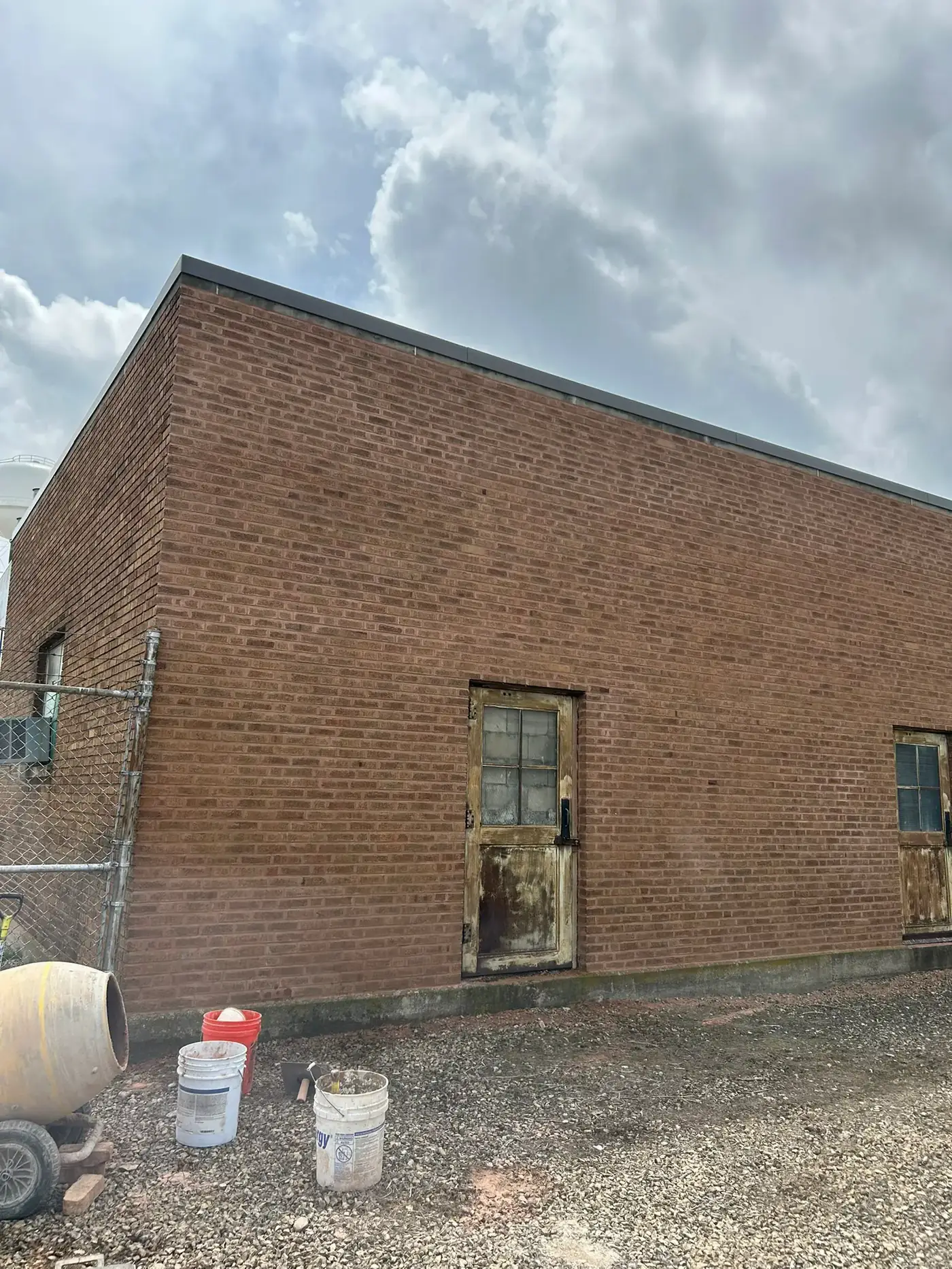
CMU Block Repair in Bolingbrook, IL
CMU block repair in Bolingbrook, IL means repairing cracked and spalled concrete block, repointing failed joints, replacing damaged units and rebuilding sections on warehouse, industrial and commercial walls. Emerald Masonry LLC does this work across Will County's distribution corridor. Family-owned, licensed, bonded and insured, career masons with decades of Chicagoland experience, free on-site estimates. Call (708) 288-1696.
Bolingbrook is a distribution town. The warehouse and light-industrial parks off I-55, Route 53 and Remington, the flex and manufacturing buildings, the big-box retail and the commercial corridors are overwhelmingly concrete masonry unit construction — often painted, often tilt-up or block-and-panel hybrids, and often twenty to forty years old.
Block does not fail like brick, and treating it like brick produces the wrong repair.
How CMU Differs From Brick
| | Brick | Concrete block (CMU) | |---|---|---| | Unit | Small, fired clay, dense skin | Large, cast concrete, absorbent throughout | | Water | Fired face resists; joints are the path | The unit itself absorbs | | Movement | Expands slightly over time | Shrinks as it cures, then moves thermally | | Needs | Expansion joints | Control joints — different purpose | | Typical cracking | Step cracks through joints | Long straight vertical cracks | | Common damage | Spalled faces, failed joints | Shrinkage cracks, impact damage, face spalling | | Reinforcement | Usually none in the wall | Often grouted cells and horizontal joint reinforcement |
Two of those rows explain most CMU problems.
Block shrinks. Concrete masonry units continue to shrink as they cure and then move with temperature. That movement has to go somewhere. Control joints are the designed answer — deliberate vertical breaks that let the wall move without cracking. Where they are missing, spaced too far apart, or were sealed once and never resealed, the wall relieves the stress the only way it can: a long straight crack.
Block absorbs through its face. A brick's fired outer skin resists water; a concrete block does not have one. On an unprotected or poorly coated block wall, the units themselves take on water — which is why freeze-thaw damage on CMU often shows as face spalling across a broad area rather than concentrated at joints.
What Fails on Bolingbrook's Industrial Walls
Shrinkage and control-joint cracking
The most common call. Straight vertical cracks, frequently at openings or at regular intervals along a long elevation. Usually addressable — but repairing the crack without restoring or adding a working control joint means it reopens.
Impact damage at docks and drive aisles
Loading dock corners, bollard surrounds, truck court walls and drive-aisle elevations take hits brick walls never see. Broken and displaced units are common, and a broken face at grade lets water straight into a wall that is already absorbing splash and road salt.
Face spalling
Freeze-thaw damage across the block face, worst at grade and on north elevations.
Joint deterioration
Mortar joints failing the same way they do anywhere, plus failed sealant in the control joints — which is a caulking problem, not a mortar one, and gets missed constantly.
Efflorescence and staining
White bloom telling you water is moving through the wall.
Painted block problems
Enormously common here. Paint on block traps moisture in an already absorbent material, so coated walls that have been recoated repeatedly often hide spalling underneath.
Signs Your Block Wall Needs Work
- Long straight vertical cracks, often at regular intervals or at openings.
- Stair-step cracking through the joints — a different signal, indicating movement.
- Horizontal cracking, bowing or displacement — evaluate before anything else.
- Broken, cracked or displaced units at dock corners and drive aisles.
- Face spalling across the block, worst near grade.
- Open, sandy or missing mortar joints.
- Failed or missing sealant in control joints.
- Efflorescence on interior or exterior faces.
- Water staining inside along the wall base or at openings.
- Blistering or peeling paint, often with spalled block underneath.
Our Repair Process
- Free on-site assessment. We read the crack pattern to distinguish shrinkage from movement, check control-joint condition and spacing, and identify where water is entering.
- Determine cause before scope. A shrinkage crack, a movement crack and an impact break are three different repairs.
- Written scope with photographs, sized for facility management or ownership.
- Phasing around operations — dock schedules, shift changes, truck access.
- Unit replacement — damaged block cut out and replaced with matched units, tied appropriately.
- Repointing with mortar matched to the wall — Type S or Type M where structurally appropriate on block, particularly below grade.
- Control joints restored or installed — cleaned, backer rod set, and sealed with a flexible sealant rather than mortar.
- Rebuilding sections that have lost integrity.
- Breathable protection where a coating is warranted — never a film-forming product that traps moisture in absorbent block.
Materials We Use
Matched concrete masonry units including split-face and burnished where the wall requires them, Type S and Type M mortars, horizontal joint reinforcement and stainless anchors where needed, backer rod and high-performance sealants for control joints, grout for cell filling where specified, and vapor-permeable coatings only. Related work: commercial masonry restoration, tuckpointing, caulking and joint sealant, lintel repair and masonry sealing.
What Drives Cost
- Number of units and total crack length.
- Wall height and access — a 24-foot warehouse elevation needs a lift.
- Cause — shrinkage repair versus addressing genuine structural movement.
- Control-joint work — restoring or adding joints is a separate scope from crack repair.
- Unit matching — split-face and colored block can be difficult to source.
- Operational phasing around docks and shifts.
- Coating removal where painted block must be assessed underneath.
We assess in person, provide a free written scope with photographs, and supply the certificate of insurance industrial and commercial properties require.
Serving Bolingbrook and Will County's Industrial Corridor
Bolingbrook sits in Will County with no lake buffer, taking the full regional freeze-thaw swing — dozens of crossings of the freezing point each winter, which is hard on a material that absorbs water through its face. Heavy clay soils move seasonally, showing up as cracking at corners and openings. Road salt and de-icer at truck courts and dock aprons attack the lowest courses aggressively.
We work throughout 60440 and 60490 — the industrial and distribution parks off I-55 and Route 53, the flex and manufacturing buildings, the retail corridors along Boughton and Weber, and the association and commercial properties throughout the village. We also serve neighboring Romeoville, Woodridge, Plainfield and Lockport. Bolingbrook owners frequently pair block work with parapet repair, lintel replacement or brick repair.
Emerald Masonry LLC is a family-owned, licensed and insured masonry contractor serving Chicago and the Chicagoland suburbs led by career masons with decades of hands-on experience in tuckpointing, chimney repair, brick repair and replacement, lintel and parapet repair, foundation and limestone/sill repair, caulking, sealing, and commercial, residential and historic masonry restoration. Free on-site estimates — call (708) 288-1696.
What Waiting Costs
On block specifically, deferral has a distinctive path. A crack or a broken unit lets water into a wall that already absorbs readily. Saturated block spalls its face and loses section. Where the wall carries grouted cells and joint reinforcement, that water reaches steel — and corroding steel inside a block wall is a structural conversation rather than a maintenance one.
Impact damage at a dock corner is the cheapest repair on this page. The same corner, left open through five winters of salt spray and freeze-thaw, is not.
Get a Free Block Wall Assessment in Bolingbrook
If you have straight cracks running your elevation, broken units at the docks, or spalling across a painted wall, get it assessed before winter.
Call (708) 288-1696 or request a free estimate.
Ready to get started?
Free on-site estimates for commercial and large-scale projects.
CMU Block Repair in Bolingbrook, IL — Frequently Asked Questions
How much does CMU block repair cost in Bolingbrook, IL?
It depends on the number of units, crack length, wall height and access, and whether reinforcing or a structural cause needs addressing. Repairing a loading-dock corner is very different from rebuilding a cracked section of a 24-foot warehouse wall. Emerald Masonry assesses in person and provides a free written scope.
Why does block crack in long straight lines?
Because concrete block shrinks as it cures and continues moving with temperature, and unlike brick it needs control joints to give that movement somewhere to go. Where control joints are missing, spaced too far apart or were never sealed, the wall relieves the stress by cracking — typically in a straight vertical line.
Is a crack in our warehouse block wall structural?
It depends on the pattern. Straight vertical shrinkage cracks are common and usually addressable; stair-step cracking, horizontal cracking, displacement or bowing indicate movement or load issues and need evaluation before any cosmetic repair. We photograph what we find so ownership can see the basis for the recommendation.
Should painted block be repainted or repaired first?
Repaired first, always. Paint on block traps moisture in a material that is already absorbent, and repainting over cracked or spalled units hides the problem while it keeps progressing. Fix the units and joints, address the water, then decide about coatings — and use a breathable product.
Can you repair block walls while our facility stays operational?
Yes. Warehouse and industrial masonry repair is routinely staged around dock schedules and shift changes, with work zones protected and access maintained. We coordinate phasing with facility management before mobilizing so trucks keep moving.
What about damage at loading docks and truck courts?
Impact damage at dock corners, bollard surrounds and drive aisles is one of the most common repairs we do on these buildings. It is usually localized unit replacement plus repointing, and it is worth addressing early because a broken face lets water into a wall that is already absorbing at grade.
CMU Block Repair in Nearby Areas
Other Masonry Services in Bolingbrook, IL
Learn more about our cmu block repair services across Chicagoland, or view all service areas.