
Commercial Masonry Restoration · Melrose Park, IL
Commercial Masonry Restoration in Melrose Park, IL — Load-Bearing Walls and Veneer Are Two Different Buildings
Melrose Park has two kinds of commercial masonry sitting side by side on the same street — load-bearing brick from the 1920s and brick veneer hung on a steel frame from the 1970s. They fail differently, they get repaired differently, and they cost differently. Almost nobody asks which one you have.
Quick Answer
Emerald Masonry LLC provides commercial masonry restoration in Melrose Park, IL — tuckpointing, brick and CMU repair, parapet and lintel work, and facade restoration on warehouses, industrial buildings and storefronts, scheduled around active operations. Family-owned, licensed and insured, career masons with decades of Chicagoland experience, free estimates. Call (708) 288-1696.
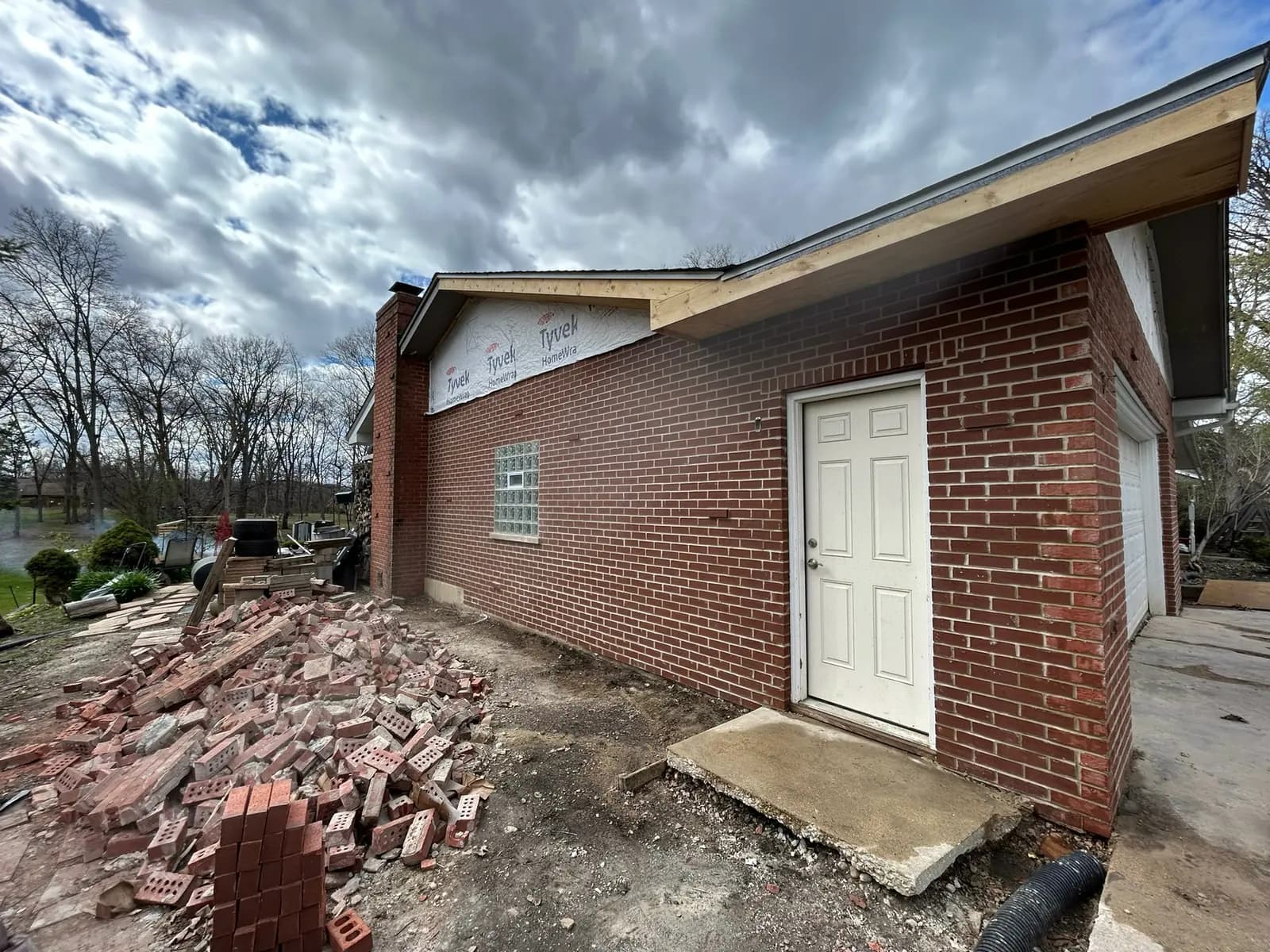
Commercial Masonry Restoration in Melrose Park, IL
Commercial masonry restoration in Melrose Park, IL covers tuckpointing, brick and block repair, parapet and coping rebuilds, lintel and shelf-angle work, and full facade restoration on warehouses, industrial buildings, storefronts and multi-tenant property. Emerald Masonry LLC does this work throughout Cook County — family-owned, licensed, bonded and insured, career masons with decades of Chicagoland experience, free on-site assessments. Call (708) 288-1696.
Here is the question that determines your scope, and it almost never gets asked:
Is your wall holding the building up, or is it hanging on the building?
Melrose Park's commercial stock runs from 1920s load-bearing industrial brick to 1970s brick veneer on steel frame, frequently on the same block and occasionally on the same property. They look similar from the street and they are structurally unrelated. A scope written without knowing which one you have is a guess.
Load-Bearing vs. Veneer: How to Tell, and Why It Matters
| | Load-bearing multi-wythe | Brick veneer on frame | |---|---|---| | Typical era here | 1900s–1950s | 1960s–present | | Wall at a window reveal | 8–16 inches deep | ~4 inches + framing | | Header courses | Present — bricks laid end-on | Absent | | Weep holes at base | None | Present (should be) | | What carries load | The masonry itself | The steel or stud frame | | Hidden steel | Lintels over openings | Lintels plus shelf/relieving angles | | Primary failure | Mortar erosion, inner-wythe saturation, bulging | Tie corrosion, shelf-angle rust, displacement | | Worst case | Loss of section in a bearing wall | Veneer separating from the structure |
On a load-bearing wall, the masonry is the structure, so eroded joints and saturated inner wythes are a capacity question, not just an appearance one. Water that gets past the outer wythe has nowhere to drain — there is no cavity — so it moves through the wall and shows up as efflorescence and damp on the interior face.
On veneer, the masonry is a rain screen. It is designed to leak, and to drain what leaks through a cavity and back out the weep holes. The structural risk is not the brick; it is the corrugated ties and the shelf angles holding it to the frame. When those rust through, the wall is sound-looking and unsupported at the same time.
Signs a Melrose Park Commercial Building Needs Restoration
- Displaced or open coping at the parapet, or mortar washed out of the coping joints.
- A parapet leaning, bowing or separating at the corners.
- Rust staining and horizontal cracking above windows, dock doors and storefront openings.
- A horizontal crack running the length of a floor line on a veneer building — the classic shelf-angle signature.
- Spalled, eroded or impacted block at the dock apron and drive aisle.
- Efflorescence or damp on the inside face of an exterior wall.
- Stepped cracking at building corners or where an addition meets the original structure.
- Weep holes mortared shut, painted over, or absent entirely on a veneer wall.
- Sealant failure at panel joints, window perimeters and control joints.
Risks of Waiting on Commercial Masonry
Commercial deferral costs more than residential deferral, for three reasons.
Scale. A residential wall is a few hundred square feet. An industrial elevation is thousands, so the same rate of deterioration multiplies.
Access. Once damage climbs above the reach of a lift, you are into swing stage or scaffold, and access frequently costs more than the masonry.
Liability. Falling masonry from a parapet or a facade over a sidewalk, a dock or an employee parking area is a different category of problem than a cosmetic one — and on taller buildings, facade condition is increasingly a documented obligation rather than a discretionary maintenance item.
Our Commercial Restoration Process
- Survey and classification. Determine wall construction, locate hidden steel, identify prior repairs, photograph and map conditions by elevation.
- Prioritize by risk and water path. Parapet and coping first, then openings and steel, then field walls, then grade — because that is the order water travels.
- Written scope by elevation, with quantities, so you can phase it across budget years if you need to.
- Access plan built around your operations — lift, scaffold or swing stage, with dock doors and drive aisles kept usable.
- Steel first. Expose corroded lintels, relieving and shelf angles, treat or replace, and install through-wall flashing above the steel so it stays dry.
- Rebuild and repoint — joints cut to sound mortar, mortar matched to the units, tooled to the original profile.
- Parapet and coping reset or rebuilt with proper flashing and positive drainage.
- Sealant and control joints renewed with the correct product and backer rod.
- Coatings only where appropriate, breathable, and only after the joints are sound.
Materials We Use
Mortars matched by type and color to the existing masonry (Type N on most older brick, Type S where the wall genuinely calls for it), matched face brick and salvaged units, CMU and matched block, primed and galvanized steel for lintel and angle replacement, stainless and helical anchors and ties, through-wall flashing and weep components, urethane and hybrid sealants with proper backer rod, and vapor-permeable coatings only. Related work: tuckpointing, parapet wall repair, lintel repair, brick replacement, caulking and joint sealant and masonry sealing.
What Drives Cost
- Wall construction — veneer with shelf-angle work is a different project than repointing a solid wall.
- Height and access — ground-and-lift work versus scaffold or swing stage.
- Steel involved — every corroded lintel or angle adds shoring, removal and rebuild.
- Parapet condition — resetting coping is minor; rebuilding a parapet is major.
- Repair versus rebuild ratio across each elevation.
- Operational constraints — night work, phased access, keeping docks live.
- Protection requirements over entries, docks, sidewalks and parked vehicles.
Phasing is normal here. A written scope broken out by elevation lets you take the parapet this year and the field walls next, in the order that actually protects the building.
Working in Melrose Park and the Near West Suburbs
Melrose Park is a working commercial and industrial village in western Cook County, and its masonry reflects that — distribution and warehouse buildings, light manufacturing, multi-tenant industrial, and the older brick storefront corridors along the main commercial streets. The building stock is unusually mixed in age, which is exactly why the load-bearing-versus-veneer question matters more here than in a uniformly post-war suburb.
Exposure is hard. Flat roofs mean parapets exposed on both faces with no heated interior moderating them, truck courts get the heaviest de-icer application of any surface on a property, and Chicagoland freeze-thaw delivers dozens of crossings of the freezing point each winter into whatever is already saturated.
We serve 60160 and 60164 and the surrounding near-west communities, including Forest Park, River Forest, Oak Park, Berwyn and Westchester. Property managers here often pair restoration with parapet wall repair and joint sealant renewal on the same mobilization.
Emerald Masonry LLC is a family-owned, licensed and insured masonry contractor serving Chicago and the Chicagoland suburbs led by career masons with decades of hands-on experience in tuckpointing, chimney repair, brick repair and replacement, lintel and parapet repair, foundation and limestone/sill repair, caulking, sealing, and commercial, residential and historic masonry restoration. We work with property managers, HOAs, churches and insurance companies. Free on-site estimates — call (708) 288-1696.
Request a Free Commercial Masonry Assessment in Melrose Park
If you have rust staining above your dock doors, coping moving at the parapet, or a horizontal crack running a floor line, get the wall classified before anyone writes a number against it.
Call (708) 288-1696 or request your free estimate.
Ready to get started?
Free on-site estimates for commercial and large-scale projects.
Commercial Masonry Restoration in Melrose Park, IL — Frequently Asked Questions
How do I know whether my building is load-bearing masonry or brick veneer?
Wall thickness at a window or door reveal is the quickest tell — a solid multi-wythe wall reads eight to sixteen inches deep, veneer reads about four plus framing. Header courses of brick laid end-on, and the absence of weep holes at the base, also point to load-bearing construction. It matters because the two fail and get repaired very differently.
How much does commercial masonry restoration cost in Melrose Park, IL?
It is driven by wall area, height and access, whether steel is involved, and how much of the work is repair versus rebuild. A one-elevation tuckpointing scope on a single-story building and a parapet rebuild on a four-story warehouse are entirely different projects. Emerald Masonry provides a free written scope with itemized areas.
Can you work on our building while we stay open?
Yes, and on commercial and industrial properties in Melrose Park that is the normal condition. We stage by elevation, keep dock doors and drive aisles usable, and coordinate the sequence with your operations rather than assuming a shutdown.
What usually fails first on a Melrose Park warehouse or industrial building?
The parapet and coping at the top, and the base course at the dock apron. Both take the most water — the parapet is exposed on two faces with no heated interior behind it, and the base takes splash, de-icer and impact. Mid-wall failures are usually secondary to one of those two.
Do you handle the steel as well as the brick?
Yes. Corroded lintels, relieving angles and shelf angles are a routine part of commercial masonry restoration, and repointing over rusting steel just hides the problem. We expose it, address the corrosion, and rebuild the masonry with proper flashing above it.
Can you repair concrete block as well as brick?
Yes — much of the industrial stock here is CMU, sometimes with a brick face on the street elevation only. Block behaves differently from brick because it absorbs across its whole face rather than through joints, so it gets a different repair and a different coating decision.
Commercial Masonry Restoration in Nearby Areas
Learn more about our commercial masonry restoration services across Chicagoland, or view all service areas.