
Limestone / Sill Repair · Riverside, IL
Limestone and Sill Repair in Riverside, IL — Stone on a Landmark-District Home
Riverside is a National Historic Landmark district, which changes the standard a stone repair is held to. Removing an original unit is a decision you cannot reverse — so on these houses, repair is not the frugal option, it is the correct one.
Quick Answer
Emerald Masonry LLC provides limestone and sill repair in Riverside, IL — restoring cracked, spalled and eroded stone window sills, lintels, water tables and trim on landmark-district homes using dutchman inserts and matched patching. Family-owned, licensed and insured, career masons with decades of Chicagoland experience, free estimates. Call (708) 288-1696.
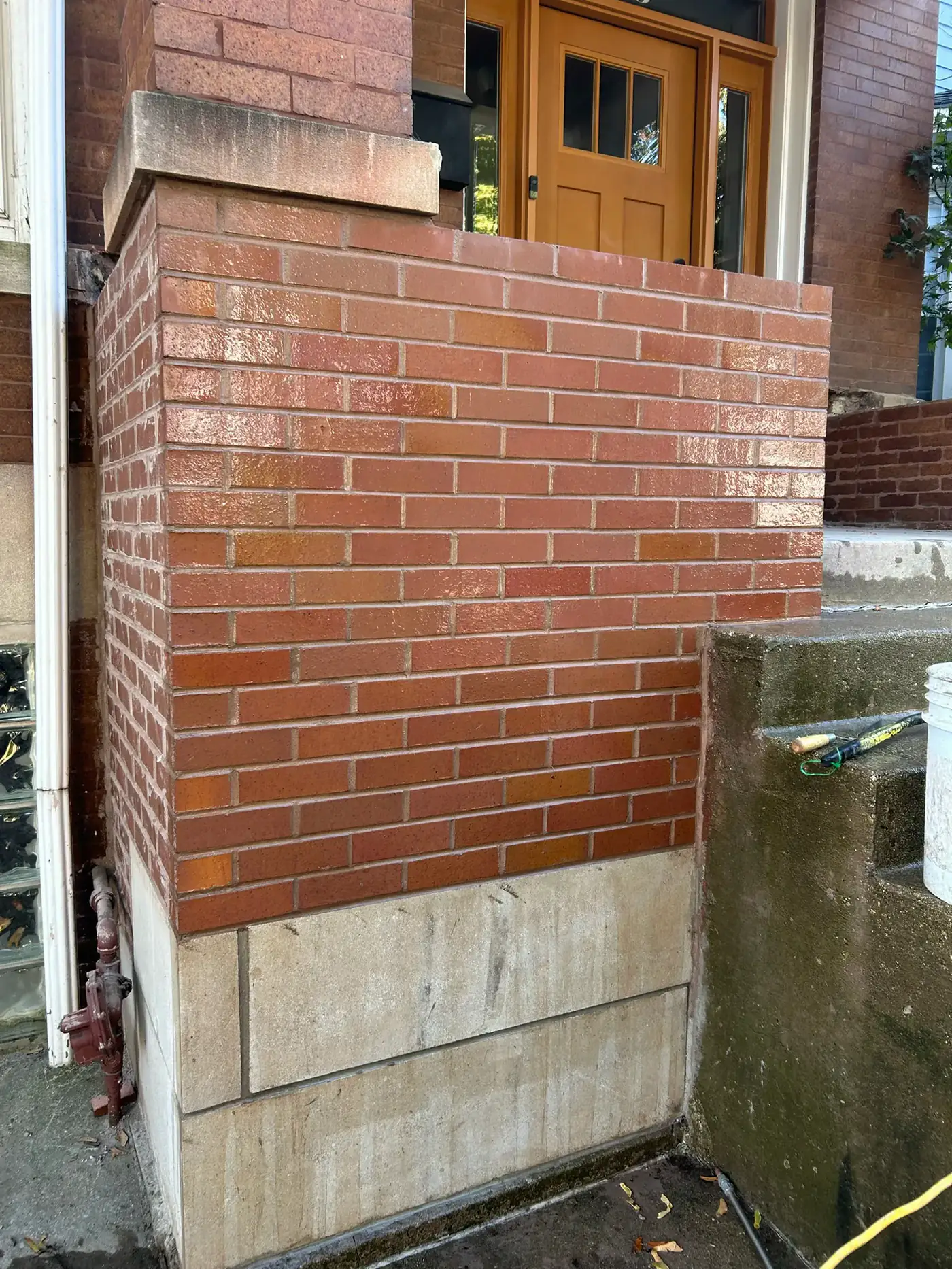
Limestone and Sill Repair in Riverside, IL
Limestone and sill repair in Riverside, IL is the restoration of the stone elements on a house — window and door sills, lintels, water tables, steps and trim — when they crack, spall, erode or shift. Emerald Masonry LLC repairs those units rather than replacing them, using dutchman inserts, matched patching and correctly matched stone. Family-owned, licensed, bonded and insured, career masons with decades of Chicagoland experience, free on-site estimates. Call (708) 288-1696.
Riverside changes the calculation on stone repair, and it is worth being explicit about why.
The village was laid out in 1869 by Frederick Law Olmsted and Calvert Vaux — the same partnership behind Central Park — as one of the first planned suburban communities in America. It is a National Historic Landmark district, which is the highest level of historic designation in the country.
On an ordinary house, repairing a stone sill instead of replacing it is a sensible economy. Here it is the correct answer on the merits, because an original unit removed is historic fabric that does not come back.
What Actually Fails on Limestone
Limestone is sedimentary, deposited in visible bedding planes — horizontal layers that are planes of relative weakness. It is durable and handsome, and it is porous, so it takes on water.
In a Cook County winter that absorbed water freezes inside the stone, expands, and splits it along those layers. Four failure modes follow:
- Delamination and spalling — the face shedding in sheets or shells following the bedding.
- Cracking — often across a sill span, or radiating from a bearing point.
- Surface erosion — the slope flattening and the crisp nose profile rounding over. The quiet one, because the sill still looks intact while it has stopped shedding water.
- Displacement — a unit dropping or tilting because the mortar bed beneath it failed.
Horizontal stone fails first, always, because it holds water rather than shedding it. Sills, water tables, steps and caps take the worst of it.
Signs Your Riverside Home Needs Stone Repair
- Sills flaking, shelling or crumbling at the face or the nose.
- Cracks running through a sill, lintel or trim unit.
- Masonry below a window streaked, stained or spalling — the strongest single indicator.
- Open or missing mortar joints where stone meets brick.
- Failed or missing caulking at the sill-to-window joint.
- Stone that has dropped, tilted or shifted out of plane.
- A sill that no longer looks sloped — check with a level; a flat sill is a failed sill.
- Rust staining on the stone, indicating corroding embedded metal or a steel lintel behind it.
- Eroded carved detail on trim, porches and door surrounds.
- Prior hard-mortar repairs — gray Portland pointing against soft historic stone.
The Repair Hierarchy — Least Invasive First
In a landmark district this ordering is not conservatism. It is the standard the work is judged against.
| Approach | What it involves | When it is right | |---|---|---| | Repointing and recaulking | Restoring joints and sealant around sound stone | Stone intact, joints failed | | Matched patching | Cementitious patch rebuilding lost material | Localized spalling and edge loss | | Dutchman repair | Cutting out the damaged area, fitting matched new stone | Significant local damage, unit otherwise sound | | Repinning / resetting | Removing, rebedding and anchoring a shifted unit | Displaced but intact stone | | Full replacement | New matched limestone unit | Structurally failed or broken — last resort |
Why the Mortar Decides the Outcome
The governing rule: mortar must be softer than the masonry it holds. Mortar is the sacrificial layer — it absorbs movement and moisture stress and wears out first, because replacing mortar is cheap and replacing a 150-year-old carved unit is not.
At a stone joint, a hard modern Portland mix concentrates stress at the stone face rather than in the joint. On porous, layered limestone that means accelerated delamination — the repair destroying the material it was meant to protect. On Riverside's pre-1900 and early-1900s stock we use lime-based mixes deliberately.
If a previous contractor pointed your stone with hard gray mortar and the faces have started shedding since, those two facts are related.
Working in a Landmark District
Practical expectations rather than legal advice.
Exterior work generally requires a village permit, and Riverside maintains preservation review. Work that changes visible material, profile or appearance is more likely to require approval than in-kind repair using matching materials — which is another reason the repair hierarchy above matters.
We work within whatever process applies and provide the scope documentation with photographs that the village or commission asks for. Bring us in before you submit, not after, so the scope you file is the scope that will actually be performed.
Our Process
- Free on-site assessment. Every stone element examined, slope checked on sills, and — critically — the water path identified.
- Correct the water path first. Failed joints, missing caulking, bad flashing, a clogged gutter discharging onto stone.
- Cut back to sound material without over-cutting. On soft historic stone this is hand work.
- Method selected per unit — patching, dutchman, repinning or replacement, decided unit by unit rather than applied across the board.
- Matched stone and mortar. Indiana limestone and matched stone, with soft lime-based mortar on pre-1920 walls.
- Restore the slope. A repaired sill that still does not shed water has not been repaired.
- Sealant and breathable protection — new backer rod and sealant where needed, vapor-permeable products only.
- Photo documentation of conditions and completed work, for your records and any commission file.
Materials We Use
Indiana limestone and matched replacement stone, stainless anchors and pins, matched stone patching compounds, lime-modified and Type N mortars appropriate to the age of the wall, backer rod and sealant, and breathable sealers only. Related work: historic masonry restoration, tuckpointing, brick repair and lintel repair.
What Drives Cost
- Number of units — a few sills versus stone across a full facade.
- Repair method — patching is less involved than a dutchman; a dutchman less than replacement.
- Height and access — upper-floor sills need staging.
- Matching difficulty — unusual grain, color or a carved profile.
- Hand work required on soft historic stone.
- Undoing prior hard-mortar repairs, which is delicate and slow.
- Related damage — a rusting steel lintel behind the stone, or spalled brick below a failed sill.
- Review and documentation where preservation approval applies.
Serving Riverside and the Near West Suburbs
Riverside sits along the Des Plaines River in Cook County with no lake buffer, taking dozens of freeze-thaw crossings each winter. The village's defining feature — its extraordinary mature tree canopy, part of the original Olmsted plan — is also hard on masonry: shaded elevations dry slowly and enter every freeze cycle wetter, and heavy leaf load overwhelms gutters. It is common here to find sound sills on one elevation and delaminating stone thirty feet away.
We work throughout 60546 — the curvilinear streets of the original Olmsted plan, the homes along the river and around the Common, the blocks near the Riverside Metra station and the historic Water Tower, and the churches and institutional buildings in the village. We also serve neighboring Brookfield, La Grange Park, Berwyn and Cicero. Riverside owners frequently pair stone work with tuckpointing.
Emerald Masonry LLC is a family-owned, licensed and insured masonry contractor serving Chicago and the Chicagoland suburbs led by career masons with decades of hands-on experience in tuckpointing, chimney repair, brick repair and replacement, lintel and parapet repair, foundation and limestone/sill repair, caulking, sealing, and commercial, residential and historic masonry restoration. Free on-site estimates — call (708) 288-1696.
Why Waiting Costs More Here
A failed sill does not stay a sill problem. It becomes a wet wall, then spalled masonry below, then a rusting lintel behind it, then water inside at the window head.
On a landmark-district house there is a second cost that does not appear on any invoice: once a carved profile erodes away or a face delaminates off, the original material is gone. Every replacement unit is a compromise against something that cannot be reproduced. Repair while there is still something to repair.
Request a Free Stone Assessment in Riverside
If your sills are flaking or cracked, if the masonry under a window is streaked, or if a past repair used the wrong mortar — have it assessed before another freeze-thaw season.
Call (708) 288-1696 or request your free estimate.
Ready to get started?
Free on-site estimates for commercial and large-scale projects.
Limestone / Sill Repair in Riverside, IL — Frequently Asked Questions
Can a cracked limestone sill be repaired or does it need replacing?
Most cracked sills are repairable. Cracks, spalled edges and eroded faces are commonly restored with dutchman stone inserts, matched patching mortars, or careful cutting and repinning. In a landmark district that matters more than usual, because replacing an original unit removes historic fabric permanently.
How much does limestone sill repair cost in Riverside, IL?
It depends on how many units are involved, whether they can be repaired in place, and how high off the ground they sit. Landmark-district work is often slower and more exacting than standard repair, which affects the number. Emerald Masonry assesses in person and provides a free written estimate.
Do I need village or commission approval for stone work in Riverside?
Riverside is a National Historic Landmark district and the village has preservation review, so exterior work — particularly anything that changes visible material or profile — can require approval, and a permit is generally needed regardless. In-kind repair using matching materials is usually the simplest path. We work within whatever process applies.
Why is the brick under my window streaked and spalling?
That is the signature of a failed sill above it. Once a sill loses its slope or its joints open, it holds water and delivers it down the wall instead of throwing it clear. The masonry below then takes concentrated runoff every storm, which is why sill repair often prevents brick repair.
What is a dutchman repair?
A dutchman is a stone patch — the damaged section of a unit is cut out cleanly and a matched piece of new stone is fitted into its place. It preserves the original unit and most of its material while restoring a sound surface, which is exactly what preservation standards favor over wholesale replacement.
Should limestone be sealed after repair?
Only with a breathable, vapor-permeable product, and only after the water source is corrected. Film-forming coatings and paint trap moisture inside porous stone, and the trapped water then spalls the face off from behind — a common and entirely avoidable way historic stone gets destroyed.
Limestone / Sill Repair in Nearby Areas
Other Masonry Services in Riverside, IL
Learn more about our limestone / sill repair services across Chicagoland, or view all service areas.