
Limestone / Sill Repair · Elgin, IL
Limestone & Sill Repair in Elgin, IL — Why the Stone Under Your Windows Fails Before the Brick Does
On Elgin's Victorian and early-1900s homes, the limestone sills, water tables and steps fail long before the brick around them. The reason is simple: they are the only horizontal stone on the building, and every wrong repair made to them — caulk, cement patches, hard mortar — makes them fail faster.
Quick Answer
Emerald Masonry LLC provides limestone and sill repair in Elgin, IL — repairing cracked, spalling and delaminating window sills, water tables, lintels, steps and stone trim on Victorian and early-1900s homes and commercial buildings using dutchman repairs, matched replacement stone and compatible lime mortar. Family-owned, licensed and insured, career masons with decades of experience. Call (708) 288-1696.
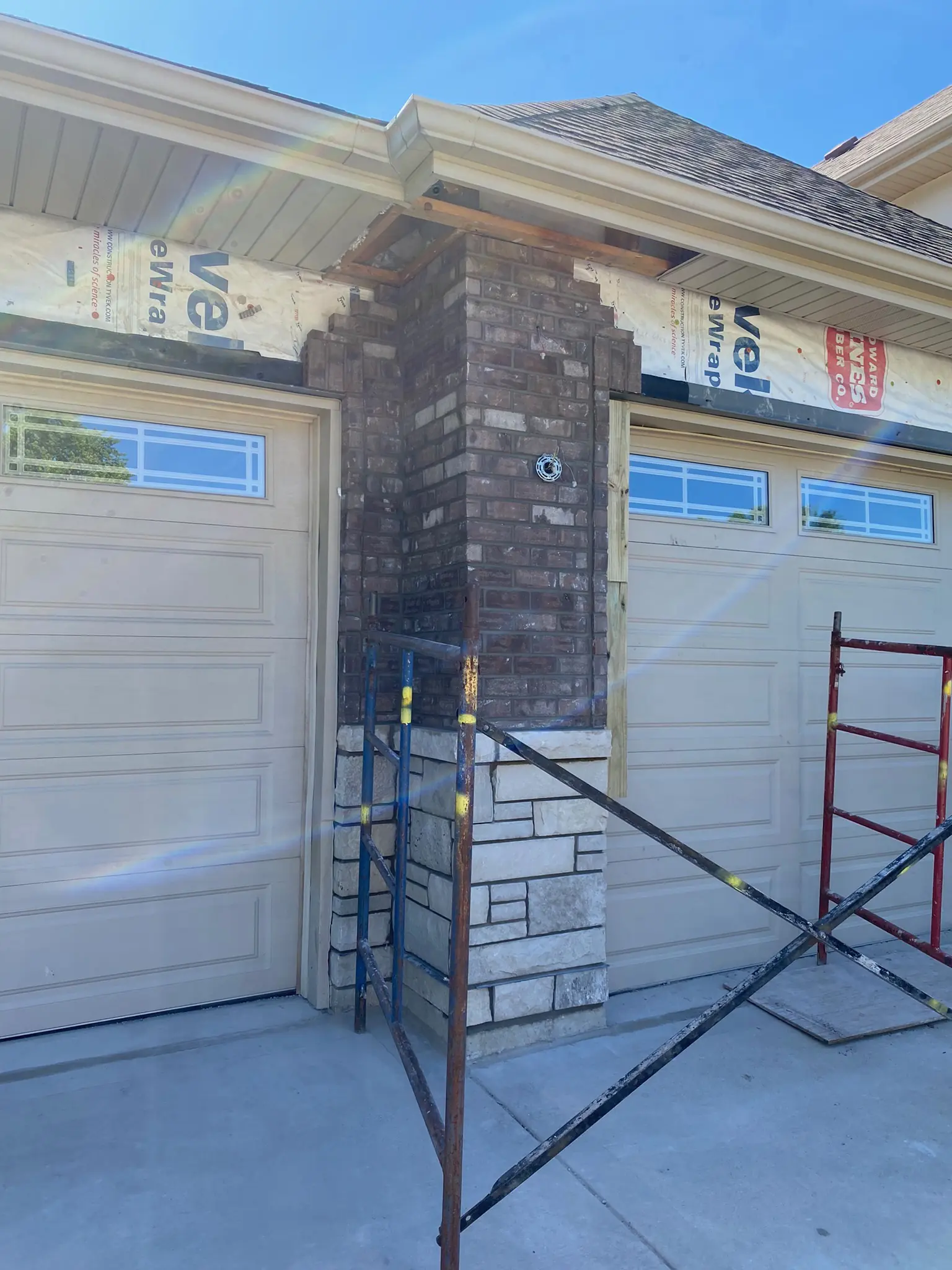
Limestone & Sill Repair in Elgin, IL
Limestone and sill repair in Elgin, IL is a stone problem, not a brick problem — and it needs to be treated as one. Emerald Masonry LLC repairs and replaces window sills, water tables, lintels, steps, porch stone and decorative trim on Elgin's Victorian, early-1900s and commercial masonry. Family-owned, licensed, bonded and insured, career masons with decades of Chicagoland experience, free on-site estimates. Call (708) 288-1696.
Walk any older street off Elgin's Fox River bluff and you will see the same thing repeatedly: brick that has held up reasonably well for a hundred and twenty years, and stone sills under the windows that are cracked, crumbling, patched with grey cement, or sagging. That is not bad luck. It is physics.
Why Sills and Horizontal Stone Fail First
Everything else on a masonry wall is vertical. Vertical surfaces shed water. A sill is horizontal, and horizontal stone holds water.
Then it does three more jobs no other stone on the building has to do:
- It collects all the runoff from the window above it and concentrates it in one narrow band.
- It spans an opening, so unlike the wall around it, there is nothing supporting its middle.
- It carries the wall load transferring down around the window.
Add Elgin's climate — Kane County freeze-thaw cycling, wind-driven rain off the Fox River valley — and the sequence writes itself. Water sits on the sill or wicks into it, freezes, expands, and opens a hairline into a crack. The crack takes more water. The next winter widens it. Eventually the sill cracks through at midspan, or the face spalls off in sheets.
The same mechanism attacks every other horizontal stone on an Elgin house: water table courses, belt courses, cornice stone, stone steps, porch caps, wall copings and stone lintels.
The Three Repairs That Make It Worse
We are usually not the first ones to look at a failing sill. These are the three fixes we most often have to undo.
Caulk over the crack. It looks solved for a season. In reality the crack is still there, water still gets in from the top and the ends, and now it cannot get back out. Sealing a crack in porous stone is a way of storing water in it.
Cement patching. A grey Portland patch troweled over a spalled area is harder, denser and far less permeable than the limestone underneath. Moisture moving through the stone hits the back of the patch, cannot evaporate through it, and freezes there — taking off a bigger piece of stone than the one being repaired. Then the patch itself falls off, usually with original stone attached.
Hard mortar in the joints. Repointing a stone sill or water table with a modern Portland mix on a nineteenth-century building is the same mistake at a smaller scale. The mortar and any patch must be softer and more permeable than the stone. Stone is the part you cannot replace.
Signs Your Elgin Limestone Needs Attention
- Cracks running front to back through a sill, especially at midspan
- Flat layers flaking or sheeting off the face — delamination
- Crumbling, sugaring or powdery surface texture
- Loss of the drip edge or wash pitch, so water now runs back toward the wall
- Open or missing mortar at the joints under and beside the sill
- Cement patches that are blistered, cracked, or falling away
- Rust staining from embedded or adjacent steel
- Stone steps and porch caps that rock, have separated, or are spalling at the nosing
- Efflorescence or dark staining on the brick directly beneath a sill
Risks of Waiting
A failed sill is an open channel into the wall. Water that gets past it does not stop at the stone — it enters the masonry below and around the opening, wets the interior of the wall, and reaches whatever steel is in the assembly. On many Elgin buildings that means the window framing and any steel lintel behind the stone.
Structurally, a sill that has cracked through has lost its ability to distribute the load above it, which shows up as cracking in the brick at the corners of the opening. And practically: a sill repairable with a dutchman this year may need full replacement in three, at several times the cost — and replacement means disturbing the surrounding masonry.
Our Limestone and Sill Repair Process
- Identify the stone and the failure mode — surface spalling, through-cracking, delamination from face bedding, or loss of the mortar around it.
- Determine repair, dutchman, or replacement for each unit, and explain the reasoning.
- Remove failed patches and hard mortar carefully by hand where they are damaging the stone.
- For in-place repair: clean and consolidate the sound surface, then repoint joints with a soft, permeable, colour-matched lime mortar.
- For a dutchman: cut a clean, squared recess into sound stone, fabricate a matched natural stone patch, pin it with stainless anchors, and set it in compatible mortar.
- For replacement: shore the opening as needed, remove the failed unit without damaging the surrounding masonry, and set matched replacement stone with correct pitch and a proper drip edge.
- Rebuild the wash and drip so the finished stone sheds water away from the wall — this is the detail most often lost in previous repairs.
- Repoint the surrounding masonry and address adjacent brick with brick repair where the stone failure has already damaged it.
- Seal only where appropriate — a breathable treatment where one is warranted, never a film-forming coating that traps moisture in the stone.
Materials
Elgin's older stone is regional Midwestern limestone, and much of the trim on the city's Victorian stock came from the Fox River valley's quarrying era. It is porous, sedimentary and layered — which is why bedding orientation matters so much. Stone set on its natural bed, with the layers horizontal, sheds water across them. Stone set face-bedded, with layers vertical, lets water in between them and freezes them apart. Face bedding is the single most common reason an Elgin sill delaminates.
Mortars are lime-rich and permeable. Anchors are stainless. Replacement stone is selected for colour, grain and finish against the actual wall in daylight. Related work commonly runs alongside: tuckpointing, historic masonry restoration, lintel repair and caulking and joint sealant.
What Drives the Cost
- Repair, dutchman, or full replacement — three very different scopes
- Number of openings and whether damage is scattered or a full elevation
- Height and access, including staging over porches, walks and landscaping
- Stone matching difficulty and fabrication time
- Whether shoring is required to remove a load-bearing unit
- Undoing prior repairs — old cement patches and hard mortar add labour
- Historic district review where applicable
We do not quote stone work over the phone. Estimates are free, on-site and written.
Serving Elgin and Kane County
Emerald Masonry LLC is a family-owned, licensed and insured masonry contractor serving Chicago and the Chicagoland suburbs led by career masons with decades of hands-on experience in tuckpointing, chimney repair, brick repair and replacement, lintel and parapet repair, foundation and limestone/sill repair, caulking, sealing, and commercial, residential, and historic masonry restoration. Free on-site estimates — call (708) 288-1696.
We work throughout Elgin and neighbouring St. Charles, Geneva, Bartlett and Streamwood, for homeowners, property managers, HOAs, churches and insurance companies. $5,000 project minimum.
Get a Free Elgin Limestone Assessment
If a sill has cracked through, stone is flaking off in layers, or someone has patched your limestone with cement, have it looked at by a mason who works on stone rather than around it. Call (708) 288-1696 or request a free estimate.
Ready to get started?
Free on-site estimates for commercial and large-scale projects.
Limestone / Sill Repair in Elgin, IL — Frequently Asked Questions
How much does limestone sill repair cost in Elgin, IL?
It depends on whether a sill can be repaired in place, needs a dutchman patch of matched stone, or has to be cut out and replaced entirely — and on how many openings are affected. A single accessible first-floor sill is a small job; a full elevation of failing water table stone is not. Emerald Masonry assesses on site and provides a free written estimate.
Why do my limestone sills crack when the brick around them looks fine?
Because a sill is the only horizontal stone surface on the wall, so it holds water instead of shedding it. That water soaks in, freezes, and expands. Sills also carry the load of the wall above, sit over an opening with nothing under the middle, and take the runoff from the whole window.
What is a dutchman repair?
A dutchman is a patch of matched natural stone cut to fit a sound recess in the original, pinned and set with a compatible mortar. It preserves the original stone and the original profile, and on historic Elgin homes it is usually a better answer than replacing a whole sill or covering the damage with a cement patch.
Can a cracked limestone sill just be filled with caulk or cement?
It should not be. Caulk hides the crack while sealing water inside the stone, and a hard cement patch is denser and less permeable than the limestone around it, so moisture concentrates behind the patch and pops more stone off. Both are common, and both accelerate the failure they were meant to stop.
My limestone is flaking off in flat layers. What is that?
That is delamination, and it usually means the stone was set face-bedded — installed with its natural sedimentary layers vertical rather than horizontal — so water gets between the layers and freezes them apart. Delaminating stone rarely stabilizes on its own and generally needs a dutchman repair or replacement.
Do you work on historic homes in Elgin's historic districts?
Yes. Much of our Elgin work is on Victorian and early-1900s stock where the correct mortar is soft and lime-rich rather than modern Portland-based. We also work with owners on documentation for local review where a district requires it.
Can you match old Elgin limestone?
We can usually get very close on colour, grain and finish, though an exact match to century-weathered stone is not realistic — new stone has not aged yet. Where the original is repairable we prefer to keep it, because salvaged and original stone is almost always a better match than anything quarried today.
Limestone / Sill Repair in Nearby Areas
Other Masonry Services in Elgin, IL
Learn more about our limestone / sill repair services across Chicagoland, or view all service areas.