
Limestone / Sill Repair · Beverly, Chicago, IL
Limestone & Sill Repair in Beverly, Chicago — The Greystone Problem Is the Face, Not the Stone
Beverly's greystones are faced in Bedford limestone that was tooled by hand a century ago. When that stone starts to sugar, delaminate or spall, the damage is almost always in the outer inch — and what you do to that inch decides whether the stone lasts another hundred years or gets destroyed in a weekend.
Quick Answer
Emerald Masonry LLC provides limestone and sill repair in Beverly, Chicago — repairing sugaring, delaminating and spalling greystone facades, window sills, water tables, stone lintels and stoops using dutchman repairs, matched stone and soft lime mortar rather than cement patching. Family-owned, licensed and insured, career masons with decades of experience. Call (708) 288-1696.
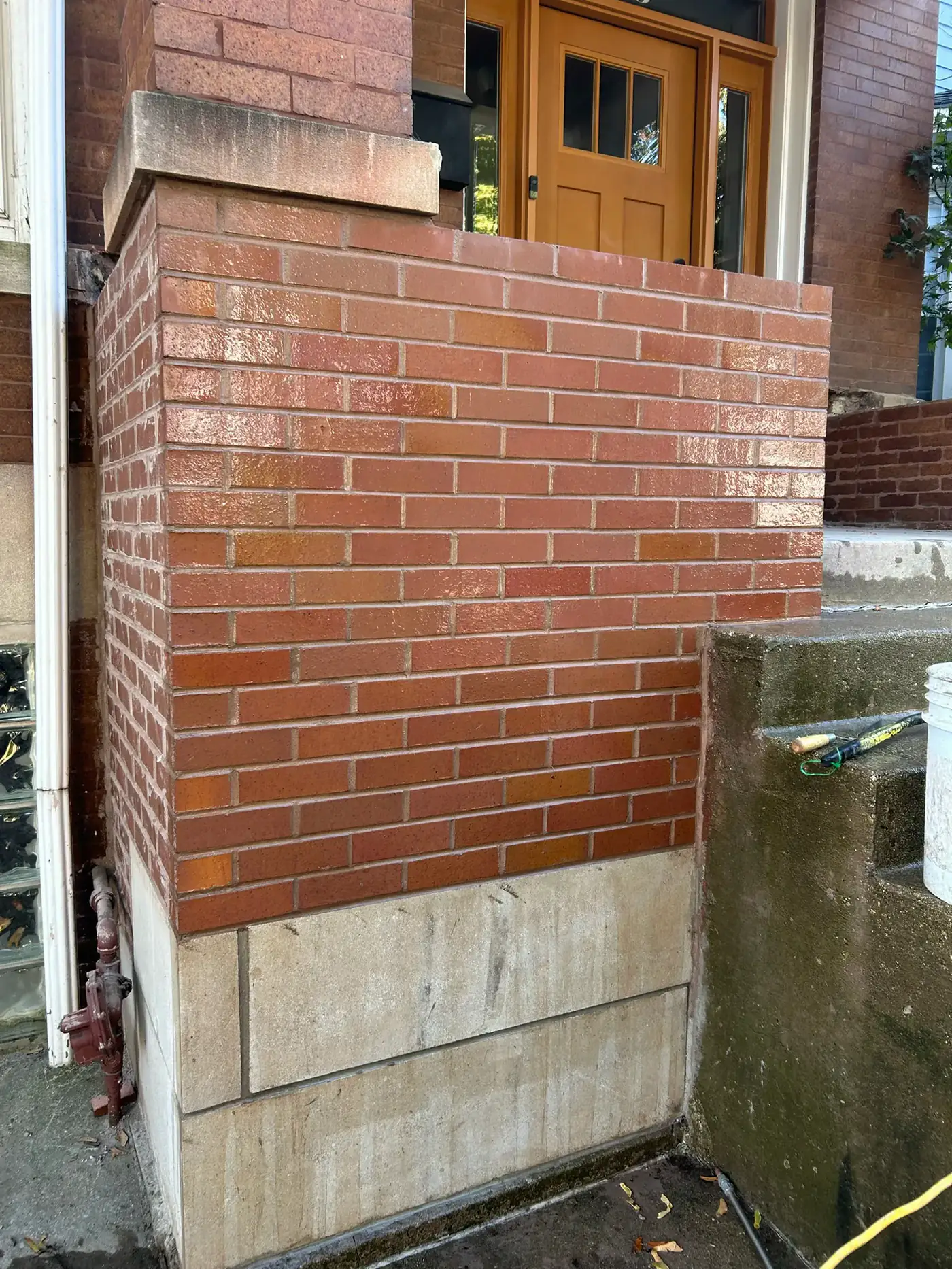
Limestone & Sill Repair in Beverly, Chicago
Limestone and sill repair in Beverly, Chicago is a conservation problem disguised as a repair problem. Emerald Masonry LLC repairs greystone facades, window sills, water tables, stone lintels, stoops and steps across the 60643 area and the Southwest Side. Family-owned, licensed, bonded and insured, career masons with decades of Chicagoland experience, free on-site estimates. Call (708) 288-1696.
Walk Longwood Drive or any of the streets running off the Ridge and the housing stock announces itself: grey limestone facades, hand-tooled faces, deep window reveals, heavy stone stoops. Beverly has one of the densest concentrations of intact greystones anywhere in Chicago.
And the thing worth knowing about all of them is this:
The limestone on your house is a facing, not a wall. It is a few inches of Indiana limestone in front of a common brick structure. Which means every square inch of damage is happening in a very thin, very visible, essentially irreplaceable layer.
Why Greystone Limestone Fails
Indiana limestone — Bedford limestone, which faces a remarkable amount of Chicago — is a fine, even-grained sedimentary rock. It is durable, it carves beautifully, and it is porous. That porosity is the whole story.
Water enters the stone. Then three things go to work.
Freeze-thaw. Water in the pore structure freezes, expands roughly nine percent, and pushes against the surrounding material — dozens of cycles a Chicago winter, lifting the outer surface off in flakes and sheets.
Salt crystallization. Water carries dissolved salts through the stone and deposits them as it evaporates at the surface. Those crystals grow and exert pressure inside the pores, disaggregating the stone from within. The result is sugaring — a surface gone soft, granular and powdery.
Delamination. Limestone is bedded in layers. Stone set on its natural bed sheds water across them; stone set face-bedded, with the layers vertical, lets water in between them and freezes them apart in flat sheets. Face bedding is common on sills and water tables, and it is a leading reason those fail first.
And the horizontal pieces get it worst
Everything vertical on a facade sheds water. Sills, water tables, belt courses, cornice stone, stoop treads and porch caps do not. They hold it. Those are the units that fail first on virtually every greystone, and once a sill loses its wash or its drip edge, it starts routing water back into the facade below it.
The Repairs That Destroy Greystones
We are rarely the first ones to touch a failing sill in Beverly. Three prior "fixes" cause most of the damage we have to undo.
Portland cement patching. A grey cement patch over a spalled area is harder, denser and far less permeable than the limestone. Moisture moving out through the wall reaches the back of the patch, cannot pass, and freezes there — removing a larger piece of stone than the one being repaired, often with the patch still attached.
Hard mortar repointing. Repointing century-old stone joints with a modern Portland mix does the same thing at every joint on the facade. The joint is supposed to be the sacrificial, permeable path. Make the joint harder than the stone and the stone becomes the sacrificial element instead.
Caulk in a crack. Looks resolved for a season, and seals water inside porous stone where it freezes.
The rule on a greystone: everything you put on the stone must be softer and more permeable than the stone.
Signs Your Beverly Limestone Needs Attention
- Surface gone powdery, granular or soft — sugaring
- Flat parallel layers flaking off the face — delamination
- Cracks running front to back through a sill, especially at midspan
- Loss of the tooled face, so the original hand finish is gone in patches
- Loss of wash or drip edge, so water now runs back toward the wall
- Open, missing or visibly hard grey mortar in the stone joints
- Cement patches blistered, cracked, or lifting away
- Dark saturation staining, or white efflorescence on the stone or the brick beneath
- Rust staining from embedded anchors or adjacent steel
- Stone stoop treads that rock, have separated, or are spalling at the nosing
- Damage concentrated under a specific window, downspout or roof valley
Risks of Waiting
Limestone damage compounds because the mechanism feeds itself. Once the tooled outer face is lost, the stone behind it is more absorptive than the surface that was protecting it, so it takes on water faster and each winter does more damage than the last.
At the facade scale, a failed sill routes water into the masonry below it and reaches whatever anchors, cramps or steel lintels are in the assembly. A sill or stone lintel cracked through has stopped distributing the load above it, which shows as cracking at the corners of the opening.
Practically: a unit repairable with a dutchman this year may need full replacement in a few, and replacement means disturbing surrounding original stone that is currently fine. On a greystone, every replacement is a permanent loss of original material.
Our Limestone Repair Process
- Identify the stone, the tooling and the failure mode — sugaring, spalling, delamination, through-cracking, or joint failure.
- Find the water. A stone problem with an active water source above it will recur regardless of the repair quality.
- Decide unit by unit: repair in place, dutchman, or replace. We default to keeping original stone.
- Remove failed cement patches and hard mortar by hand, with chisels rather than grinders where the stone is soft.
- In-place repair: clean and stabilize the sound surface, then repoint with a soft, permeable, colour-matched lime mortar.
- Dutchman: cut a clean squared recess into sound stone, fabricate a matched natural stone patch, pin with stainless anchors, set in compatible mortar, and dress the face to match the original tooling.
- Replacement: shore the opening where the unit is load-bearing, remove without damaging neighbours, and set matched stone with correct pitch and a true drip edge.
- Rebuild the wash and drip so the finished stone throws water clear of the wall — the detail most often lost in earlier repairs.
- Repoint surrounding stone and brick, and address adjacent masonry with brick repair where the stone failure has already damaged it.
- Correct the water source — gutter, downspout, roof edge, or grade — as part of the job rather than as an afterthought.
Materials
Lime-rich, low-Portland mortars for all joints and repair mortars, matched for colour and texture against the actual facade in daylight. Stainless anchors for dutchman pinning, never mild steel. Matched Indiana limestone for replacement, selected for grain, colour and finish — and dressed to match the original tooling, because on a greystone the tooling is most of what the eye reads.
Related services that commonly run with this work: tuckpointing and repointing, historic masonry restoration, residential masonry restoration, lintel repair, and caulking and joint sealant.
What Drives the Cost
- Repair, dutchman, or full replacement — three very different scopes
- Number of units and whether damage is scattered or covers a full elevation
- Access and height, including staging over stoops, walks and plantings
- Stone matching and fabrication time
- Tooling — matching a hand-finished face is skilled hand work
- Shoring where a load-bearing unit must come out
- Undoing prior repairs — cement patches and hard mortar add real labour
- Historic or landmark documentation where applicable
We do not quote stone work over the phone. Estimates are free, on site and written.
Serving Beverly and Chicago's Southwest Side
Emerald Masonry LLC is a family-owned, licensed and insured masonry contractor serving Chicago and the Chicagoland suburbs led by career masons with decades of hands-on experience in tuckpointing, chimney repair, brick repair and replacement, lintel and parapet repair, foundation and limestone/sill repair, caulking, sealing, and commercial, residential, and historic masonry restoration. Free on-site estimates — call (708) 288-1696.
We work throughout Beverly and neighbouring Mount Greenwood, Evergreen Park, Oak Lawn and Palos Heights, for homeowners, property managers, HOAs, churches and insurance companies. $5,000 project minimum.
Get a Free Beverly Limestone Assessment
If your greystone is sugaring, a sill has cracked through, or someone has patched your limestone with cement, have it looked at by masons who work on stone rather than around it. Call (708) 288-1696 or request a free estimate.
Ready to get started?
Free on-site estimates for commercial and large-scale projects.
Limestone / Sill Repair in Beverly, Chicago, IL — Frequently Asked Questions
How much does limestone sill repair cost in Beverly, Chicago?
It depends on whether each unit can be repaired in place, needs a dutchman patch of matched stone, or must be cut out and replaced — and on access, since a second-floor bay sill is a different job than a first-floor opening. On a greystone the surrounding stone joints usually need repointing too. Emerald Masonry assesses on site and provides a free written estimate.
What is a greystone and why does its stone fail?
A greystone is a Chicago house or two-flat faced in grey Indiana limestone over a common brick structure, built largely between the 1890s and the 1920s. The limestone is only a facing a few inches thick, so damage concentrates in the outer surface — and once the tooled face is lost, water penetrates the softer stone behind it.
Why is my limestone turning powdery and crumbling to the touch?
That is sugaring, and it means the stone surface is disaggregating as water and dissolved salts move through it and crystallize. It is usually driven by an ongoing water source — a failed sill above, a blocked downspout, or hard cement mortar forcing moisture to exit through the stone instead of the joint.
Can limestone be patched with cement or mortar?
It should not be with ordinary Portland cement. A hard cement patch is denser and far less permeable than the limestone around it, so moisture moving through the stone stops behind the patch and freezes there, taking off more stone than was originally damaged. A matched stone dutchman or a proper lime-based repair mortar is the correct answer.
What is a dutchman repair on a greystone?
A dutchman is a piece of matched natural stone cut to fit a squared recess in the original, pinned with stainless anchors and set in compatible mortar. On Beverly greystones it preserves the original tooling and profile of the facade, which is exactly what makes these houses look right, and it is usually far less invasive than replacing a whole unit.
Do you work on homes in the Ridge Historic District?
Yes. A large share of our Beverly work is on the pre-1930 stock in and around the Ridge, where the correct mortar is soft and lime-rich rather than modern Portland-based. We can also document scope and materials for owners whose property is subject to landmark or district review.
Should I seal my limestone after repair?
Usually not with a film-forming coating, which traps moisture inside porous stone and accelerates spalling in a Chicago winter. Where a treatment is warranted at all it should be breathable and vapour-permeable, and it comes after the water sources are corrected and the stone is sound — never instead of that.
Limestone / Sill Repair in Nearby Areas
Other Masonry Services in Beverly, Chicago, IL
Learn more about our limestone / sill repair services across Chicagoland, or view all service areas.