
Chimney Repair · Chicagoland, IL
How Much Does Chimney Repair Cost in Illinois? What Actually Drives the Price
There is no single price for chimney repair, because "chimney repair" covers everything from a cap install to a full rebuild. Here is the honest ladder of chimney work — cap, crown, flashing, tuckpointing, rebuild above the roofline, full rebuild — what each one fixes, and the real variables that move the number on your estimate.
2026-07-12
Quick Answer
Chimney repair cost in Illinois has no single number because the work spans a ladder of very different jobs — chimney cap, crown repair, flashing, tuckpointing the stack, rebuild above the roofline, or full rebuild. Price is driven by chimney height, roof pitch and access, how much of the stack has failed, and brick and mortar matching. Emerald Masonry LLC gives free on-site chimney estimates across Chicagoland — call (708) 288-1696.
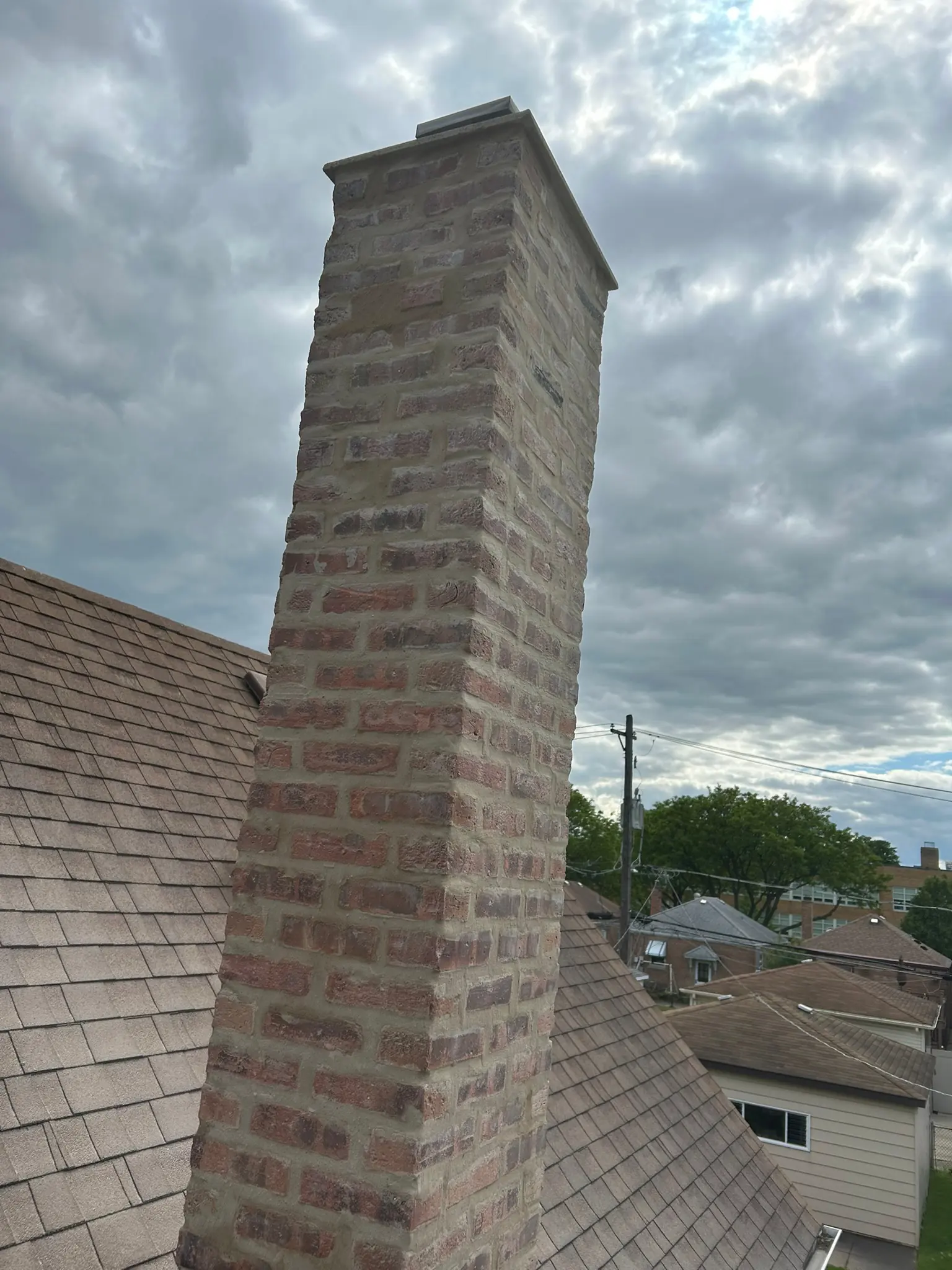
How Much Does Chimney Repair Cost in Illinois? What Actually Drives the Price
The honest answer: there is no single chimney repair cost in Illinois, because "chimney repair" is not one job. It is a ladder of very different jobs that share a name — installing a cap, recasting a cracked crown, resealing flashing, tuckpointing the mortar joints, rebuilding the stack above the roofline, or tearing down and rebuilding a leaning chimney from the bottom. Those sit at wildly different points on the price scale. Emerald Masonry LLC repairs and rebuilds chimneys across Chicago and the Chicagoland suburbs, and the number on your estimate comes down to four things: how tall the chimney is, how hard it is to get to, how much of it has actually failed, and how much brick and mortar matching the repair demands. Free on-site chimney estimates — call (708) 288-1696.
Anyone who quotes you a firm chimney repair price over the phone, before seeing your roof, is guessing — and a guess that low usually turns into a change order later. What follows is the framework we use, so you can read any estimate you receive and understand exactly what you are paying for.
The chimney repair ladder: seven very different jobs
Start here, because this is where most confusion about chimney repair cost comes from. When a homeowner searches "how much does chimney repair cost," they are picturing one job. Contractors are pricing seven. Here is the ladder, from simplest to most involved.
| Repair | What it actually fixes | What drives its cost | |---|---|---| | Chimney cap | Keeps rain, snow, animals, and debris out of the open flue | Number of flues, size, material (galvanized vs. stainless), roof access | | Crown repair or rebuild | The slab on top that sheds water off the entire chimney | Whether it can be patched or must be demolished and re-cast; chimney footprint | | Flashing repair | The seal where the chimney meets the roof — the #1 source of chimney leaks | Roof material, pitch, whether counterflashing must be cut back into the joints | | Tuckpointing the stack | Failed, receding, crumbling mortar joints | Square footage of the stack, mortar matching, access | | Rebuild above the roofline | An exposed stack whose brick and mortar are both gone | Number of courses, brick matching, staging, disposal | | Full rebuild | A leaning, separating, or structurally unsound chimney | Total height, foundation condition, interior work, demolition | | Waterproofing / sealer | Protects sound masonry from the next freeze-thaw cycle | Surface area; only worth doing on masonry that is already sound |
1. Chimney cap — the cheapest thing that prevents the expensive thing
A chimney cap is a simple metal cover over the flue opening. It is the least expensive item on this list and it prevents an enormous amount of damage, because an uncapped flue is a funnel pouring rain and snow directly into the core of your chimney. If your estimate includes a cap and yours is missing or rusted through, that is a line item worth every dollar.
2. Crown repair vs. crown rebuild — where cheap bids hide
The chimney crown is the sloped slab on the very top of the masonry that sheds water away from the brick below. This is the single most misunderstood part of a chimney, and it is where a suspiciously cheap bid usually reveals itself.
A proper crown is cast concrete, sloped to drain, and extends past the face of the brick with an overhanging drip edge that throws water clear of the stack. It is a structural element with a job to do.
A mortar wash is a thin skim of mortar troweled flat across the top. It looks like a crown to an untrained eye. It cracks within a handful of Chicago winters, and once it cracks, it stops shedding water and starts channeling water into the chimney core. If one bid is dramatically cheaper than the others, ask specifically: are you casting a new crown with an overhang, or washing mortar over the top? The difference in price is real, and so is the difference in lifespan. We covered this distinction in depth in our guide to the difference between a chimney crown and a chimney cap.
3. Flashing — where the leak usually actually is
Here is a fact that surprises most homeowners: when water shows up on the ceiling near the chimney, the chimney brick often is not the culprit — the flashing is. Flashing is the metal that seals the joint between the chimney and the roof plane. When it rusts, lifts, or was never properly counterflashed into the mortar joints, water runs straight down the outside of the chimney and into the house.
Flashing cost is driven by roof material and pitch, and by whether the counterflashing has to be cut back into the mortar joints and re-sealed properly rather than just caulked over. Our breakdown of chimney flashing leaks in Chicago homes walks through how to tell flashing failure from masonry failure.
4. Tuckpointing the stack
Tuckpointing — grinding or raking out deteriorated mortar joints and repacking them with fresh, color-matched mortar — is the workhorse repair for a chimney whose brick is still sound but whose mortar joints are receding, crumbling, or washed out. If you can scrape mortar out of a joint with a screwdriver or a key, the joints are done.
Cost here scales with the square footage of the stack, the difficulty of the access, and how much care the mortar matching takes. On an older Chicagoland chimney, matching mortar is not cosmetic — the mortar must be matched in strength as well as color, because a modern Portland-heavy mix packed into soft, century-old brick will not yield, and the brick spalls instead of the mortar. See our full chimney repair services and tuckpointing and repointing pages for how we approach this.
5. Rebuild above the roofline — the most common significant repair
This is the repair most Chicagoland chimneys eventually need, and there is a physical reason why. The section of chimney above your roofline is the most abused masonry on the entire house. It is exposed on all four sides and from the top, with no roof over it and no heated interior behind it. Every other brick wall on your house is exposed on one face. The stack takes weather from every direction, which is why it fails decades before the walls do.
When the mortar has failed throughout that exposed section and the brick faces are spalling, tuckpointing is throwing good money after bad — there is not enough sound material left to point into. The right repair is to take the stack down course by course to sound masonry, salvage what brick is reusable, and rebuild it with matching brick and appropriate mortar, finished with a properly cast crown and a new cap.
6. Full rebuild — the structural case
When a chimney leans, separates from the house, or has a failing base, you are no longer looking at a maintenance repair. Rebuilding from the roofline down — or from the foundation — is a demolition-and-reconstruction job, and it prices accordingly. Our article on why brick chimneys lean and pull away from the house explains what causes this and why patching a leaning stack does not hold.
7. Waterproofing — the cheap insurance at the end
Once the masonry is sound, a breathable masonry sealer slows the water absorption that drives the whole freeze-thaw failure cycle. The word breathable matters: a film-forming coating traps vapor inside the brick and makes spalling worse. Never seal failing joints — seal repaired ones. See masonry sealing and waterproofing.
The cost-driver framework: what moves your number
Whichever rung of the ladder you are on, these are the variables that move the price. Understanding them is how you read an estimate intelligently.
Height and stories. A chimney on a one-story ranch and a chimney on a three-story two-flat are the same masonry and completely different jobs. Height changes staging, safety, material handling, and time.
Roof pitch and access. This is the driver homeowners least expect and it is often the largest single one. On a walkable roof, a crew works directly off the roof. On a steep pitch or a tall stack, the job requires scaffolding or a lift — which means setup labor, equipment, and teardown before a single brick is touched. That cost exists whether the repair itself is small or large, which is why a small repair on a hard-to-reach chimney can cost more than a bigger repair on an easy one.
How much of the stack has failed. Spot-pointing eight joints and rebuilding forty courses are different orders of magnitude. An honest contractor measures this rather than eyeballing it from the driveway.
Brick and mortar matching. Matching common Chicago brick from the 1920s — size, color, texture, and hardness — takes sourcing effort. Reclaimed brick costs more than a pallet of modern modular. Mortar color matching takes test batches. This is real work, and it is the difference between a repair that disappears into the wall and a patch you can see from the street.
Crown, cap, and flashing scope. These are often bundled into a "chimney repair" line. Ask which are included.
Interior implications. Water stains, a damaged firebox, or a compromised flue liner mean the scope may extend past the exterior masonry.
Permits and season. Some municipalities require permits for structural chimney work. And masonry has a temperature floor — mortar cannot cure properly in a hard freeze, which is why we discuss cold-weather masonry repair in Illinois with clients scheduling in late fall.
Repair or rebuild? A decision table
| Condition | Likely repair | Likely rebuild | |---|---|---| | Mortar joints receding, brick faces intact | ✅ Tuckpoint the stack | — | | Crown cracked, stack otherwise sound | ✅ Recast the crown | — | | Ceiling stains, masonry looks fine | ✅ Flashing repair | — | | Brick faces spalling across the exposed stack | — | ✅ Rebuild above the roofline | | Mortar gone throughout the stack; brick loose | — | ✅ Rebuild above the roofline | | Chimney leans or pulls away from the house | — | ✅ Structural rebuild | | You can see daylight through the stack | — | ✅ Rebuild |
Why Chicagoland chimneys fail faster
Illinois is hard on masonry, and chimneys take the worst of it. Our region cycles repeatedly across the freezing point through late fall, winter, and early spring, and each cycle is a small act of demolition: water soaks into an open mortar joint or a porous brick, freezes, expands roughly nine percent, and pries the material apart from the inside. Thaw, absorb, freeze, expand — over and over. Add lake-effect moisture keeping masonry damp longer, and the exposed stack above your roofline endures more of these cycles, from more directions, than any other masonry on the property.
That is why crumbling mortar, spalling brick, and efflorescence show up on chimneys first in Chicago bungalows, greystones, and two-flats, and why a chimney here needs attention on a shorter cycle than the same chimney would in a milder climate. Our comparison of Chicago freeze-thaw cycles versus national averages puts real numbers to it.
How to compare chimney repair bids apples-to-apples
Three bids with three different numbers are usually three different scopes. Before you compare price, make each contractor answer the same questions:
- The crown: cast concrete with an overhang and drip edge, or a mortar wash? (This one question separates most bids.)
- The stack: how many courses are you taking down, and to what point? "We'll point it up" is not a scope.
- The flashing: included, excluded, or "not our trade"?
- The mortar: what type, and are you matching the existing mortar's color and strength?
- The brick: matched how, and sourced from where?
- Access: roof work, scaffolding, or lift — and is that in the number or a surprise later?
- Licensing and insurance: are you licensed, bonded, and insured, and can I see it?
- Writing: is every one of the above on the written estimate?
A bid that is 40% below the others is not a bargain — it is a smaller job with the same title. Our guide to evaluating a masonry contractor's bid goes deeper on this.
Why chimney work is not a DIY job
Chimney repair combines the two things homeowners are worst positioned to handle: working at height and matching masonry materials. A wrong mortar mix does not fail visibly for two or three seasons and then destroys the brick it was supposed to protect. A poorly bedded replacement brick lets water in behind the wall. And a rebuild above the roofline is structural work performed on a roof edge. The material cost of doing it yourself is small; the cost of doing it twice is not.
Keeping the next repair small
- Cap the flue. An open flue is an invitation.
- Look up every spring. Binoculars from the ground will show you a cracked crown, a leaning stack, or missing mortar.
- Fix flashing early. A small flashing leak becomes an interior repair.
- Point joints before they recede deeply. Tuckpointing a stack costs a fraction of rebuilding one.
- Seal sound masonry with a breathable sealer, never a film-forming one.
- Manage water everywhere else — gutters and downspouts that dump against masonry do damage far from the chimney.
Related services
If your chimney assessment turns up related masonry issues — and it often does — these are the repairs that most commonly travel with it: brick repair for isolated cracked or deteriorated units, brick replacement when the brick faces themselves have failed, tuckpointing and repointing for the surrounding walls, and masonry sealing and waterproofing to protect the finished work. If you are also weighing wall repointing costs, our companion piece on what tuckpointing costs in Illinois uses the same cost-driver framework.
The bottom line
Chimney repair cost in Illinois is a range, not a number, and the range is honest. A cap install and a structural rebuild are both "chimney repair," and the difference between them is tens of thousands of percent, not tens of dollars. What determines where you land is the height of the stack, how we have to reach it, how much of it has genuinely failed, and how carefully the brick and mortar have to be matched. Any contractor who can tell you the price without looking at the roof is not telling you the price.
Emerald Masonry LLC is a family-owned, licensed and insured masonry contractor serving Chicago and the Chicagoland suburbs led by career masons with decades of hands-on experience in tuckpointing, chimney repair, brick repair and replacement, lintel and parapet repair, foundation and limestone/sill repair, caulking, sealing, and commercial, residential, and historic masonry restoration. We work for homeowners, property managers, HOAs, churches, and insurance companies — and we will tell you when a chimney needs a rebuild and when it honestly does not.
Get a free on-site chimney estimate. Call (708) 288-1696 or request an estimate here, and we will climb up, look at the crown, the flashing, and the stack, and give you a written scope you can actually compare.
Frequently Asked Questions
How much does chimney repair cost in Illinois?
There is no flat price, because chimney repair ranges from a simple cap install to a full structural rebuild — those are completely different jobs. What sets your number is the height of the chimney, the roof pitch and how we access it, how much of the stack has actually failed, and whether the crown and flashing need to be redone. Emerald Masonry LLC gives free on-site chimney estimates across Chicagoland — call (708) 288-1696.
Should I repair or rebuild my chimney?
Repair is the right call when the brick and mortar below the roofline are still sound and the damage is limited to the crown, cap, flashing, or the top few courses. Rebuild the stack above the roofline when the mortar joints have failed throughout the exposed section or the brick faces are spalling off. A leaning or separating chimney is a structural problem and usually means a rebuild, not a patch.
Why is one chimney repair bid so much cheaper than the others?
Almost always because it is a smaller scope wearing the same name. A cheap bid often means a thin mortar wash smeared on top instead of a properly cast crown with an overhang, or spot-pointing a few visible joints instead of rebuilding a stack that has failed throughout. Ask each contractor exactly what they are doing to the crown, the flashing, and how many courses they are taking down.
What are the signs my chimney needs repair?
Look for crumbling or receding mortar joints, brick faces flaking or popping off (spalling), a stack that leans or pulls away from the house, white chalky efflorescence, rust on the cap or flashing, and water stains on the ceiling or wall near the chimney. Daylight visible in the flue or debris in the firebox means water is already getting in.
Why do chimneys fail faster in Chicago than elsewhere?
A chimney is the most exposed masonry on your house — weather hits it on all four sides and from above, while the rest of your walls are only exposed on one face. Add Chicagoland's freeze-thaw cycling and lake-effect moisture, and water that soaks into open mortar joints freezes, expands, and pries the joint and brick apart, over and over, every winter.
Does a new chimney crown really matter, or can you just patch it?
It matters enormously. The crown is the concrete slab on top that sheds water off the whole chimney, and a proper one is cast with a slope and an overhanging drip edge that throws water clear of the brick. A thin mortar wash troweled over the top cracks within a few seasons and then funnels water straight into the stack.
Will you match my existing brick and mortar?
Yes. We match mortar color, texture, and joint profile, and we source close-matching replacement brick for any units that have to be swapped out. On older Chicagoland chimneys, matching the mortar's strength to the brick matters as much as matching the color — a mix that is too hard will damage soft, older brick.
How long does chimney repair take?
A cap or a crown repair is often a single day. Tuckpointing the stack or rebuilding above the roofline is typically a couple of days depending on access and weather, and a full rebuild takes longer. We give you a realistic schedule with your written estimate — not a guess to win the job.
Should I waterproof my chimney after the repair?
In most cases yes, once the masonry is sound. A breathable masonry sealer lets trapped vapor escape while shedding liquid water, which slows the freeze-thaw cycle that caused the damage in the first place. Never seal a chimney with a film-forming coating over failing joints — that traps moisture inside the brick and accelerates spalling.
Do you offer free chimney estimates?
Yes. Emerald Masonry LLC is a family-owned, licensed, bonded, and insured masonry contractor led by career masons with decades of hands-on Chicagoland experience, and we provide free on-site estimates. Call (708) 288-1696 and we will look at the chimney, tell you what it actually needs, and put it in writing.