
Chimney Repair · Hickory Hills, IL
Chimney Repair in Hickory Hills, IL — Crown, Cap, Flashing, Then Everything Else
The two cheapest parts of a chimney decide how long the expensive part lasts. Most of the rebuilds we quote started as a cracked crown nobody could see from the ground.
Quick Answer
Emerald Masonry LLC provides chimney repair in Hickory Hills, IL — crown and cap replacement, flashing repair, repointing, spalled brick replacement and rebuilds above the roof line on residential and multi-unit buildings. Family-owned, licensed, bonded and insured, with free on-site assessments. Call (708) 288-1696.
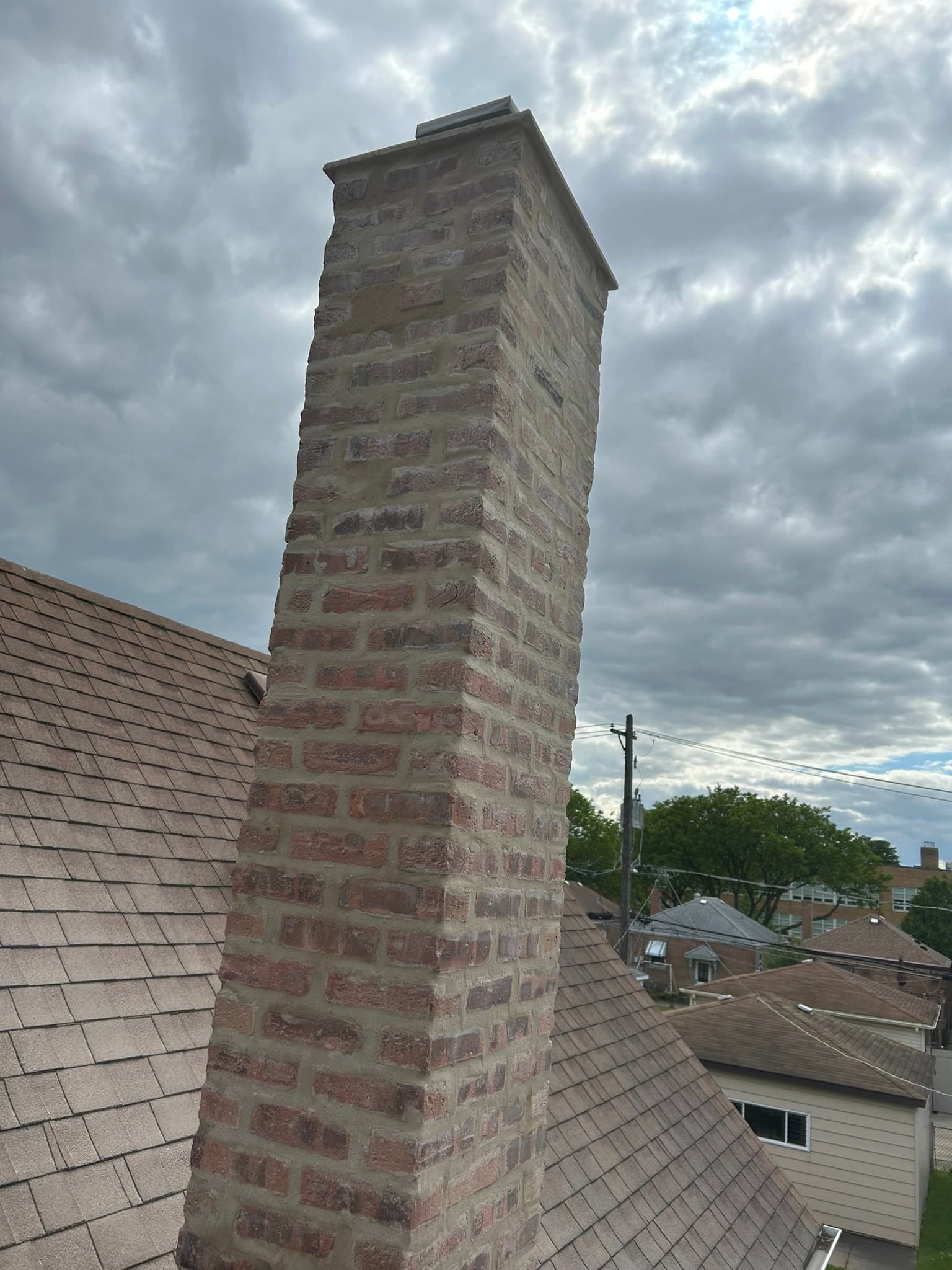
Most chimney rebuilds we quote in Hickory Hills began as something that cost almost nothing to fix.
A hairline crack in the crown. A missing cap over the flue. A section of step flashing that lifted. Each of those is a small item — and each one quietly pours water into the core of a masonry stack for years before anything shows from the driveway.
Chimney repair in Hickory Hills, IL is mostly about attending to the top of the stack before the rest of it needs replacing.
Emerald Masonry LLC is a family-owned masonry contractor serving Chicago and the Chicagoland suburbs, led by career masons with decades of hands-on Chicagoland experience, in chimney repair and rebuilds, tuckpointing, brick repair and replacement, lintel repair, foundation and limestone/sill repair, caulking, sealing, and residential, commercial and historic masonry restoration. Free on-site assessments — call (708) 288-1696.
Why chimneys go first
A chimney is the most punished masonry on any building, and the reason is geometry.
Every wall on your house has weather on one face and conditioned space on the other. A chimney above the roof line has weather on all four faces plus the top, no roof over it, and no heat behind it. It swings through the full range of an Illinois day on every side.
Then add the freeze-thaw cycle. A Chicago-area winter does not freeze once and hold — it thaws in the afternoon and refreezes overnight, dozens of times a season. Every one of those cycles is an expansion event inside wet masonry.
That is why the top four feet of a chimney is almost always in worse condition than the forty feet of wall below it.
The order that matters
1. The crown
The concrete or mortar cap across the top of the stack, around the flue. It is the chimney's roof, and it should be sloped, with an overhang and a drip edge, and isolated from the flue so the two can move independently.
What is usually there instead is a flat mortar wash troweled level with the brick. It cracks, and once it cracks it funnels water straight into the middle of the masonry. A cracked crown is the single most consequential cheap defect on a house.
2. The cap
A cover over the flue opening. Without one, rain, snow, animals and debris go directly down the flue. With one, they do not. See chimney crown versus chimney cap for the distinction — they are different components and people routinely conflate them.
3. The flashing
Where the stack passes through the roof. Proper work uses step flashing and counterflashing let into the masonry, not a bead of sealant smeared at the joint. Most "chimney leaks" that turn out not to be masonry at all are flashing. See chimney flashing leaks.
4. Then the masonry
Repointing, spalled unit replacement, and — where the deterioration has gone through — rebuilding to sound work.
Doing four before one through three is the definition of money spent twice.
Hickory Hills, specifically
Hickory Hills is a compact Cook County city built out largely through the post-war decades, and the housing stock reflects it: brick ranches, bi-levels and split-levels, Georgian-style brick homes, and a layer of small apartment and multi-unit buildings along the 87th, 95th and Roberts Road corridors.
Two local patterns show up repeatedly.
Everything aged together. When a neighbourhood goes up within a narrow band of years with the same detailing, the crowns, caps, flashings and mortar all reach the end of their service lives at roughly the same time. If your neighbour just had chimney work, that is information about your house.
Exterior chimneys on gable ends. Common on this stock, and they are the harshest case — a stack standing proud of the wall, exposed on three sides for its full height, with no warm interior against it. Those deteriorate visibly faster than an interior chimney rising through the middle of the roof.
Add the mature tree canopy through much of the city, which keeps north-facing stacks damp long after the sun side has dried.
Signs to look for
- Crumbling, sandy or missing mortar joints on the stack
- Spalling or flaking brick faces, particularly on one weathered side
- A cracked, flat, or missing crown
- No cap over the flue opening
- White efflorescence on the brick — water is actively moving through it
- Rust staining around the flashing or a damper
- Water stains on the ceiling or wall near the chimney
- Daylight through joints seen from inside the attic
- The stack visibly out of plumb against a downspout or door frame — that one is urgent
What we do
- Assess the full height, from the roof rather than the ground, including the crown, cap and flashing.
- Establish where sound, plumb masonry begins — that sets repointing versus rebuilding.
- Protect the roof before any staging or material handling.
- Dismantle to sound work where rebuilding is needed, salvaging brick that can be reused.
- Rebuild plumb and true, with brick matched in size, colour and texture and mortar matched in type, colour and joint profile.
- Form a proper crown — sloped, with overhang and drip, isolated from the flue.
- Set the cap.
- Reflash with step and counterflashing let into the masonry.
- Repoint, clean down, and check the flue.
Materials
Mortar matched to the existing masonry and, critically, softer than the brick around it — Type N is the usual choice on residential chimney work for exactly that reason, with Type S where the assembly genuinely calls for more strength. Brick matched in size, colour and texture, salvage reused where sound. A formed crown rather than a mortar smear. Real flashing. A correctly sized cap.
What drives the cost
Stack height and how much comes down. Roof pitch, access and staging. Whether the work is repointing or rebuilding. Crown, cap and flashing scope. Whether the brick can be matched. Roof protection. Weather windows, since mortar needs workable temperatures to cure.
Free on-site assessment and a written scope — call (708) 288-1696.
Serving Hickory Hills and the surrounding southwest suburbs
We work throughout Hickory Hills and the communities around it — Palos Hills, Bridgeview, Burbank, Justice, Oak Lawn and Palos Heights, where our office is.
Related services: chimney repair, tuckpointing and repointing, brick repair, brick replacement, and masonry sealing.
For the decision itself, see chimney repair versus rebuild and why the top of your chimney fails first.
Handle the crown before it becomes a rebuild
Emerald Masonry LLC is family-owned, licensed, bonded and insured, with free on-site assessments.
Request a free on-site assessment — or call (708) 288-1696.
Ready to get started?
Free on-site estimates for commercial and large-scale projects.
Chimney Repair in Hickory Hills, IL — Frequently Asked Questions
How much does chimney repair cost in Hickory Hills, IL?
It is priced by scope. The drivers are stack height and how much of it comes down, roof pitch and access, whether the work is repointing or rebuilding, crown, cap and flashing scope, and whether the brick can be matched. Emerald Masonry provides a free on-site assessment and a written scope.
What are the signs my chimney needs repair?
Crumbling or missing mortar joints, spalling or flaking brick faces, a cracked or missing crown, no cap over the flue, rust staining, white efflorescence on the stack, water stains on the ceiling near the chimney, or daylight visible through joints from the attic.
Why does the top of the chimney always look worse than the bottom?
Because everything above the roof line is weathered on all four sides plus the top, with no roof over it and no heated interior behind it. That is the harshest exposure on the whole house, which is why the top courses deteriorate years ahead of the stack below.
Should my chimney be repointed or rebuilt?
It depends how deep the deterioration runs. A plumb, sound stack with eroded joints is a repointing scope; one that leans, has displaced courses, or has lost mortar through its full thickness generally needs taking down to sound work and rebuilding. Repointing a debonded stack is money spent twice.
My chimney is unused since the furnace was replaced. Does it still need work?
Yes, if it is still standing. An abandoned chimney weathers at exactly the same rate as a working one, and it sits above a roof with the capacity to drop material. Capping and maintaining it — or removing it properly — are both better than ignoring it.
How urgent is a cracked chimney crown?
More urgent than it looks. The crown is the chimney's roof, and a crack in it is a funnel pointed into the core of the masonry. It is one of the cheapest components on the stack and it determines how long everything beneath it lasts.
Chimney Repair in Nearby Areas
Other Masonry Services in Hickory Hills, IL
Learn more about our chimney repair services across Chicagoland, or view all service areas.