
Masonry Sealing · Chicagoland, IL
Why Is Water Coming Through My Brick Wall? Causes, Diagnosis, and Fixes
Water coming through a brick wall almost never means the brick itself failed — it means the wall's water-shedding system did. Here is how brick walls actually manage water, the real entry points behind an interior leak, how a professional traces the source, and the fix that matches each cause.
2026-07-20
Quick Answer
Water coming through a brick wall is almost never the brick 'leaking' — brick and mortar are porous by design, and the wall stays dry by draining water back out through flashing, weep holes, and sound mortar joints. Interior leaks appear when that system fails: cracked mortar, spalled brick, failed flashing or caulking, or a bad crown. Emerald Masonry LLC diagnoses and repairs masonry water problems across Chicagoland — call (708) 288-1696.
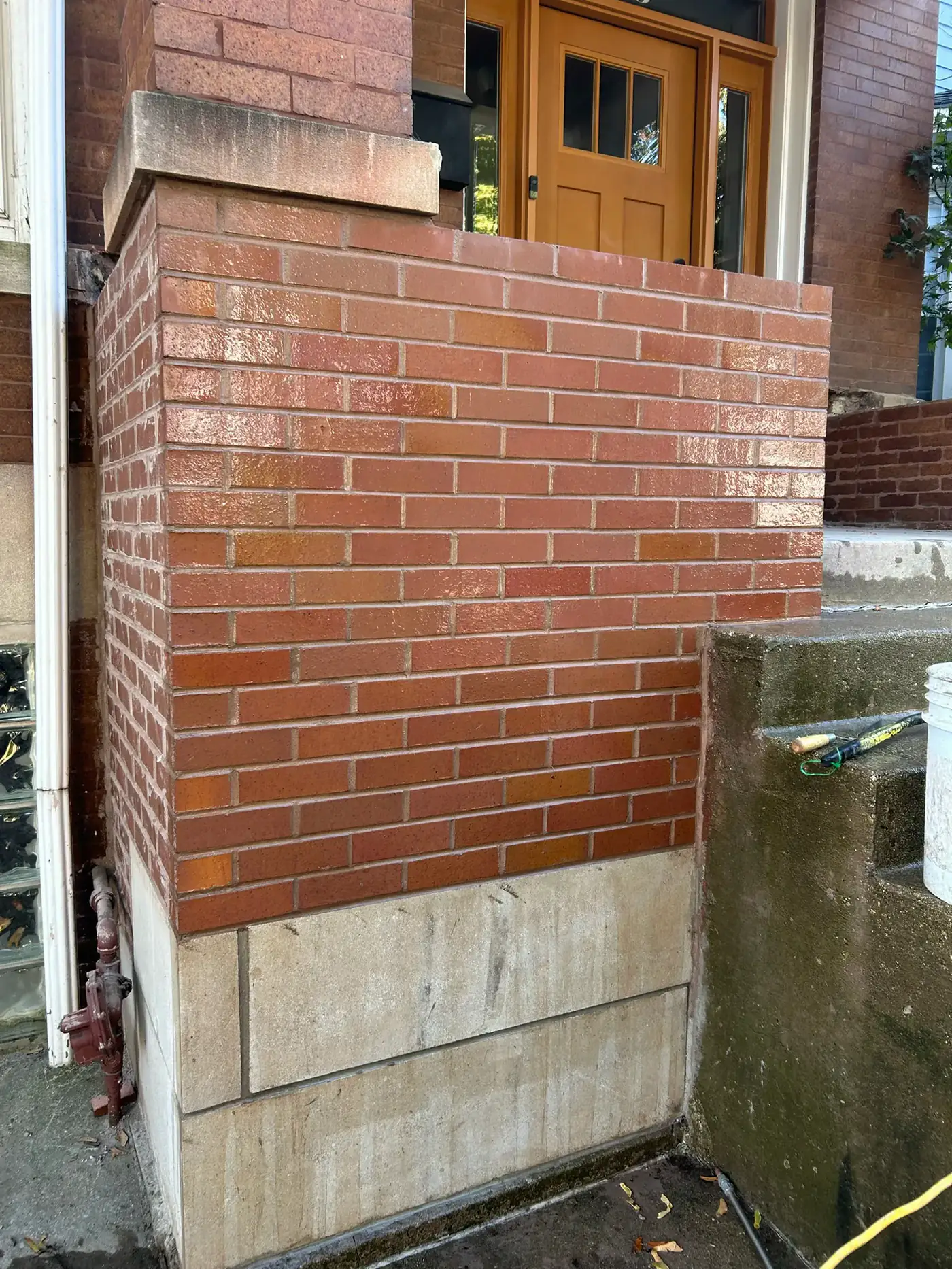
Why Is Water Coming Through My Brick Wall?
If water is coming through your brick wall, the brick almost certainly did not fail — the wall's water-management system did. Brick and mortar are porous and absorb water on purpose; a masonry wall stays dry by draining that water back out and letting itself dry, not by blocking it. When a mortar joint, a piece of flashing, a chimney crown, or a window seal gives out, water finds a path inside and shows up as a stain, a damp spot, or a chalky white bloom. Emerald Masonry LLC diagnoses and repairs masonry water intrusion throughout Chicago and the Chicagoland suburbs — if you have a leaking brick wall, call (708) 288-1696 for a free on-site assessment.
The single most useful thing to understand is this: a brick wall is not waterproof, and it was never designed to be. Once you know how the wall is supposed to move water, the reason it is leaking becomes far easier to find.
How a Brick Wall Actually Manages Water
Homeowners are often surprised to learn that brick and mortar soak up water like a sponge, especially during a sustained, wind-driven rain. That is normal and expected. A masonry wall handles moisture through a "absorb, then drain and dry" cycle rather than a waterproof barrier.
There are two common wall types in Chicagoland, and they manage water differently:
- Brick veneer walls (most homes built from roughly the 1960s onward) are a single outer wythe of brick standing in front of a framed or block backup wall, with an intentional drainage cavity — an air gap — between them. Water that gets through the brick runs down the back of the veneer, lands on through-wall flashing, and exits through weep holes at the bottom. The cavity and weep holes are the whole safety system.
- Solid multi-wythe masonry walls (older bungalows, greystones, two-flats, churches, and commercial buildings) are two, three, or more brick courses thick with no cavity. These rely on their sheer mass, sound mortar joints, overhangs, and good drainage detailing to keep interior faces dry. They have less margin for error — once the mortar goes, water moves straight through.
In both systems, the parts that keep the inside dry are sound mortar joints, intact brick faces, working flashing, open weep holes, a good chimney crown and cap, tight caulking at openings, and sloped sills and copings that throw water clear. A leak means one of those has failed. Understanding how through-wall flashing keeps a wall dry and what weep holes do is the foundation of every diagnosis below.
The Real Entry Points Behind a Leaking Brick Wall
Water coming through a brick wall traces back to a defect in that shedding-and-draining system. Here are the culprits, roughly in order of how often we find them on Chicagoland homes, and what to look for on each.
Failed or Cracked Mortar Joints
This is the most common cause. Mortar is the sacrificial, water-managing element of the wall — softer than the brick, meant to wear first, and designed to be repaired periodically. When joints crack, recede behind the brick face, or crumble into sand, they open a direct highway for water. Look for receding, powdery, or missing mortar, hairline gaps you can slip a coin into, and small piles of mortar sand collecting on ledges or at the base of the wall. The fix is tuckpointing (also called repointing): grinding out the failed mortar to sound depth and refilling with matched mortar. If your joints are failing, professional tuckpointing is the repair that restores the wall's ability to keep water out.
Spalled, Cracked, or Loose Brick
When a brick face flakes, pops, or cracks through — spalling — the hard, weather-resistant outer skin is gone and the soft interior soaks up water freely. Cracked-through and loose bricks do the same. Spalling is usually a downstream sign that water already got in and froze; it both signals a leak and becomes a new entry point. The remedy is brick replacement — cutting out the failed units and setting matched brick in color-matched mortar.
A Failed Chimney Crown, Cap, or Flashing
Chimneys are the hardest-working masonry on the house because they are exposed on all sides above the roofline. A cracked chimney crown (the concrete slab on top), a missing or rusted cap, or failed flashing where the chimney meets the roof lets water pour into the stack and travel down — often appearing as a ceiling or wall stain near the chimney one or two floors below. If your leak is anywhere near a chimney, the crown and flashing are prime suspects; see chimney flashing leaks and our chimney repair service.
Missing or Bad Through-Wall Flashing and Clogged Weep Holes
On veneer walls, flashing and weep holes are the drainage system — and when flashing is missing, torn, or was installed to drain inward, or when weep holes are clogged with mortar droppings, caulked shut, or painted over, the cavity fills with water like a bathtub. It backs up and pushes through to the interior. Look along the bottom course of brick, above windows, and at shelf angles for open weep holes every couple of feet; if you cannot find any, that is a red flag.
Failed Caulking at Windows, Doors, and Control Joints
The joints where brick meets a different material — window and door frames, control/expansion joints, where masonry meets siding — are sealed with flexible sealant, not mortar, because they need to move. When that caulking dries, cracks, and pulls away, water runs straight in beside the window and shows up on the interior trim. Re-sealing these joints with the correct backer and sealant is a routine part of caulking and joint sealant work.
Deteriorated Limestone or Concrete Sills
Window sills are sloped to throw water away from the wall, and grooved underneath with a drip edge so water drips clear instead of running back to the brick. When a sill cracks, loses its slope, or its drip edge wears away, it funnels water straight into the wall below the window — a classic source of interior stains under windowsills. Sill repair or replacement restores the drainage.
Coping and Parapet Failure on Flat-Roof Buildings
On flat-roofed commercial buildings, two-flats, and rowhouses, the parapet wall and its coping caps take weather on both faces and the top. Open coping joints, cracked or displaced caps, and failed coping flashing let water into the top of the wall, where it travels down and emerges on the top-floor interior. Roofline and coping leaks are a leading cause of leaks on flat-roof masonry.
Foundation Masonry at Grade
Where the wall meets the ground, the exposed foundation course and its parge coat take splashback, snowmelt, and soil moisture. Cracked parging and deteriorated mortar at grade let water into the base of the wall and the basement, showing up as a damp basement, efflorescence, and peeling paint on the inside of the foundation.
Upstream Water Management — the Cause Behind the Cause
Very often the masonry defect is only half the story. Overflowing gutters, downspouts that dump at the foundation, and soil graded toward the house flood the wall with far more water than any masonry is built to handle. Fixing the mortar without fixing the water source just resets the clock. Clean gutters, extended downspouts, and grading that slopes away from the wall are the cheapest, highest-leverage improvements you can make.
Painted or Film-Sealed Brick Trapping Moisture
Finally, a self-inflicted one. Paint and film-forming "waterproof" coatings on brick trap moisture inside the wall. Water still gets in through hairline cracks and edges, but the coating stops the brick from drying to the outside — so the trapped water pushes inward as leaks and efflorescence, and freezes into spalling. This is why painted brick so often develops moisture problems, and why any sealing we do uses a breathable repellent, never a film.
How a Professional Diagnoses a Brick Wall Leak
The reason DIY leak-hunting so often fails is that the entry point is almost never directly behind the interior stain. Water enters high and travels down and sideways inside the wall before it emerges. A masonry contractor works methodically:
- Start at the interior symptom and note its exact location, height, and when it appears (during rain, after snowmelt, only in wind-driven storms).
- Inspect the mortar above and around the area — probing joints with a screwdriver or key to find soft, sandy, or receding mortar. (You can run the same screwdriver test yourself.)
- Examine the brick for spalling, cracks, and loose units.
- Check the drainage system — flashing, weep holes (open or clogged?), sills, and control-joint caulking.
- Look above — chimney crown, cap, and flashing; parapet and coping on flat roofs; roof-to-wall junctions.
- Reproduce the leak where needed with a controlled hose test, wetting the wall from the bottom up in sections so the actual entry point reveals itself rather than guessing.
The deliverable is the real source, not just a treated wet spot — because sealing or patching the interior symptom while the true entry point keeps feeding water is the number-one reason "fixed" leaks come back.
Matching the Fix to the Cause
There is no single cure for a leaking brick wall — the right repair depends entirely on the entry point. This table maps common interior symptoms to their likely masonry cause and the typical fix.
| Interior symptom | Likely masonry cause | Typical fix | |---|---|---| | Damp patch / stain mid-wall, worse in wind-driven rain | Cracked or receded mortar joints | Tuckpointing / repointing | | Stain with flaking brick faces outside | Spalled or cracked brick | Brick replacement | | Ceiling/wall stain near a chimney | Cracked crown, bad cap, or failed flashing | Chimney crown/cap + flashing repair | | Water at the bottom of a veneer wall | Clogged weep holes / failed through-wall flashing | Clear weeps, correct/replace flashing | | Leak beside a window or door | Failed perimeter caulking | Re-caulk with proper backer + sealant | | Stain directly under a windowsill | Cracked sill / lost drip edge | Sill repair or replacement | | Top-floor leak on a flat-roof building | Open coping joints / parapet failure | Coping reset + parapet repair | | Damp basement, efflorescence at grade | Cracked parging / mortar at foundation | Foundation masonry repair + parging | | New leaks after painting/sealing brick | Film coating trapping moisture | Remove/convert to breathable repellent |
Crucially, sealing is a finishing step, not a cure. A breathable masonry water-repellent is applied after the defect is repaired, to reduce absorption while still letting the wall dry. Applied over failed mortar or a bad flashing, no sealer will hold — and a film-forming sealer will make it worse.
What Drives the Cost of Fixing a Leaking Brick Wall
Every wall is different, so a real number only comes from seeing it. The factors that move the cost are:
- The cause and how many are stacked — a single re-caulked window is minor; failed flashing buried in a veneer wall is major.
- Extent — a few feet of tuckpointing versus a whole elevation.
- Access and height — ground-floor work versus scaffolding or a lift for an upper story, chimney, or parapet.
- Matching — sourcing brick and color-matching mortar on older or discontinued masonry.
- Whether hidden steel is involved — a rusted lintel or shelf angle behind the leak adds scope.
We never quote an exact price sight-unseen, and we never promise a flat rate over the phone. What we do is come out, find the real entry point, and give you an itemized estimate for free. Call (708) 288-1696 to schedule it.
DIY vs. Hiring a Pro
There is real DIY value in the upstream fixes: clean your gutters, add downspout extensions to carry water several feet from the foundation, regrade soil to slope away from the wall, and gently clear obstructed weep holes. Those alone resolve a surprising number of "leaks."
The masonry side is specialized. Diagnosing whether the source is mortar, flashing, a crown, a sill, or caulking takes trained eyes, and the repairs demand matched materials and technique. The common DIY mistakes actively worsen leaks: smearing hard Portland-rich mortar over soft old brick (which spalls the brick), caulking weep holes shut (which dams the drainage cavity), and rolling a film-forming sealer or paint over the brick (which traps moisture). When in doubt, get it diagnosed before you seal anything.
Why Chicagoland Brick Walls Leak — the Local Reality
Our climate is uniquely hard on masonry. Freeze-thaw cycling is the driver: water soaks into brick and mortar, freezes, expands about 9%, and pries the material apart — then thaws and does it again, dozens of times each winter. A joint that merely looked tired in October can be an open leak by spring. Lake-effect moisture and wind-driven rain off Lake Michigan push water horizontally into walls that would stay dry in a calmer climate, which is why interior leaks so often spike right after big storms and during the first hard thaw. Add a century of soft-lime-mortar housing stock — bungalows, greystones, two-flats — and you have exactly the conditions that turn a small drainage defect into a wet interior wall. Our freeze-thaw damage explainer and the recurring efflorescence it causes go deeper on why.
Maintenance and Prevention
You can dramatically cut your odds of a leaking brick wall with a few habits:
- Inspect mortar joints every year or two with the screwdriver test; repoint before joints open up.
- Keep gutters clean and downspouts extended well away from the wall.
- Regrade so soil slopes away from the foundation.
- Keep weep holes clear — never caulk or paint over them.
- Have the chimney crown, cap, and flashing checked periodically.
- Re-caulk window, door, and control joints when the sealant hardens or cracks.
- Only seal with a breathable repellent, and only after repairs — never trap moisture with paint or film coatings.
The Bottom Line — Get the Entry Point Found
Water coming through a brick wall is a symptom, not a diagnosis. The brick is doing what brick does; something in the wall's drainage-and-drying system has failed, and the fix is to find that entry point and repair it with the right materials — then, and only then, protect the wall with a breathable sealer. Guessing, sealing over the symptom, or trapping moisture behind paint just buys a bigger repair later.
Emerald Masonry LLC is a family-owned, licensed and insured masonry contractor serving Chicago and the Chicagoland suburbs, led by career masons with decades of hands-on experience in tuckpointing, brick repair and replacement, chimney repair, lintel and parapet work, foundation and limestone/sill repair, caulking, and breathable masonry sealing for homeowners, property managers, HOAs, and churches. If your brick wall is leaking, don't wait for freeze-thaw to turn it into a rebuild — reach out through our contact page or call (708) 288-1696 for a free on-site assessment, and we'll find where the water is really getting in.
Frequently Asked Questions
Why is water coming through my brick wall when brick is supposed to shed rain?
Because brick and mortar are porous — they absorb and pass water by design, especially in wind-driven rain. A masonry wall stays dry by draining that water back out through flashing, weep holes, and sound mortar joints, then drying out between storms. Water shows up inside when that drainage-and-drying system fails, not because the brick itself 'leaked.'
Where does a brick wall leak actually start?
Usually well above where the stain appears inside. Water enters at a defect higher up — a cracked mortar joint, a spalled brick, a failed chimney crown or flashing, or a bad window seal — then travels down inside the wall and emerges lower. That is why chasing the interior wet spot rarely finds the real entry point; a pro traces upward from the symptom.
Will sealing or waterproofing my brick stop the leak?
Not on its own, and the wrong sealer makes things worse. A breathable water-repellent is a finishing step applied after the actual defect — failed mortar, cracked brick, bad flashing — is repaired. A film-forming or waterproof paint traps moisture inside the wall, and in Chicagoland's freeze-thaw climate that trapped water spalls the brick face.
Is water coming through a brick wall an emergency?
It is not usually a same-day emergency, but it should not wait. Ongoing water intrusion rots framing, ruins interior finishes, feeds mold, corrodes hidden steel lintels and shelf angles, and accelerates freeze-thaw spalling that turns a minor repair into a wall rebuild. The sooner the entry point is found and fixed, the smaller the repair.
Why did my brick wall start leaking only after I had it painted or sealed?
Because a film-forming paint or non-breathable sealer stops the wall from drying to the outside. Water still gets in through hairline cracks and around edges, but now it cannot escape — so it pushes inward and shows up as interior leaks, efflorescence, and spalling. Breathable repellents avoid this; film coatings on brick often cause the very problem they were meant to prevent.
Can I fix a leaking brick wall myself?
You can improve the upstream causes — clean gutters, extend downspouts, regrade soil away from the wall, and clear obstructed weep holes. But diagnosing whether the source is mortar, flashing, a crown, a sill, or caulking, and repairing it correctly with matched materials, is specialized work. A wrong DIY fix (hard mortar on soft brick, caulk over weep holes, film sealer) commonly makes the leak worse.
How does a masonry contractor find where a brick wall is leaking?
By working from the inside symptom outward and upward: inspecting mortar joints with a probe, checking brick for spalling and cracks, examining flashing, weep holes, the chimney crown and cap, window and sill caulking, and copings, then often running a controlled hose test from the bottom up to reproduce the leak. The goal is to find the real entry point, not just treat the wet spot.
Does a leaking brick wall mean I need the whole wall rebuilt?
Rarely. Most masonry leaks are fixed with targeted work — tuckpointing failed joints, replacing a few spalled bricks, correcting flashing and weep holes, rebuilding a chimney crown, or re-caulking. Full rebuilds are reserved for walls with widespread structural or freeze-thaw failure. A free on-site assessment tells you which situation you actually have.