
Limestone / Sill Repair · Palos Heights, IL
Limestone & Sill Repair in Palos Heights, IL — The Stone That Decides How Your Brick Ages
Palos Heights is where our office is. The mid-century brick ranches and split-levels here are now sixty-odd years old, and their sills are usually the first thing on the elevation to give out.
Quick Answer
Emerald Masonry LLC provides limestone and sill repair in Palos Heights, IL — restoring cracked, spalling and delaminating stone and cast sills, caps and trim that have stopped shedding water, through repointing, patching, Dutchman inserts or replacement. Family-owned, based in Palos Heights, licensed, bonded and insured. Call (708) 288-1696.
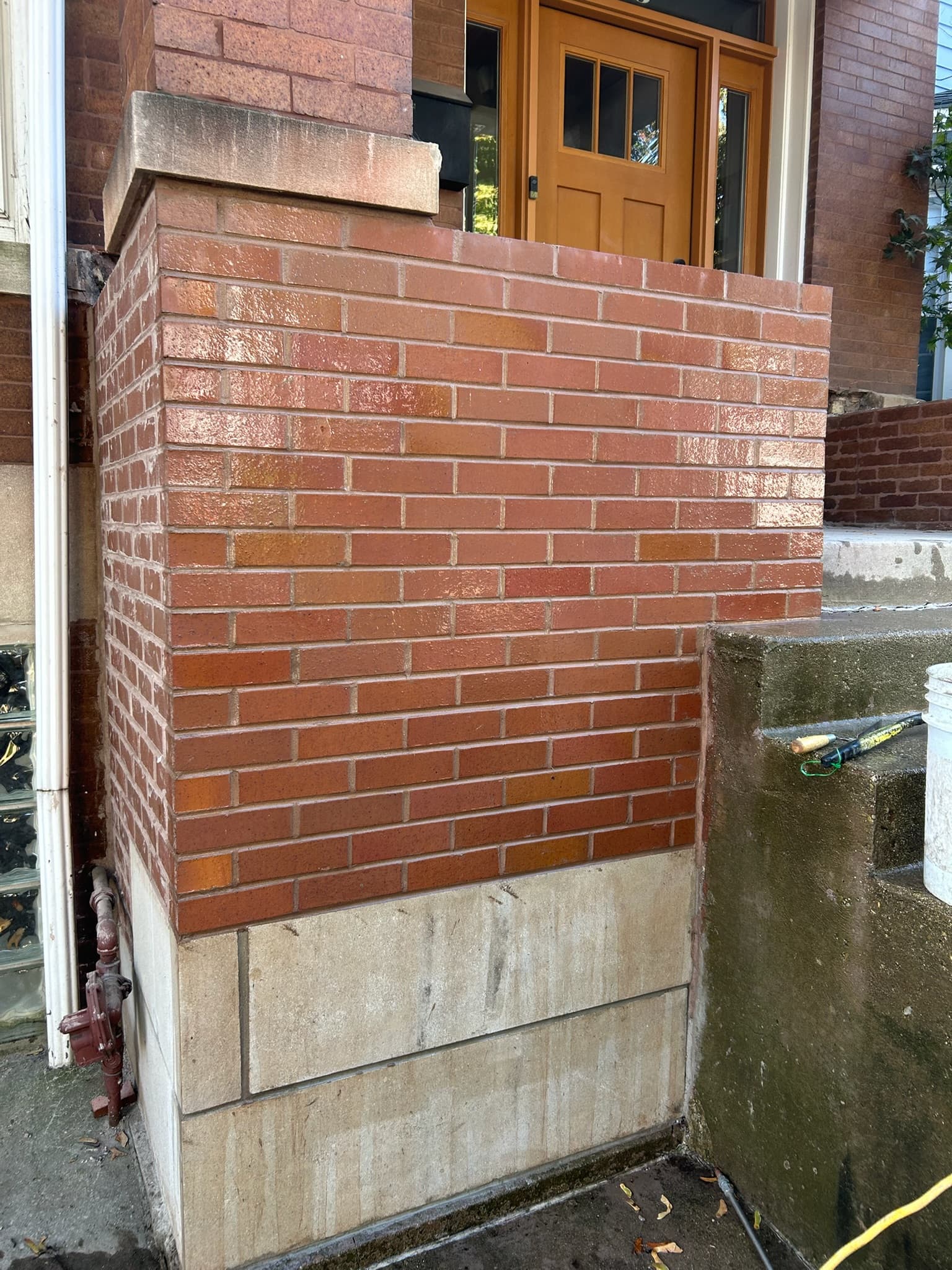
There is a pattern on Palos Heights houses we see constantly, and it always gets reported backwards.
A homeowner calls about damaged brick beneath a wide front window — spalled faces, eroded joints, a stain running down the wall — while the brick two feet either side is perfectly sound. They want the brick fixed. Repair the brick and leave the sill above it alone, and it looks exactly the same again in four winters.
Limestone and sill repair in Palos Heights, IL is the actual fix, because the sill is the cause and the brick is the casualty.
Emerald Masonry LLC is a family-owned masonry contractor with its office here in Palos Heights, serving Chicago and the Chicagoland suburbs, led by career masons with decades of hands-on Chicagoland experience, in tuckpointing, brick repair and replacement, chimney work, lintel repair, foundation and limestone/sill repair, caulking, sealing, and residential, commercial and historic masonry restoration. Free on-site assessments — call (708) 288-1696.
What a sill is actually doing
A sill has two jobs, and both are about moving water away from your wall.
It sheds. The stone is pitched outward so water runs off rather than sitting on it or tracking back toward the window.
It breaks the flow. A properly detailed sill has a drip edge — a groove or projecting lip on the underside — that stops water wrapping around and running back onto the brick. Water will not cross a clean drip edge. It lets go and falls clear.
Lose either function and every drop hitting that window starts going somewhere it was never meant to go.
How sills fail here
Delamination. Limestone is a sedimentary stone laid down in layers. Water gets between them, freezes, and lifts the stone apart in sheets — a flaking, layered face rather than a clean break.
Spalling. The face pops off in patches, typically where water sits longest.
Cracking through the section. Often across the middle of a longer sill, sometimes accelerated by a steel lintel corroding nearby or by movement below.
Lost slope. Old sills settle, and well-meant repointing with a fat bed of mortar can level one out entirely. A flat sill is a shelf that holds water.
Bridged drip edge. Repeated painting, a heavy parge coat, or a bead of caulk run along the underside will bridge the groove and route water straight back to the brick. This one is common and completely avoidable.
Open end joints. Where the sill meets the brick jamb at either end is the single most common water entry point on the assembly, and the easiest to overlook.
Palos Heights, specifically
This is our home village, and the housing stock here has a recognisable profile: built out largely through the post-war decades — brick ranches, split-levels and tri-levels through the fifties, sixties and seventies, Georgian-style brick homes, and newer custom construction on the wooded lots toward the preserves and the Cal-Sag corridor.
Three consequences.
Wide openings. Mid-century houses here favour a wide front picture window, and a long sill is more prone to cracking through than a short one — while concentrating far more water onto a single stretch of wall below.
A great deal of it is cast stone. Much of what people call "the limestone" on a 1960s ranch is cast stone: a moulded concrete product that looks convincing and fails like concrete, sometimes exposing internal reinforcement as it spalls. Repairing it correctly means identifying it correctly first.
Age. Stone trim on a house built in 1962 has been through six decades of Illinois freeze-thaw. That is exactly the window where sill work stops being optional and becomes the thing protecting the rest of the wall.
Add the tree cover and the low, damp ground toward the preserves, and the shaded north and east elevations stay wet long after the sun side dries — which is why those sills usually look a decade older than the rest of the house.
How we repair a stone sill
We do the smallest repair that genuinely solves it.
- Assess the stone and the water path. Is the pitch intact, is the drip edge clear, are the end joints open, and what has the brick below been taking?
- Repoint the end joints and bed joint with matched mortar, where the joints are the failure.
- Patch localised spalling with a stone-appropriate repair mortar, tinted and textured on site, where the unit is otherwise sound.
- Dutchman repair where one portion has failed but the rest is good — the damaged section is cut out and a matched piece let in.
- Replace the sill where it has cracked through or delaminated across its depth, setting the new unit with proper pitch and a real drip edge.
- Repair the brick below that the failed sill has been feeding — usually the reason you called.
- Repoint and clean down.
Materials
Limestone matched in colour and finish on limestone houses. Cast or precast units where that is what is there. Repair mortars formulated for stone rather than generic patching compound. Mortar matched in type, colour and joint profile. Sealant only where sealant belongs — never run across a drip edge, where it does more harm than good.
What drives the cost
Size and number of stone units. Whether the repair is repointing, patching, a Dutchman or replacement. How much brick comes down and goes back up. Height and access. Whether the stone can be matched from stock or must be cut. Whether the brick below needs replacement too.
Free on-site assessment and a written scope — call (708) 288-1696.
Working in our own village
We are based in Palos Heights and work throughout it and the surrounding southwest suburbs — Palos Park, Palos Hills, Worth, Orland Park, Oak Lawn and Hickory Hills.
Related services: limestone and sill repair, brick repair, tuckpointing and repointing, residential masonry restoration, and masonry sealing.
For the wider material picture, see why limestone sills and lintels fail and terra cotta and cast stone façade repair.
Fix the sill, and the wall below stops losing ground
Emerald Masonry LLC is family-owned, licensed, bonded and insured, with free on-site assessments.
Request a free on-site assessment — or call (708) 288-1696.
Ready to get started?
Free on-site estimates for commercial and large-scale projects.
Limestone / Sill Repair in Palos Heights, IL — Frequently Asked Questions
How much does limestone sill repair cost in Palos Heights, IL?
It is priced by scope. The drivers are the size and number of stone units, whether the work is repointing, patching, a Dutchman insert or full replacement, how much brick must be taken down and relaid, and access. Emerald Masonry provides a free on-site assessment and a written scope.
Why is the brick under my window damaged when the rest of the wall is fine?
Because the sill above it has stopped shedding water. Once a sill cracks, loses its pitch, or has its drip edge bridged by paint or caulk, water runs back onto the masonry beneath and saturates one concentrated area. Repairing the brick without repairing the sill means doing it twice.
Is my sill limestone or cast stone?
Look for uniformity. Natural limestone varies unit to unit and shows fine fossil texture; cast stone is a moulded concrete product, so every piece is identical and a damaged area often reveals aggregate or, occasionally, reinforcement. The repair approach differs between them.
Can a cracked sill be repaired instead of replaced?
Frequently. Tight cracks and localised spalling can be repaired in place, and a failed section can be cut out with a matched piece of stone let in — a Dutchman repair. Stone that has cracked through its full section or delaminated across its depth is replaced.
Why is my stone flaking apart in layers?
Freeze-thaw acting on a sedimentary stone. Limestone absorbs water, and when that water freezes inside it the stone splits along its natural bedding planes. A sill that has lost its slope holds water instead of shedding it, which accelerates the whole cycle.
Should the sill be sealed after repair?
A breathable penetrating sealer can help a repaired sill shed water, but only after the stone and mortar have cured and only where it will not trap moisture in the unit. Sealing stone that is still cracked or still holding water accomplishes nothing.
Limestone / Sill Repair in Nearby Areas
Other Masonry Services in Palos Heights, IL
Learn more about our limestone / sill repair services across Chicagoland, or view all service areas.