
Tuckpointing & Repointing · New Lenox, IL
Tuckpointing in New Lenox, IL — Newer Brick Fails at the Details, Not Across the Wall
New Lenox is a young masonry town, and young brick does not fail the way century-old brick does. It fails at specific details — sill lines, chimney chases, the bottom courses, the weather elevation — which means most homes here need targeted spot repointing, not a whole-house job.
Quick Answer
Emerald Masonry LLC provides tuckpointing and repointing in New Lenox, IL — grinding out failed mortar joints and repacking them with matched mortar, targeting the sill lines, chimney chases and bottom courses where newer brick veneer actually fails. Family-owned, licensed and insured, career masons with decades of Chicagoland experience, free estimates. Call (708) 288-1696.
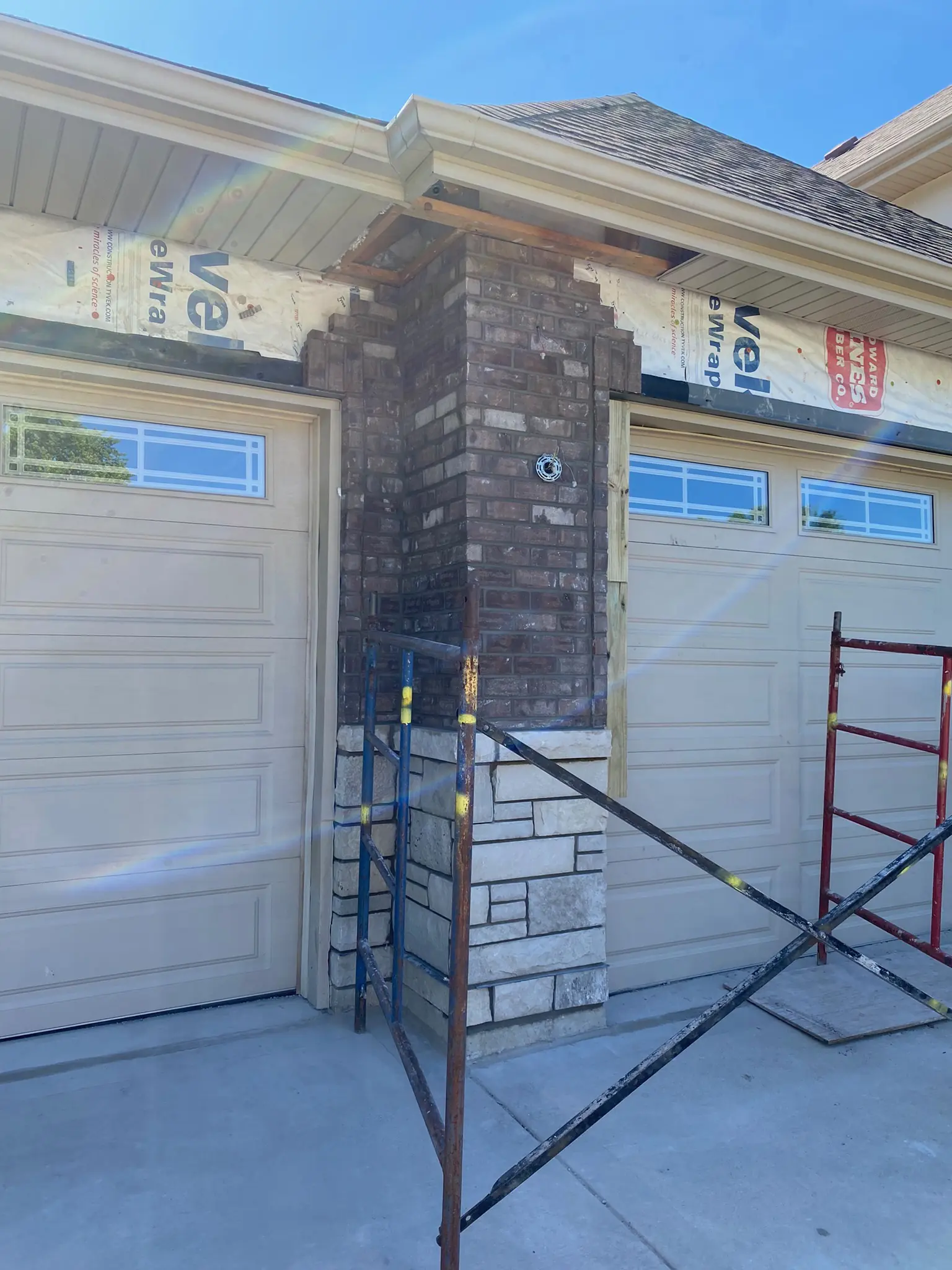
Tuckpointing in New Lenox, IL
Tuckpointing in New Lenox, IL is usually a smaller job than homeowners are told it is. Emerald Masonry LLC repoints brick and stone on homes, subdivisions, associations and commercial buildings throughout Will County. Family-owned, licensed, bonded and insured, career masons with decades of Chicagoland experience, free on-site estimates. Call (708) 288-1696.
That claim needs explaining, because it runs against most of what gets sold in this market.
New Lenox Is a Young Masonry Town
Most tuckpointing advice is written for century-old buildings — soft brick, lime mortar, solid double-wythe walls, joints eroded a half inch deep across an entire facade. That is real, and it describes a great deal of Chicago and the older inner suburbs.
It does not describe New Lenox.
The village's masonry is overwhelmingly modern brick veneer on homes built from roughly the 1980s onward, through the large subdivision growth along the Route 30 and Cedar Road corridors and out toward Lincoln-Way. That means:
- Dense, machine-made brick with low absorption compared with century-old common brick
- Modern Portland-based mortar, hard and durable by historic standards
- A drained cavity behind the brick, with weep holes and flashing designed to let water back out
- Twenty to forty years of exposure, not a hundred and twenty
Young brick in a drained wall does not fail uniformly across an elevation. It fails at details. And that changes what a competent repointing job actually looks like.
Where New Lenox Joints Actually Fail
On a typical New Lenox home, mortar failure concentrates in a short, specific list:
- Under window and door sills. A sill collects the entire runoff of the opening above and delivers it to one narrow joint. If the sill has lost its slope or drip edge, or the sealant at its ends has failed, that joint takes several times the water the rest of the wall does.
- The bottom two or three courses. Splash-back off walks, drives, patios and stoops, plus mulch and grade holding moisture against the wall, plus winter salt.
- Chimney chases and full-height fireplace walls. Exposed on three or four sides, with no heated interior behind them and no roof over them. On most modern homes this is the worst masonry on the property.
- The weather elevation. In Will County, generally the north and west faces, which see wind-driven rain and stay frozen longest.
- At the shelf angle, on taller elevations where veneer is carried on steel.
- Around penetrations — hose bibs, vents, conduit, light fixtures and anything anchored into the wall.
Everywhere else, the joints on a thirty-year-old veneer wall are often genuinely fine.
Which is why the right scope is usually targeted spot repointing, not a whole-house repoint. A contractor who quotes every elevation without walking every elevation is quoting volume.
Signs You Need Tuckpointing
- Joints receding noticeably behind the face of the brick
- Mortar that crumbles, powders, or lets a screwdriver sink in — the simplest self-test there is
- Sand or grit collecting on the sill, walk or foundation below a wall
- Open joints or visible gaps, especially under sills and at the chase
- Hairline cracking running through joints in a line
- Efflorescence, the white powdery bloom left when water passes through masonry and evaporates
- Spalled or flaking brick faces, which means water has been getting in for a while
- Damp interior walls, or staining at the top floor near a chimney
- Weep holes that are blocked, buried, or have been mortared shut
Risks of Waiting
An open joint is a hole in the wall. On a veneer wall, the water that enters does not simply sit in the brick — it reaches the cavity and the veneer ties, the corrugated metal straps holding the brick back to the frame. Ties are typically galvanized, and once they corrode they expand, lose capacity, and eventually stop restraining the wall. A veneer wall that has begun to bow is a rebuild, not a repointing.
Before that, open joints produce spalled brick, efflorescence, rust staining below sills and lintels, damp sheathing behind the veneer, and interior finish damage. Repointing a detail early costs a fraction of what any of that costs later.
Our Tuckpointing Process
- Walk every elevation and record which details need work and which do not.
- Test the existing mortar for hardness so the new mix is matched rather than guessed.
- Scope by elevation and detail — full repointing, spot repointing, or none.
- Protect windows, landscaping, walks and neighbouring property.
- Cut the joints — grind or rake failed mortar back to sound material, roughly two to two and a half times the joint width, without nicking brick edges.
- Clean and dampen so the brick does not pull water out of the fresh mortar before it cures.
- Match and mix in controlled batches so colour does not shift partway up an elevation.
- Pack in lifts, not one deep pass, so the joint is dense the whole way back.
- Tool to the existing profile — concave, weathered or flush.
- Confirm drainage — weep holes open, flashing intact, nothing sealed that should not be.
- Clean down and walk the finished elevation with the owner.
Materials
Type N is the general-purpose mix for most New Lenox veneer. Type S is stronger and appropriate for below-grade and some structural conditions, but it is harder than many brick and is not a default. The governing rule holds regardless of the building's age: mortar must be softer than the brick it sits against, because mortar is the sacrificial component and a joint can be replaced while a brick face cannot.
On spot repointing, matching matters more than on a full job, because the new work sits directly beside the old. We match colour against cured mortar, match sand and texture, and match the tooled profile exactly.
Related services that commonly run alongside: brick repair and brick replacement, limestone and sill repair, chimney repair for the chase, caulking and joint sealant at sills and penetrations, and masonry sealing where genuinely warranted.
What Drives the Cost
- How much of the wall genuinely needs work — the biggest variable, and the reason a real walk-through matters
- Number of elevations in scope
- Height, access and staging — ladder, scaffold or lift
- Chimney chase work, which is roof access and prices differently
- Brick replacement required alongside the repointing
- Match difficulty on unusual brick or unusual joint profiles
- Coordination on association and multi-building work
We do not quote over the phone or by the linear foot before seeing the wall. Estimates are free, written and itemized by elevation.
Serving New Lenox and Will County
Emerald Masonry LLC is a family-owned, licensed and insured masonry contractor serving Chicago and the Chicagoland suburbs led by career masons with decades of hands-on experience in tuckpointing, chimney repair, brick repair and replacement, lintel and parapet repair, foundation and limestone/sill repair, caulking, sealing, and commercial, residential, and historic masonry restoration. Free on-site estimates — call (708) 288-1696.
We work throughout New Lenox and neighbouring Mokena, Frankfort, Manhattan and Homer Glen, for homeowners, property managers, HOAs, churches and insurance companies. $5,000 project minimum.
Get a Free New Lenox Tuckpointing Estimate
If your joints are opening under the sills or your chimney chase is losing mortar, get it scoped properly — you may need far less work than you have been told. Call (708) 288-1696 or request a free estimate.
Ready to get started?
Free on-site estimates for commercial and large-scale projects.
Tuckpointing & Repointing in New Lenox, IL — Frequently Asked Questions
How much does tuckpointing cost in New Lenox, IL?
On most New Lenox homes the honest answer is less than owners expect, because the work is usually targeted rather than whole-house. Cost is driven by which elevations and details need attention, height and staging, and how much brick has to be replaced alongside it. Emerald Masonry itemizes by elevation in a free written estimate.
My house is only 25 years old. Can it need tuckpointing already?
Yes, in specific places. Twenty-five Chicagoland winters is enough to open joints where water concentrates — under sills, at the bottom courses, on chimney chases and on the weather-facing elevation — even while the rest of the wall is still sound. That is normal, and it is far cheaper to address at that stage.
Do I need the whole house repointed or just part of it?
On newer brick veneer, usually just part of it. A contractor who quotes a whole-house repoint on a 1990s or 2000s New Lenox home without walking every elevation is selling volume rather than diagnosing a wall. Spot repointing is legitimate work when the rest of the joints are genuinely sound.
Why do the joints under my window sills fail first?
Because a sill concentrates all the runoff from the window above it and sheds it directly onto the joint beneath. If the sill has lost its slope or drip edge, or the sealant at its ends has failed, that joint gets a great deal more water than the rest of the wall.
Should the weep holes be filled during tuckpointing?
Never. Weep holes are the openings in the bottom course that let water drain out of the cavity behind brick veneer. Mortaring or caulking them shut during repointing traps water in the wall and causes far worse damage a few winters later.
Will new mortar match my existing joints?
We match hardness first, then colour, sand and texture, and we tool the joint to the same profile as the surrounding field. Mortar lightens as it cures, so matching is judged against cured mortar rather than the wet mix. On spot repointing, profile and colour matter more than anything else.
Do you work with New Lenox HOAs and property managers?
Yes. We serve homeowners associations, property managers, churches, commercial owners and insurance companies throughout Will County, and we can scope common-area and multi-building masonry by element so a board can budget and phase it.
Tuckpointing & Repointing in Nearby Areas
Other Masonry Services in New Lenox, IL
Learn more about our tuckpointing & repointing services across Chicagoland, or view all service areas.