
Brick Repair · Chicagoland, IL
What Brick Repair and Brick Replacement Cost in Illinois — and What Actually Moves the Number
Nobody can price brick repair from a photo, and any per-brick figure you find online is describing a job that isn't yours. What actually drives the cost is how many units failed, how they're distributed, how hard they are to match, how high they are, and whether the water that caused it is still running.
2026-08-15
Quick Answer
Brick repair and replacement cost in Illinois is not a per-brick rate. It is driven by how many units have failed, whether they are concentrated or scattered, how difficult the brick is to match, working height and access, how much surrounding repointing is needed, and whether the water source causing the damage must also be corrected. Emerald Masonry LLC gives free on-site estimates itemized by area, with a $5,000 project minimum. Family-owned, career masons, licensed and insured. Call (708) 288-1696.
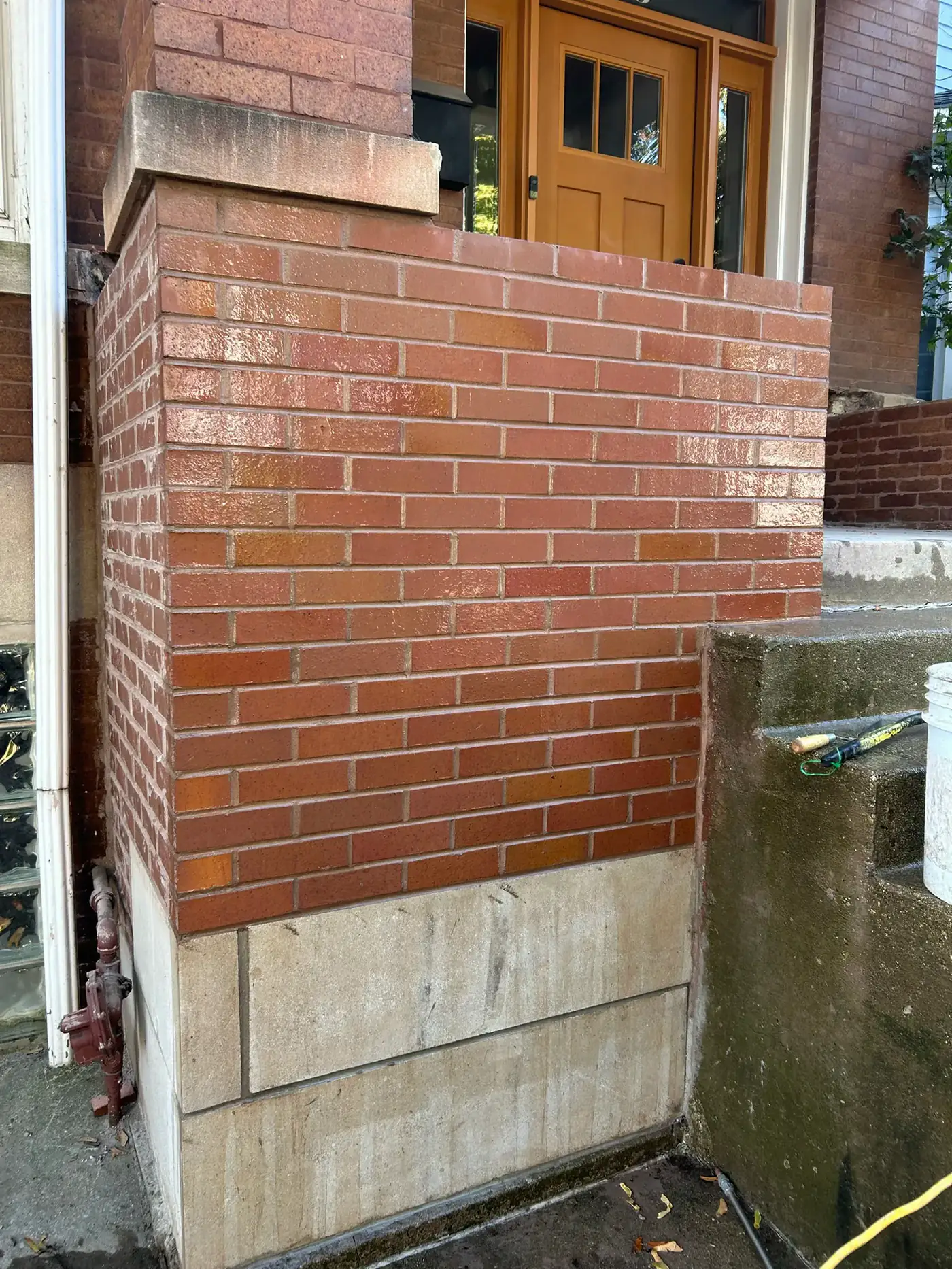
The Short Answer
There is no per-brick price for brick repair in Illinois, and any figure quoted without seeing the wall is describing someone else's job. What actually sets the number is how many units have failed, whether they are concentrated in one area or scattered across an elevation, how hard the brick is to match, how high the work is, how much surrounding repointing is needed, and whether the water source that caused the damage still has to be corrected.
Emerald Masonry LLC gives free on-site estimates itemized by area across Chicago and the Chicagoland suburbs — family-owned, licensed and insured, career masons with decades of experience, $5,000 project minimum. Call (708) 288-1696.
Why "Cost Per Brick" Is the Wrong Unit
The internet is full of per-brick and per-square-foot masonry figures. They are convenient for an article and close to useless for a real quote, for one structural reason:
Almost all the cost of a small masonry repair is in getting to it, not in doing it.
Consider two jobs. In the first, forty spalled bricks are clustered in one area, low on a rear wall, reachable from the ground. In the second, forty spalled bricks are scattered across a three-story front elevation, five here, three there, in eleven separate locations.
Same brick count. The second job can cost several times the first, because it needs scaffolding, it needs that scaffolding moved, and each cluster needs its own setup, cutting, matching and cleanup.
Distribution matters as much as quantity. That is the first thing an estimator is actually reading when they look at your wall.
The Cost Drivers, In Order of How Much They Move the Number
1. Access and height
This is the largest single variable on most jobs, and the one homeowners consistently underestimate.
| Working height | Typical access | Effect on cost | |---|---|---| | Ground level, reachable | Ladders, minimal setup | Baseline | | Second story | Ladder jacks or light staging | Moderate increase | | Third story and above | Full scaffolding or lift | Substantial increase | | Tight gangway or alley | Custom staging, neighbor protection | Substantial increase | | Over a public sidewalk | Overhead protection, sometimes permits | Substantial increase |
A repair that takes two hours at ground level can take a day at the third floor, and most of that day is scaffolding.
2. How much has failed, and where
- Concentrated damage — one area, one setup, one matching exercise. Most efficient.
- Scattered damage — many small setups. Cost per unit rises sharply.
- Full elevation — most efficient per unit, because everything is done once.
This is why we itemize by area rather than quoting a wall at its worst spot. A 90-foot wall might need 20 feet rebuilt, 30 feet of unit replacement and 40 feet of straightforward repointing, and pricing all 90 at the worst condition would be both wrong and expensive.
3. Repair versus replacement versus rebuild
These are three different price tiers, and knowing which one you are in explains most of the range you have been quoted.
| Scope | When it applies | Relative cost | |---|---|---| | Repointing | Brick faces sound, mortar joints eroded | Lowest — this is maintenance | | Unit replacement | Faces spalled off, units cracked through or crumbling | Moderate | | Section rebuild | Wall has bowed, displaced, or lost cohesion | Highest |
The honest rule: once a brick has lost its fired outer skin, it cannot be restored. That skin is what makes it weather-resistant. A spalled unit will keep absorbing water no matter what is painted or troweled over it, so it needs replacing. Brick with sound faces surrounded by failed joints needs repointing, not replacement — and any contractor recommending wholesale replacement of sound units should be asked to justify it.
4. Brick matching difficulty
| Brick era | Matching approach | Effect on cost | |---|---|---| | 1990s–present | Often still in production or close current equivalent | Minimal | | 1950s–1980s | Close production match, or salvage | Modest | | 1900–1940 (Chicago common, face brick) | Salvage yards, era-matched reclaimed units | Meaningful | | Pre-1900 hand-formed | Scarce salvage; sometimes harvesting from a hidden elevation | Significant |
That last technique is worth knowing about: on a historic building, we frequently take sound original brick from a rear or concealed elevation to repair the visible face, and put the new or near-match units in the concealed location. It costs more labor and delivers a far better result on the wall people actually see. See brick matching and replacement material and salvaged brick sourcing in Chicago.
5. Mortar matching
Matching mortar means matching hardness first, then color, sand and texture.
Hardness is not a preference — it is a rule. Mortar must be softer than the brick it holds, so that seasonal movement and freeze-thaw stress land in the replaceable joint rather than in the brick face. Century-old Chicago brick is soft; a bagged Portland-heavy mix is hard. Using the wrong one produces a repair that looks flawless for two years and then spalls the brick around it.
A custom-blended mortar — sand sourced to match, pigment adjusted, test panels laid — costs more than opening a bag. It is also the difference between a repair that disappears into the wall and one you see from the street forever. See Type N vs. Type S mortar and mortar color matching.
6. The water source
This is the cost driver that nobody quotes and everybody pays.
Brick does not spall for no reason. Something kept it wet: a downspout discharging at the foundation, mulch and grade covering the weep line, a sprinkler head clipping the wall, a failed sill, an open coping joint, a rusting lintel, a gutter that overflows every storm.
Replacing brick without correcting that means replacing it again. Sometimes the correction is free — rotating a sprinkler head, pulling a mulch bed back down. Sometimes it is real work. Either way it belongs in the conversation before the masonry is priced, and an estimate that never mentions it is an estimate that has not diagnosed anything.
7. Removing someone else's repair
On older Chicagoland buildings, a surprising share of the scope is undoing previous work: hard mortar patches on soft brick, mortar smeared over failing joints instead of cut back, sealant packed into mortar joints, coatings applied over spalling, mortar filling the weep holes.
Removing a hard patch from soft brick without damaging the brick is slow, careful, hand-tool work — often slower than the original repair took to install. It is legitimate scope, and a good estimate names it. See why masonry repairs fail: contractor shortcuts.
8. Everything found once the wall is open
With units removed, you can see things that were invisible from outside: corroded veneer ties, missing or damaged flashing, blocked weeps, a lintel end that has lost section, wet sheathing behind a veneer.
Good estimates handle this with a clear allowance and a written process for changes, not with a surprise. Ask how it will be handled before work starts.
Why Two Bids on the Same Wall Look Nothing Alike
Because they are frequently not describing the same job. The most common divergences:
- Joint preparation depth. Cutting back to sound mortar — generally two to two and a half times joint width — versus skimming over failed joints. Invisible at handover, decisive within five winters.
- Mortar specification. Custom-matched hardness and color versus whatever is in the truck.
- Brick sourcing. Era-matched salvage versus the closest thing available today.
- Access method. Proper staging versus working off ladders at heights where that is neither safe nor thorough.
- What is included. Water-source correction, weep clearing, cleaning down, protection of landscaping and neighboring property.
- Insurance and licensing. A genuinely insured, licensed crew costs more per hour than one that is not, and that difference is real, not padding.
Read the scopes side by side. If one bid is dramatically lower, the useful question is not "why are you cheaper" but "what are you doing differently." Related: why commercial masonry bids vary and how to evaluate a masonry contractor's bid.
The Illinois Context
Freeze-thaw is the engine. Chicagoland crosses the freezing point dozens of times each winter. Water inside a saturated brick expands roughly nine percent when it freezes, and each cycle takes a little more of the face. This is why identical brick in a milder climate lasts noticeably longer, and why deferring a repair here is more expensive than deferring one elsewhere. See Chicago freeze-thaw vs. national averages.
Housing stock sets the matching difficulty. Chicago bungalows, greystones, two-flats and worker cottages mean soft brick and lime-rich mortar; post-war ranches mean denser units and early Portland mortars; 1990s-onward suburban homes mean brick veneer over a drainage cavity. Each carries different matching, different mortar and different cost.
Salt adds a second mechanism. De-icer splash crystallizes inside brick and damages it independently of frost, which is why the lowest courses so often fail first.
Season affects scheduling, not just comfort. Mortar needs temperature to cure properly. Cold-weather work is possible with precautions but requires protection and heat, which is a real cost. See cold-weather masonry repair in Illinois.
How to Get a Number You Can Trust
- Insist on an on-site look. Nobody can price masonry from a photo, and anyone who offers to is guessing or building in margin for guessing.
- Ask for the scope in writing, itemized by area — units to be replaced, footage to be repointed, sections to be rebuilt.
- Ask what mortar, and why. A contractor who cannot explain hardness matching in plain language is telling you something.
- Ask about the water. What caused this, and what is being done about it.
- Ask how access is being handled, and whether staging is included.
- Ask what happens if something is found once the wall is open.
- Compare scopes before totals.
Related Services
- Brick repair and brick replacement
- Tuckpointing and repointing
- Lintel repair and limestone/sill repair
- Masonry sealing and caulking
- Residential masonry restoration and commercial masonry restoration
The Bottom Line
Brick repair pricing is not mysterious, it is just specific. The number is set by access, distribution, matching difficulty, scope tier and whether the underlying water problem is being solved — and every one of those requires someone standing in front of your wall.
The one generalization that does hold: the cheapest moment to address masonry is while the problem is still joints. Repointing is maintenance. Unit replacement is repair. Section rebuilding is construction. Each tier is a large step up from the last, and Chicagoland winters move a wall from one tier to the next faster than most owners expect.
Emerald Masonry LLC is a family-owned, licensed and insured masonry contractor serving Chicago and the Chicagoland suburbs led by career masons with decades of hands-on experience in tuckpointing, chimney repair, brick repair and replacement, lintel and parapet repair, foundation and limestone/sill repair, caulking, sealing, and commercial, residential and historic masonry restoration.
Free on-site estimates, itemized by area — call (708) 288-1696 or request an estimate.
Frequently Asked Questions
How much does it cost to replace one brick?
There is effectively no such job. Mobilization, access, matching and setup are the same whether one unit or thirty come out, so a single-brick price would be almost entirely overhead. Cost per unit drops sharply as the count rises, which is why scattered damage is priced very differently from a concentrated area.
Why do masonry bids for the same wall vary so much?
Usually because they are not describing the same work. One bid may cover face pointing over failed joints while another cuts them back to sound mortar; one may use a bagged mix while another custom-matches hardness and color; one may include salvaged matched brick while another sets whatever is available. Compare the scopes before comparing the numbers.
Is repointing cheaper than replacing brick?
Substantially, yes. Repointing addresses the joints while leaving the units in place; replacement means removing brick without damaging its neighbors, sourcing a match, and setting new units. That gap is exactly why acting while the problem is still joints is the single biggest cost saver in masonry.
Does brick matching really change the price that much?
It can. Current-production brick on a 1990s home is often matched easily. A pre-1900 hand-formed unit is no longer manufactured, so matching means sourcing reclaimed brick of the right size, color range and texture — and sometimes harvesting sound units from a hidden elevation to use on the visible one.
Why is height such a big cost factor?
Because reaching the work can cost more than the work. Ground-floor repairs need little setup; a third-story elevation needs scaffolding or a lift, plus the time to erect, move and dismantle it. That is why doing everything on one elevation in a single mobilization is far cheaper than three separate visits.
Should I get several estimates?
Yes, and read the scopes side by side rather than just the totals. A good estimate says how deep the joints are cut, what mortar is being used and why, whether brick is matched or salvaged, how the area is accessed, and what happens to the water source that caused the damage.
Does Emerald Masonry have a project minimum?
Yes, $5,000. Mobilization, setup, matching and quality control cost roughly the same regardless of job size, and a minimum keeps every project worth doing properly. On-site estimates are free.
Can I phase the work across a few years to spread the cost?
Often, yes, and we itemize by area so you can. The rule is that anything actively taking water or posing a hazard is done first; cosmetic and lower-exposure areas can wait. Phasing does cost more in total, because you pay for access more than once.
Will insurance cover brick repair?
Gradual deterioration from freeze-thaw and age is maintenance and is not covered. Sudden accidental damage — vehicle impact, storm, fire — often is. The distinction turns on cause, which is why documentation matters when a claim is involved.
Is a low bid ever the right choice?
It can be, if the scope genuinely matches. What it usually reflects, though, is shallower joint preparation, a bagged mortar with no hardness matching, or unmatched brick — all of which look identical on day one and diverge sharply within five winters. The cheapest masonry is the masonry you only pay for once.