
Foundation Masonry Repair · Downers Grove, IL
Foundation Masonry Repair in Downers Grove, IL — Four Different Foundations, Four Different Repairs
Downers Grove has four common foundation materials under four eras of housing, and each one fails and gets repaired differently. Parging a rubble stone wall the way you would parge block is one of the most common — and most damaging — mistakes made on older Village homes.
Quick Answer
Emerald Masonry LLC provides foundation masonry repair in Downers Grove, IL — repointing and rebuilding rubble stone, brick, hollow clay tile and concrete block foundation walls, and correcting the water sources that cause them to fail. Family-owned, licensed and insured, career masons with decades of Chicagoland experience, free on-site estimates. Call (708) 288-1696.
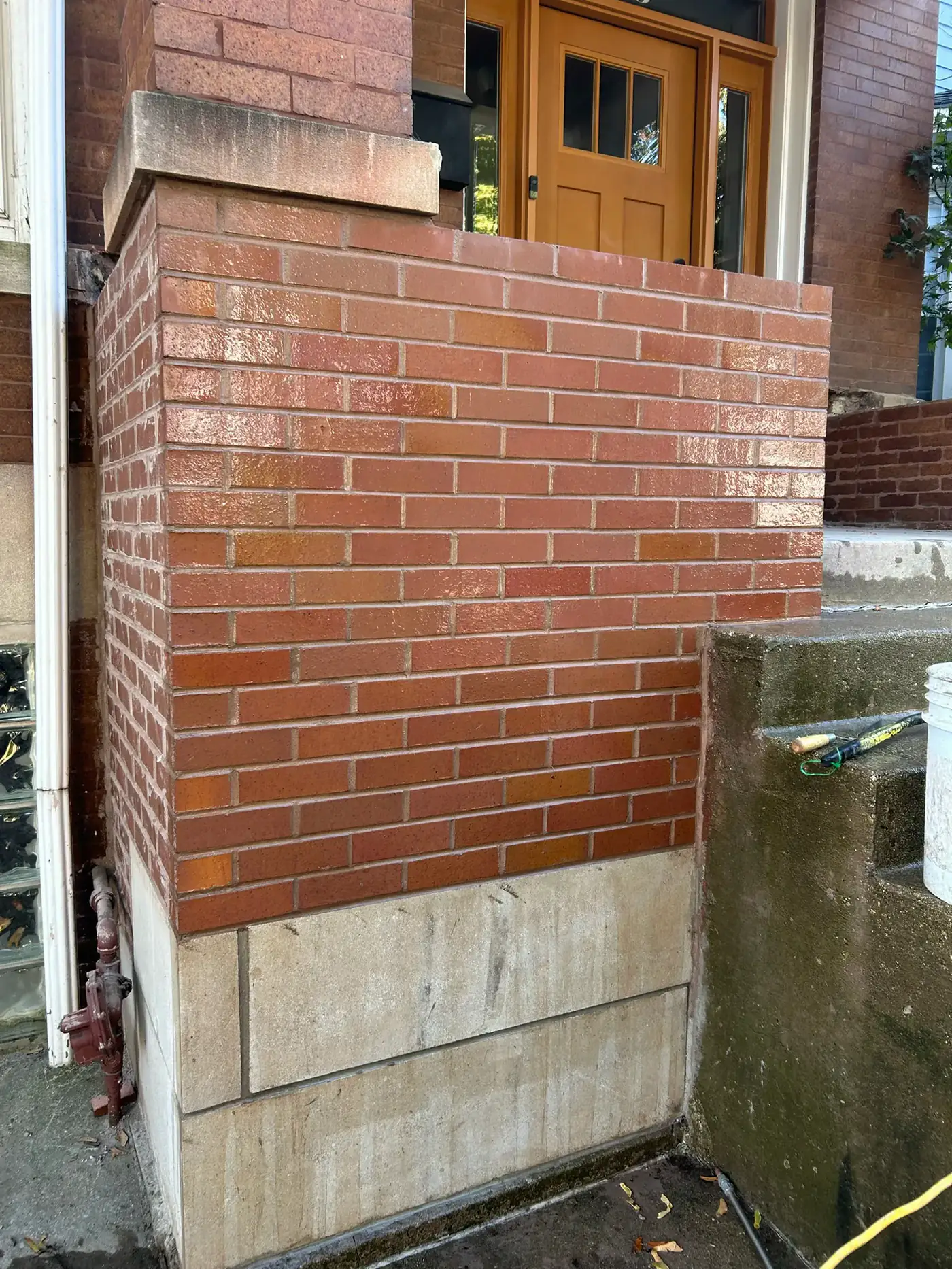
Foundation Masonry Repair in Downers Grove, IL
Foundation masonry repair in Downers Grove, IL depends almost entirely on one question: what is the foundation actually made of? Emerald Masonry LLC repairs rubble stone, brick, hollow clay tile and concrete block foundations throughout DuPage County — family-owned, licensed, bonded and insured, career masons with decades of Chicagoland experience, free on-site estimates. Call (708) 288-1696.
Downers Grove is unusual in how many foundation types sit within a few blocks of each other. A house near the older Village core and a house in a post-war subdivision a mile away can have the same symptom — crumbling joints, damp walls, a crack — and need almost nothing in common.
The Four Foundations Under Downers Grove
Rubble limestone. The oldest stock, roughly pre-1900, common in and around the historic core near the downtown and the older tree-lined blocks. Irregular quarried stone laid up in soft, lime-rich mortar. It is heavy, it is durable, and its mortar is supposed to be soft — that is what lets the wall move without cracking the stone.
Brick. Early twentieth century. Multiple wythes of common brick below grade, often the same Chicago common brick used above it. Brick foundations do well until water reaches them repeatedly, then the below-grade faces spall and the joints wash out.
Hollow clay tile. Roughly 1910s through 1930s. Large hollow blocks with internal webbing. Structurally fine when dry and intact, but brittle, and once water gets inside the cells it freezes and cracks the webs. Hollow tile is the material most often misdiagnosed as block.
Concrete block (CMU). Post-war through modern. Uniform eight-by-sixteen units. Its characteristic failures are horizontal cracking at mid-height from lateral soil pressure, step cracking at corners, and mortar joint deterioration where water sits.
Each of those four wants a different repair. That is the whole point of this page.
Where Downers Grove Foundations Get Into Trouble
Downers Grove sits on heavy DuPage clay under a mature tree canopy, and the Village has spent years on stormwater management for good reason. For masonry foundations that combination produces a specific set of problems:
- Clay soil that swells and shrinks with moisture, loading and unloading foundation walls seasonally.
- Mature root systems near century-old homes, drawing moisture unevenly under one side of a footing and driving differential settlement.
- Downspouts discharging at the wall — still the single most common cause of foundation masonry failure we see anywhere in Chicagoland.
- Negative grade, where decades of landscaping and mulch have raised soil against the house and reversed the slope.
- Window wells without drainage, holding a column of water directly against the wall.
- Cold joints at additions, where a newer foundation meets an original and the two settle differently.
Freeze-thaw finishes the job. Water saturates the masonry, freezes, and expands, which is how a damp joint becomes an open joint and an open joint becomes a missing one.
Signs You Need Foundation Masonry Repair
- Mortar you can rake out of the joints with a finger or a screwdriver
- Sand or grit accumulating on the floor along the base of the wall
- Stones or blocks that have shifted, dropped, or rotated out of plane
- A wall that bulges inward when you sight along it
- Horizontal cracking at mid-height on a block wall
- Step cracking through the joints at a corner
- Efflorescence, the white powdery deposit left when water moves through masonry and evaporates
- Spalled, flaking below-grade brick
- Parge coat blistering, hollow-sounding, or falling off in sheets
- Active water entry at a specific joint or crack
Risks of Waiting
A foundation wall is holding back soil and carrying the building. Eroded joints reduce the wall's ability to distribute that load, and once individual stones or blocks begin to move, the wall's geometry — not just its mortar — is compromised. Water that runs through a foundation wall also carries fines out with it, undermining the material behind the wall and accelerating movement.
The practical escalation: repointing becomes section rebuilding, section rebuilding becomes excavation and full rebuilding, and a wall that has begun to bow may require structural reinforcement that was entirely avoidable a few years earlier.
Our Foundation Masonry Repair Process
- Identify the material — stone, brick, hollow tile, or block — and the original mortar type.
- Find the water. Downspouts, grade, window wells, sump discharge, gutters, irrigation, and any interior source.
- Assess movement. Is the wall stable and simply eroded, or is it actively moving? These get different scopes.
- Correct the water source first where it is ours to correct, and identify it plainly where it is not.
- Rake and clean the joints back to sound mortar without over-cutting soft stone or fracturing hollow tile webs.
- Repoint with a compatible mix — soft and lime-rich on historic stone, appropriate Type N or Type S where the material and loading call for it.
- Rebuild deteriorated sections, resetting displaced stone or block on a sound bed.
- Parge only where the material warrants it, using a coating compatible with the substrate rather than a hard cement skin over soft stone.
- Address the transition at additions, stoops, window wells and utility penetrations.
- Review the finished work and document what still needs to be watched.
Materials and the Rule That Governs Everything
The rule is the same one that governs every masonry repair, and it is violated most often below grade: the mortar must be softer than the masonry unit it sits against. A high-Portland mortar or a hard cement parge on a soft rubble limestone or century-old brick foundation does not strengthen it. It concentrates stress and moisture in the stone and the brick, which are the parts you cannot replace.
Related work often runs with foundation repair: brick repair where above-grade courses have spalled, tuckpointing on the exposed foundation and lower wall, masonry sealing where genuinely appropriate, and caulking and joint sealant at penetrations and transitions.
What Drives the Cost
- Foundation material and how fragile it is to work on
- Access — interior only, or excavation to reach the exterior face
- Linear footage and height of wall needing work
- Whether sections must be rebuilt rather than repointed
- Water correction required as part of the scope
- Site conditions — landscaping, decks, walks, utilities, and tight side yards
We do not price foundation work sight unseen. The assessment is free and the estimate is written.
Serving Downers Grove and DuPage County
Emerald Masonry LLC is a family-owned, licensed and insured masonry contractor serving Chicago and the Chicagoland suburbs led by career masons with decades of hands-on experience in tuckpointing, chimney repair, brick repair and replacement, lintel and parapet repair, foundation and limestone/sill repair, caulking, sealing, and commercial, residential, and historic masonry restoration. Free on-site estimates — call (708) 288-1696.
We work throughout Downers Grove and neighbouring Westmont, Lisle, Woodridge and Naperville, for homeowners, property managers, HOAs, churches and insurance companies. $5,000 project minimum.
Get a Free Downers Grove Foundation Assessment
If mortar is falling out of your foundation wall, water is finding its way in, or a crack has started to widen, have it identified properly before it becomes a rebuild. Call (708) 288-1696 or request a free estimate.
Ready to get started?
Free on-site estimates for commercial and large-scale projects.
Foundation Masonry Repair in Downers Grove, IL — Frequently Asked Questions
How much does foundation masonry repair cost in Downers Grove, IL?
Cost is driven by what the foundation is made of, how much of it is accessible, and whether excavation is required to reach the exterior face. Repointing an exposed interior stone wall and rebuilding a settled exterior corner are very different scopes. Emerald Masonry provides a free on-site assessment and a written, itemized estimate.
What kind of foundation does my Downers Grove house have?
It generally tracks the build era. Pre-1900 homes near the older Village core typically sit on rubble limestone; early-1900s homes often have brick or hollow clay tile; post-war homes are usually poured concrete or concrete block. Look at the exposed wall in your basement — irregular stone, uniform brick, hollow tile blocks with visible webbing, or eight-by-sixteen block are all easy to tell apart once you know what to look for.
My old stone foundation has crumbling mortar. Is the house sinking?
Usually not. Rubble stone foundations were laid in soft lime mortar that erodes over a century, and eroding joints are a maintenance issue, not automatically a structural one. What matters is whether stones have shifted, whether the wall is bulging inward, and whether water is running through it. Those are the signs that move it from repointing to rebuilding.
Should I parge or seal my foundation wall?
Only if it is the right wall for it. A hard cement parge coat over a soft rubble stone or older brick foundation traps moisture behind it, spalls off in sheets, and can accelerate deterioration of the masonry underneath. Parging is appropriate on block and on some brick; on soft historic stone it is often the wrong answer.
Water is coming through my basement wall. Is that a masonry repair or a drainage problem?
Frequently both, and the drainage side has to be handled first. If downspouts discharge at the wall, grade slopes toward the house, or window wells hold water, repointing the interior face will not stop it. We identify the water source as part of the assessment rather than repointing over an active leak.
Can you repair a foundation from the inside?
Often yes. Interior repointing, rebuilding of deteriorated sections, and parging where appropriate are done from inside on many Downers Grove homes. Exterior work becomes necessary when the outer face has failed, when flashing or grade must be corrected, or when a section needs full rebuilding.
Do you handle foundation masonry on additions and older Village homes?
Yes. Cold joints where an addition meets an original foundation are a common trouble spot in Downers Grove, because the two sections settle at different rates. We repair the joint and the masonry on both sides rather than filling the crack and calling it finished.
Foundation Masonry Repair in Nearby Areas
Other Masonry Services in Downers Grove, IL
Learn more about our foundation masonry repair services across Chicagoland, or view all service areas.