
Chimney Repair · Downers Grove, IL
Chimney Repair in Downers Grove, IL — First Question: Is It Actually a Masonry Chimney?
Half the brick chimneys in Downers Grove's newer subdivisions are not masonry chimneys at all — they are brick veneer wrapped around a factory-built metal fireplace. They fail differently, they get repaired differently, and knowing which one you own is the first thing an honest estimate establishes.
Quick Answer
Emerald Masonry LLC repairs chimneys in Downers Grove, IL — crowns, caps, flashing, repointing, rebuilds above and below the roofline, and brick chase veneer on factory-built fireplaces. We identify whether you own a true masonry chimney or a veneer chase first, because they fail differently. Family-owned, licensed and insured, career masons. Call (708) 288-1696.
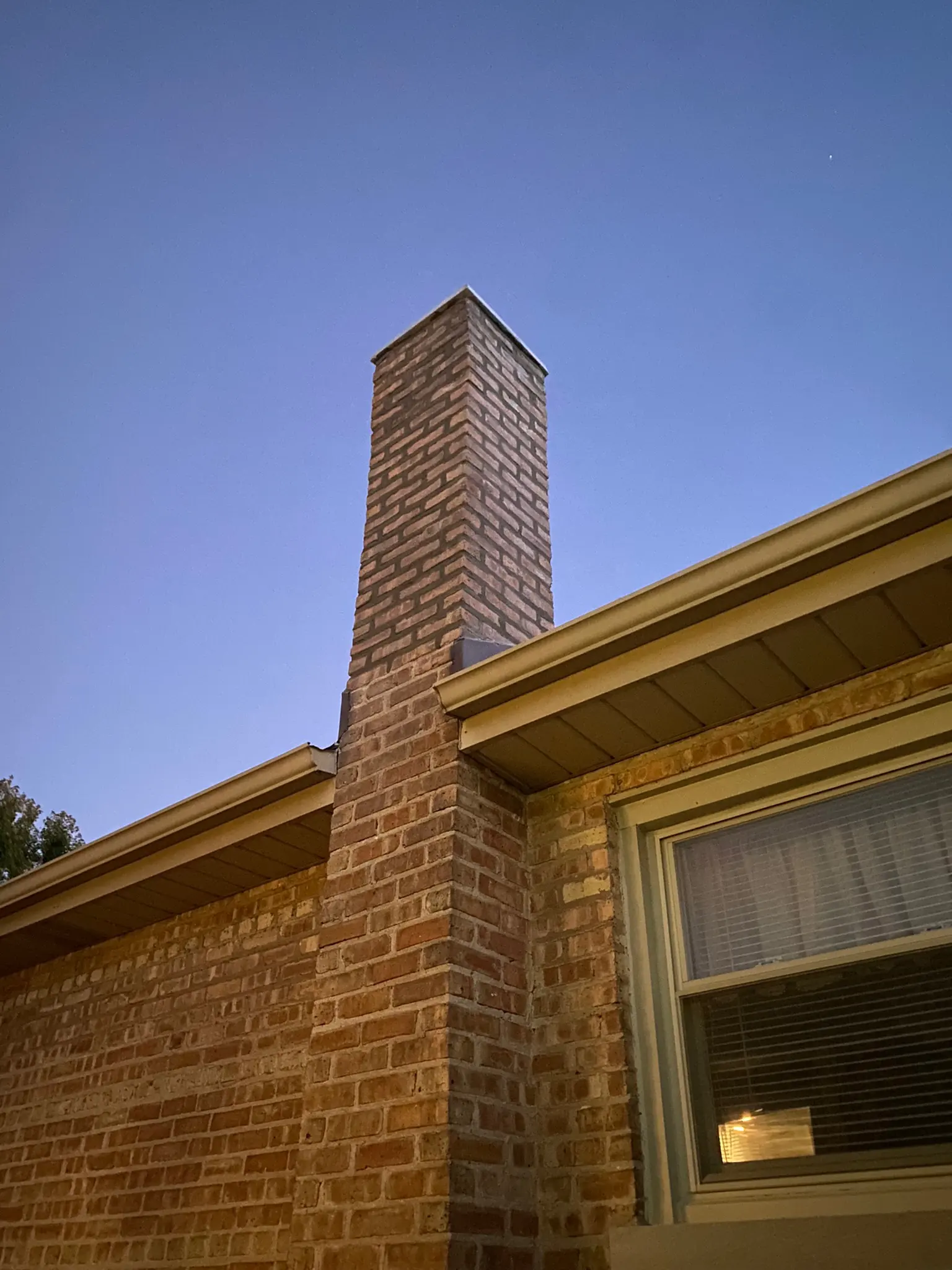
Chimney Repair in Downers Grove, IL
Chimney repair in Downers Grove, IL covers crowns, caps, flashing, repointing, brick replacement and full rebuilds — but the first thing a competent estimate establishes is what kind of chimney you actually own. Emerald Masonry LLC serves DuPage County: family-owned, licensed, bonded and insured, career masons with decades of Chicagoland experience, free on-site estimates. Call (708) 288-1696.
Downers Grove is unusual because it contains two entirely different chimney populations, and homeowners rarely know which one is on their roof.
Population one: true masonry chimneys. The pre-war housing near downtown, the historic streets around Maple Avenue, and the enormous stock of 1950s and 60s ranches and split-levels. Solid brick, firebrick firebox, clay flue tiles, poured concrete crown.
Population two: brick chase veneers. The subdivisions built from the 1970s onward. What looks like a brick chimney is a wood-framed chase clad in brick veneer, wrapped around a factory-built metal fireplace with a round metal flue. There is no crown — there is a sheet metal chase cover. There is no masonry firebox — there is a steel one with a manufacturer's plate inside.
They look nearly identical from the driveway. They fail completely differently. And the wrong diagnosis produces the wrong estimate.
How to Tell Which One You Have
Two places to look, both free:
At the top. A masonry chimney terminates in a poured concrete crown, several inches thick, sloped to shed water, with clay flue tiles projecting through it. A chase terminates in a flat metal lid — the chase cover — usually galvanized, often rusting through and streaking the brick below with orange, with a round metal cap sitting on it.
At the firebox. Open the doors and look inside. Firebrick laid in courses with mortar joints, and a masonry throat above: real masonry. Smooth steel or refractory panels, a metal frame, and a UL label on a plate: factory-built.
Why it matters: on a chase, the brick is a cladding, not a structure. Water getting behind it reaches wood framing, not more masonry. A rusted-through chase cover on a Downers Grove subdivision home is not a cosmetic issue — it is water pouring straight down the inside of a wood chase, and it is the single most common cause of chimney-related rot in that housing stock. It also costs a fraction of what a homeowner braces for, because it is not a rebuild.
The Three Water Paths
Whichever type you own, water gets in one of three ways, and they present identically from inside the house — a stain on the ceiling near the chimney, a damp smell, discoloration on the firebox wall.
- Through the top. A cracked crown or a rusted chase cover lets water straight into the structure. Crowns crack because they were poured thin, poured flat instead of sloped, or poured tight against the flue tiles with no expansion joint.
- At the roof intersection. Step flashing and counter flashing have to interlock and be let into a mortar joint. Failed, caulk-only, or surface-smeared flashing is probably the most common leak source we find in DuPage County, and it is often mistaken for a masonry problem entirely.
- Through the stack itself. Open mortar joints and spalled, porous brick absorb water directly. Above the roofline the stack is exposed on all four sides with no wall behind it to buffer temperature swings, so it always deteriorates before the house does.
Diagnosing which path is active — before anyone quotes a rebuild — is the entire job. A rebuild that does not correct failed flashing leaks exactly as much as the old chimney did.
Signs Your Downers Grove Chimney Needs Work
- White staining or efflorescence on the exterior brick — water is moving through it.
- Rust streaks running down the brick from the top — a failing chase cover, or corroding metal at the crown.
- Crumbling, missing or receding mortar joints on the stack above the roof.
- Spalled or flaking brick faces, especially on the north and canopy-shaded sides.
- A cracked, chipped or eroded crown, or gaps between the crown and the flue tiles.
- Moss or dark green growth on a stack that stays wet under heavy tree cover.
- Ceiling stains near the chimney chase, or a musty smell in the fireplace.
- Flue tile chips in the firebox — pieces of clay in the ash means the liner is deteriorating.
- A visible gap between chimney and house wall, or a stack that reads out of plumb.
- Loose or fallen brick at the base — treat as urgent.
Why Downers Grove Chimneys Deteriorate the Way They Do
The tree canopy. Downers Grove takes its urban forest seriously, and mature trees are one of the village's real assets. They are also, from a masonry standpoint, a moisture problem. A chimney under heavy canopy dries slowly, stays damp for days after rain, grows moss on shaded faces, and enters every freeze cycle already saturated. That is why the north side of a Downers Grove stack routinely looks a decade older than the south side.
Overhanging limbs add abrasion and drop debris on the crown and cap, and they keep flashing seams wet.
Freeze-thaw. DuPage County crosses the freezing point dozens of times each winter. Every crossing that catches saturated brick expands the water inside it by roughly nine percent, and each cycle takes a little more of the face. The mechanism is covered in freeze-thaw masonry damage in Chicago.
Age spread. A 1925 chimney near downtown needs soft, lime-rich mortar matched to soft original brick; a 1958 ranch chimney was built with denser brick and Portland-cement mortar; a 1994 chase is a different animal entirely. Mortar must always be softer than the brick it holds — get that backwards on a pre-war stack and the brick faces spall while the joints stay perfect.
Unused chimneys deteriorate faster. Many Downers Grove homes converted to gas or stopped using the fireplace entirely. A stack that never gets a hot fire never dries out internally, and the flue stays cool and damp year-round.
Our Chimney Repair Process
- Free on-site assessment, including roof-level inspection where safe, identifying chimney type, crown or chase cover condition, flashing, joints, brick and plumb.
- Identify the active water path — top, flashing, or stack face — and say so in writing.
- Scope the smallest repair that actually solves it. If your chimney needs a cap and flashing, that is what we quote.
- Repointing — joints cut back to sound mortar, matched for hardness, color and sand, packed in lifts and tooled to the original profile.
- Brick replacement for spalled units, using salvaged or matched brick.
- Crown repair or replacement — a new cast crown, properly sloped, with an overhang drip edge and a bond break at the flue tiles so thermal movement does not crack it. On chases, a new custom-fabricated chase cover in stainless or aluminum, cross-broken to shed water.
- Flashing — new step and counter flashing let into the joints and sealed correctly, not smeared with roof cement.
- Cap installation to keep rain, snow and animals out of the flue.
- Rebuild where warranted — taken down to sound masonry and rebuilt with matched units and correct mortar.
- Water testing and walkthrough before we call it finished.
Materials We Use
Matched replacement brick, salvaged where the original is no longer produced; Type N and lime-modified mortars for older stacks, firmer mixes only where the brick supports them; cast crown mixes with proper slope and drip edge; stainless steel and aluminum chase covers and caps; stainless or copper flashing with correct counter-flashing reglets; backer rod and elastomeric sealants at movement joints.
Related services: tuckpointing, brick repair, brick replacement, masonry sealing and caulking and joint sealant. Useful reading: chimney crown vs. chimney cap and chimney flashing leaks in Chicago.
What Drives the Cost
- Which repair you actually need — cap, crown, flashing, repointing, partial or full rebuild.
- Chimney type — masonry stack versus veneer chase, which changes both the work and the materials.
- Height and roof pitch, and whether staging, roof jacks or a lift is required.
- Stack size — a single-flue ranch chimney versus a wide multi-flue stack.
- How far down the damage goes — above roofline only, or continuing below into the attic and wall.
- Brick matching, especially on pre-war and discontinued units.
- Access — trees, landscaping, driveway position and where equipment can be set.
We never quote a chimney from a photograph. We look at it, tell you which of the three water paths is open, and put the recommendation in writing. See what a masonry estimate should include.
The Cost of Waiting
A chimney is the most exposed masonry on your house — four sides to the weather, no adjacent wall to moderate it, sitting on top of the one place a leak does the most damage. A crown crack that costs very little to address becomes saturated brick, then spalled faces, then eroded joints, then a stack that has to come down and be rebuilt from the roofline. The same water, meanwhile, is working on your roof deck, framing and ceiling.
Chimney problems are cheap early and expensive late, and the curve is steep.
Emerald Masonry LLC is a family-owned, licensed and insured masonry contractor serving Chicago and the Chicagoland suburbs led by career masons with decades of hands-on experience in tuckpointing, chimney repair, brick repair and replacement, lintel and parapet repair, foundation and limestone/sill repair, caulking, sealing, and commercial, residential and historic masonry restoration. Free on-site estimates — call (708) 288-1696.
Serving Downers Grove and DuPage County
We work throughout 60515 and 60516 — downtown and the historic streets near Maple Avenue, the post-war neighborhoods, and the subdivisions south of 75th Street — plus neighboring Westmont, Lisle, Woodridge and Darien. Downers Grove owners often pair chimney work with brick repair, tuckpointing or lintel repair.
Get a Free Chimney Assessment in Downers Grove
Stains near the chimney, rust streaks down the brick, crumbling joints above the roof, or you simply do not know whether you own a masonry chimney or a chase — that is exactly the call to make.
Call (708) 288-1696 or request your free estimate.
Ready to get started?
Free on-site estimates for commercial and large-scale projects.
Chimney Repair in Downers Grove, IL — Frequently Asked Questions
How do I know if my chimney is real masonry or a brick chase?
Look at the top and at the firebox. A true masonry chimney has a solid poured concrete crown with clay flue tiles projecting through it, and a firebox built of firebrick. A chase has a sheet metal chase cover instead of a crown, a round metal flue pipe, and a metal firebox with a visible manufacturer's plate inside the opening.
How much does chimney repair cost in Downers Grove, IL?
It depends entirely on which repair the chimney actually needs. Resealing a crown, installing a cap, replacing flashing, repointing the stack above the roof and rebuilding it are five very different scopes at five very different prices. Emerald Masonry diagnoses in person and gives you a free written estimate that itemizes each element.
Why is my chimney leaking when the roof is fine?
Most chimney leaks in Downers Grove enter through one of three paths — a cracked crown, failed step and counter flashing at the roof intersection, or open mortar joints and porous brick on the stack itself. They look identical from inside the house, so the job is identifying which path is active before anything is priced.
Can a chimney be repaired instead of rebuilt?
Usually, yes. If the brick and joints below the roofline are sound and the damage is confined to the exposed stack, repointing plus a new crown, cap and flashing solves it. Rebuilding becomes the right call when brick faces have spalled through, the stack is leaning, or mortar has eroded so deeply the units no longer bear properly.
My chimney is pulling away from the house — is that urgent?
Yes. A stack separating from the wall means either the footing has settled or the masonry has lost bearing, and gravity does not reverse. Stop using the fireplace, keep people away from the base, and have it assessed promptly.
Do you work on chimneys shaded by mature trees?
Constantly, in Downers Grove. Heavy canopy keeps a chimney damp for days after rain, which accelerates joint erosion, moss and freeze-thaw damage on the shaded faces. We assess each face separately, because the north and canopy-shaded sides are usually far worse than the sunny ones.
Do you handle the fireplace and liner too?
We are masonry contractors — we repair and rebuild the structure, crown, cap, flashing and brickwork. Flue liners, appliance venting and sweeping belong to a certified chimney sweep, and we will tell you plainly when that is who you need rather than selling you masonry you do not require.
Chimney Repair in Nearby Areas
Other Masonry Services in Downers Grove, IL
Learn more about our chimney repair services across Chicagoland, or view all service areas.