
Parapet Wall Repair · Chicagoland, IL
Your Two-Flat Has a Parapet: The Roofline Problem on Chicago Residential Masonry
A Chicago two-flat has a commercial roof detail on a residential building — a flat roof hidden behind a masonry parapet, with a decorative cap on top and nobody at all responsible for inspecting it.
2026-09-30
Quick Answer
A Chicago two-flat, three-flat or greystone has a flat roof behind a masonry parapet, which means it carries a commercial roof-edge detail with no building manager to inspect it. The parapet is exposed on both faces, capped horizontally and invisible from the sidewalk, so it fails years before the walls below and is the most common source of upper-floor water. Emerald Masonry LLC repairs parapets and coping across Chicagoland — (708) 288-1696.
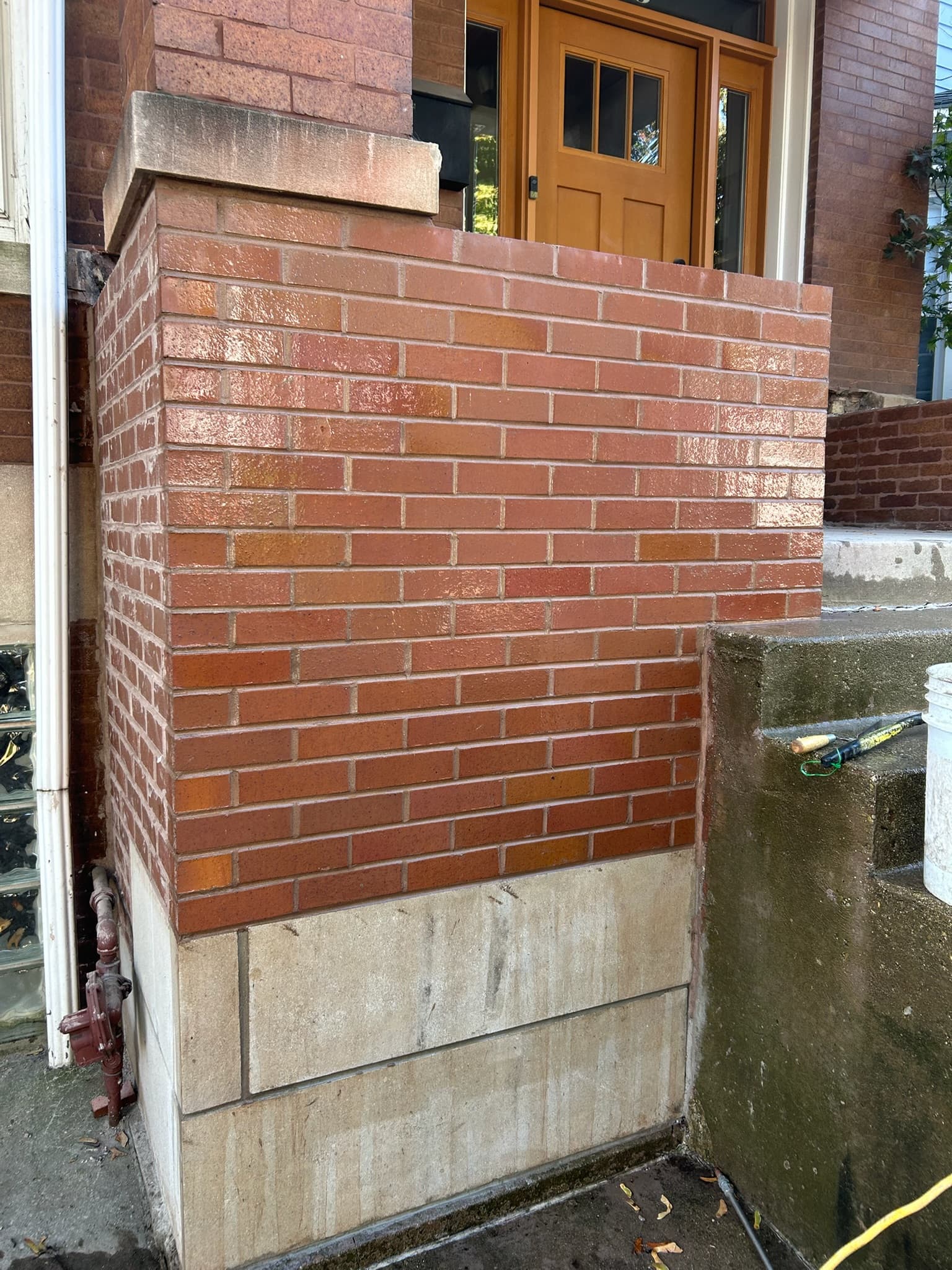
Your Two-Flat Has a Parapet: The Roofline Problem on Chicago Residential Masonry
A Chicago two-flat, three-flat or greystone carries a commercial roof-edge detail on a residential building. The roof is flat, hidden behind a masonry parapet that is exposed on both faces, capped horizontally, invisible from the sidewalk — and unlike a commercial building, there is no property manager whose job it is to walk it. That combination makes the parapet the most common source of upper-floor water on this housing stock, and the least inspected masonry in the city. Emerald Masonry LLC repairs parapets, coping and roofline masonry across Chicago and the Chicagoland suburbs. Call (708) 288-1696.
If you own a bungalow, your roof is pitched, your gutters are at the edge, and the top of your masonry is a gable or a soffit. Everything drains away from the wall.
If you own a two-flat, a three-flat, a courtyard building or a greystone, none of that is true. Your roof is flat. It drains to an internal drain or a scupper. And around its edge stands a section of brick wall continuing above the roof — tallest and most decorated at the front, often continuing down both sides, frequently shared with the building next door.
That is a parapet, and it is the same detail an office building has. The difference is that the office building has somebody paid to look at it.
What a parapet is, and why it is the worst-positioned masonry on your building
A parapet is the part of the wall above the roof line. On residential Chicago stock it usually does three jobs: it hides the roof from the street, it gives the roof membrane something to terminate against, and at the front it carries the building's decorative element — a stone or terra-cotta cornice, a corbelled brick band, a limestone cap.
Structurally it occupies the worst position masonry can be asked to occupy:
- Exposed on both faces. Street side and roof side. There is no warm interior face for it to dry toward, which every other wall on your building has.
- Topped horizontally. Water sits on it instead of running off it.
- Unrestrained at the top. It moves more than the wall beneath it, and it has nothing holding it in line.
- Invisible from grade. You cannot see its roof-side face, its coping joints or its flashing from the sidewalk.
Put those four together and the result is predictable: the parapet reaches the end of its service life years before the elevation below it, and gets looked at years later.
The leak that survives a new roof
This is the single most common call we get on this building type, and the story is almost always identical. Water stains a top-floor ceiling. A roofer replaces the roof. The following spring, the same stain.
Here is why.
Water that enters through an open coping joint does not stay at the top. It runs down inside the parapet core, where nothing can dry, and continues until it meets the first obstruction — a flashing edge, a floor line, a steel member — then exits there. That exit point is frequently several feet below and a few feet sideways from the entry point, and it is inside the wall rather than under the membrane. A new roof does not touch any of it.
So the diagnostic rule on a two-flat is: if the stain is at the top of the wall or at the wall–ceiling junction rather than in the middle of the ceiling, suspect the parapet before the roof. Coping and roofline masonry leaks and water coming through a brick wall cover the paths in more detail.
The five things that fail, in the order we find them
1. Coping joints
The coping is the cap on top — limestone, precast, clay tile or metal. Its joints are the number-one water entry point on the entire building. On a hundred-year-old two-flat they have often been sealed with caulk two or three times, which is a maintenance measure rather than a repair.
2. The roof-side face
Nobody has ever repointed it, because nobody has ever seen it. On a great many buildings the roof-side joints are noticeably worse than the street face, and repointing only the street face leaves half the parapet admitting water.
3. Missing or failed through-wall flashing
A properly built parapet has a flashing at its base that turns water escaping inside the wall back out. On a lot of older residential construction it was never installed, or it has corroded through. It cannot be added without taking courses down — which is frequently the reason a parapet gets rebuilt rather than repointed. See through-wall flashing in masonry walls.
4. Spalling and bulging
Chicago's soft common brick on the parapet's inner face, saturated and freezing repeatedly, loses faces in plates. Left long enough the wall bulges or leans, at which point it stops being a water problem and becomes a falling-material problem over a sidewalk or a rear porch. Chicago common brick and why it crumbles covers the material; parapet wall failure signs covers how to read the condition, and applies to a three-flat as much as to an office building.
5. The cornice
At the front, the decorative cornice or cap is attached with concealed steel that has been corroding since it was installed. When the anchorage goes, the unit goes — and it goes onto a public sidewalk. On greystones this is the highest-consequence element on the building; greystone façade restoration covers it.
Three complications specific to residential buildings
The party wall. On an attached two-flat the side parapet may be shared with the building next door. Repairing half a shared parapet is both technically awkward and financially wasteful — it is much cheaper to do it once, together. Who is obliged to pay is a title and legal question rather than a masonry one, and party wall masonry in Chicago covers the shape of it. Ask your own counsel about your deeds.
The rear porch. A wood rear porch or stair tower bolted into the masonry penetrates the wall at dozens of points, often near the top, and its anchors and flashings are frequently the second-largest water path on the building after the coping.
Scuppers and drains. A flat roof drains either internally or through a scupper cut through the parapet. Either way there is a deliberate penetration at the wettest point on the wall, with a sleeve and a sealant that have a shorter life than the masonry. A blocked drain also ponds water directly against the parapet, which accelerates everything above.
Repair or rebuild
| Condition | Repoint | Rebuild above roof line | |---|---|---| | Brick sound, joints at end of life | ✓ both faces | | | A few spalled units | ✓ replace and repoint | | | Coping bedding failed along a run | ✓ reset or replace coping | | | Units spalled through across the run | | ✓ | | Parapet leaning or bulging | | ✓ | | No through-wall flashing present | | ✓ (the only way to install it) | | Cornice anchorage failing | Assess separately — often its own scope | |
On the repointing itself, the governing rule on older Chicago brick is unchanged: the mortar must be softer than the brick it holds, so movement and moisture relieve through the replaceable joint instead of spalling the brick face. A hard Portland-heavy mix on soft common brick will cost you brick, not joints. Lime versus Portland mortar explains why.
The cheapest time to fix it is while the roof is off
If there is one piece of scheduling advice for this building type, it is this.
The coping, the through-wall flashing and the reglet that receives the roofer's counterflashing are all masonry work that the roofer builds against. When a roof is being replaced, the roof edge is already open, the access is already paid for, and the roofer needs a sound detail to terminate against anyway.
Doing the masonry first, or at least coordinating the two, avoids paying twice for roof-edge access and avoids the classic outcome where a new membrane is terminated into a parapet that is about to be rebuilt. The detail most often left unassigned is the counterflashing — name it in one of the two contracts. Masonry versus roofing sequencing at the parapet sets out who should own which piece.
What drives the cost
Nobody can price a parapet from the street, but the factors are consistent and worth understanding before you get quotes:
- Linear footage of parapet and of coping involved — the front elevation alone, or the sides too
- Repoint versus rebuild, which is the single largest swing in the number
- Coping treatment — reset existing, replace in kind, or a different material
- Access. A front parapet over a public sidewalk needs pedestrian protection; a rear parapet reachable off a flat roof or an alley does not. This is frequently the largest line item on a small building
- Whether flashing has to be installed, which forces courses down
- Cornice work, which is separate scope with its own access and anchorage questions
- Coordination with a roofer, and whether that is happening in the same season
Two things to ask for in any quote on this building type: is the roof-side face included, and is the coping being reset or replaced. Those two questions explain most of the spread between three numbers on the same building.
A maintenance cadence for an owner with no manager
You are the building manager. Two habits cover most of the risk:
- Get on the roof once a year. Look at the coping joints, the roof-side face of the parapet, the flashing at the base of the wall, the scupper or drain, and the chimney while you are up there. Photograph it, dated, so next year is a comparison.
- Look again after severe weather — high wind, hail, a hard freeze-thaw swing — and treat any debris on the roof or the sidewalk as a reason to look up rather than to sweep.
And the other half of water management is at the bottom of the wall, not the top: grade, downspout discharge and settled walks are why the lowest courses fail. Gutters, downspouts and grading and why the bottom three courses fail first cover it. If you rent the units, rental property masonry — what to fix first and masonry maintenance on multi-family buildings put the priorities in order.
Get someone on the roof
Emerald Masonry LLC is a family-owned masonry contractor serving Chicago and the Chicagoland suburbs, led by career masons with decades of hands-on Chicagoland experience, in tuckpointing and repointing, façade and parapet repair, chimney and stack rebuilds, brick repair and replacement, lintel and limestone/sill repair, caulking, sealing, and residential, commercial and historic masonry restoration. Free on-site assessments — call (708) 288-1696.
We assess a parapet from the roof, not from the sidewalk — opening coping joints, sounding both faces, establishing whether flashing exists, and telling you plainly whether you are looking at repointing or a rebuild. Established 2024, family-owned, licensed, bonded and insured.
Related services: parapet wall repair, tuckpointing and repointing, brick repair, limestone and sill repair and caulking and joint sealant.
The wall nobody looks at
Your two-flat's parapet is the only masonry on your building that gets no help from the roof, no help from the interior, and no help from you — because you cannot see it. That is the whole problem, and it is solved by twenty minutes on a ladder once a year.
If a ceiling is staining near the top of a wall, or a roofer has already had two goes at it, call (708) 288-1696 or request an assessment.
Frequently Asked Questions
What is a parapet on a two-flat?
It is the section of the masonry wall that continues above the flat roof, usually highest at the front where it carries a decorative cap or cornice, and often continuing along the side walls. It hides the roof from the street and gives the roof membrane something to terminate against.
Why does my top-floor ceiling stain when the roof was just replaced?
Because the water is very likely entering through the parapet rather than through the roof. Water that gets past an open coping joint runs down inside the wall where nothing can dry, then emerges at the first obstruction it meets — frequently several feet away from where it got in and on the inside face of the wall rather than the ceiling centre.
How do I inspect a parapet if I can't see it?
You have to get onto the roof, or have someone who can. From the sidewalk the parapet's roof-side face, the condition of its coping joints and the state of the flashing are all completely invisible, which is why this is the most under-inspected masonry on Chicago residential buildings.
Should the parapet be repointed on both sides?
Yes, wherever access allows. A parapet is exposed on both faces and gets wet from both, so repointing only the street face leaves half the wall admitting water — and the roof-side face is usually the one in worse condition because nobody has ever looked at it.
My neighbour's wall is attached to mine. Who fixes the shared parapet?
On a party wall that is a legal and title question rather than a masonry one, and it depends on your deeds and any recorded agreements, so it is worth asking your own counsel. Practically, a shared parapet is far cheaper to repair once, together, than twice, separately.
Do I need the roofer or the mason?
Usually both, and the split is where these leaks live. The membrane and the base flashing turned up the wall are roofing work; the coping, the through-wall flashing and the reglet the counterflashing tucks into are masonry work. The counterflashing itself needs to be named in one of the two contracts or nobody owns it.
Can a parapet be repaired, or does it have to be rebuilt?
Repointing is enough when the brick is sound and the joints have simply reached the end of their life. Rebuilding above the roof line becomes the answer when units have spalled through, the coping bedding has failed along a run, the wall leans or bulges, or there is no through-wall flashing and the only way to install it is to take courses down.
When is the cheapest time to replace the coping?
While the roof is being replaced. The roof edge is already open, access is already paid for, and the roofer needs a sound detail to terminate against — so coordinating the two is the single biggest saving available on this building type.
How often should a two-flat's roofline masonry be looked at?
A look from the roof annually, and a closer examination every few years — plus after any severe wind or hail. Emerald Masonry LLC provides free on-site assessments across Chicago and the Chicagoland suburbs; call (708) 288-1696.