
Commercial Masonry Restoration · Chicagoland, IL
Buying a Condo? The Masonry Tells You More Than the Reserve Study
You will read the reserve study, the minutes and the budget. All three are what the board says about itself. The exterior walls are the one document nobody wrote — and on a Chicagoland brick building, they are usually the most honest thing on site.
2026-09-29
Quick Answer
Before buying a Chicagoland condo or townhome, walk the exterior: patchy mismatched repointing, blocked weep holes, horizontal cracking along floor lines, spalled brick at the base, open coping joints and sealed-over balcony edges all indicate deferred masonry that a future special assessment will pay for. The walls corroborate or contradict the reserve study. Emerald Masonry LLC assesses association masonry across Chicagoland — (708) 288-1696.
Buying a Condo? The Masonry Tells You More Than the Reserve Study
Before you buy a Chicagoland condo or townhome, walk the outside of the building slowly. Patchy mismatched repointing, blocked weep holes, horizontal cracking along a floor line, spalled brick at the base of the walls, open coping joints and balcony edges sealed over more than once are all signs of deferred masonry — and deferred masonry is the most common source of the special assessment you did not budget for. The reserve study is what the board believes. The walls are what actually happened. Emerald Masonry LLC assesses association masonry across Chicago and the Chicagoland suburbs — call (708) 288-1696.
Every buyer gets handed the same packet: the declaration, the budget, a year of minutes, the reserve study, the resale certificate. All of it is useful and all of it has the same limitation — it is the association describing itself.
Meanwhile, standing right there in the parking lot, is a document nobody drafted and nobody can edit. On a brick building in this climate, the exterior is a decade-by-decade record of what the board chose to fund. It is worth twenty minutes.
Why masonry is the honest indicator
Four things make exterior masonry unusually revealing about an association's finances:
- It is expensive. Repointing a multi-building property is a capital-scale number, not a maintenance line.
- It is deferrable. Unlike a failed boiler or a leaking roof, a wall with open joints does not force anyone's hand this month. It just gets worse quietly.
- It is visible. You do not need access, permission or equipment to see most of it.
- It does not heal, and it escalates by category. Open joints become saturated brick, which becomes spalled units that must be replaced, which becomes corroding steel that must be removed and rebuilt.
A board that has deferred masonry for fifteen years has not saved money. It has converted the cheapest category of repair into the most expensive one, and the difference will be collected from whoever owns a unit when the bill lands. On a purchase, that could be you.
The walk-around: ten things to look at
1. Repointing history — the colour test
Stand back and look at one whole elevation. How many different mortar colours can you count? How many joint profiles?
One consistent colour and profile means the building was repointed as a planned scope, to a specification, by one contractor. Good sign.
Three or four patches in different greys, tooled differently means the association has been buying small emergency repairs from whoever answered the phone. That is the signature of reactive management, and it is the strongest single indicator on the whole walk. How to spot a bad tuckpointing job covers what else to look for — smeared mortar on brick faces, joints that are wider than the originals, mortar bridging over the arrises.
2. Weep holes at the base of the brick
On any building from roughly the 1960s onward, the brick is a veneer over a backup wall, and it is a drained assembly: water is expected to pass the brick and return out through small open joints — weep holes — just above the flashing near the base of each veneer panel.
Look for them. Then check whether they are open.
Commonly they are mortared shut by a previous repointing crew who did not know what they were, or buried under raised mulch beds and regraded landscaping. Either way the wall has lost its drainage, and the water now leaves through the brick instead. See weep holes in masonry walls.
3. Horizontal cracking along a floor line
This is the expensive one, and it is routinely misread.
A level crack running horizontally along an elevation at a consistent height — often at a floor line — is usually not settlement. It is the steel shelf angle that carries the veneer at that floor corroding, expanding, and lifting the brick course above it. Rust occupies more volume than the steel it came from, so it jacks the masonry apart. Look for rust staining nearby to confirm.
The repair is not repointing. It involves taking masonry down to reach the steel. Brick veneer ties, shelf angles and hidden steel covers it.
4. The bottom three courses
Splashing rain, piled snow and de-icing salt concentrate at the base of the wall, and the base is the slowest part to dry. Spalled, flaking, crumbling brick in the lowest courses is normal wear — but check why. Downspouts discharging at the foundation, grade sloping toward the building, and walks that have settled back toward the wall are all the association's to fix and all cheap compared to the brick they are destroying.
5. Efflorescence
White, powdery salt bloom on the brick means water has moved through the wall and evaporated at the surface, leaving the salts behind. It is not structural in itself — it is a receipt for water, telling you there is an unresolved path in. Persistent, recurring efflorescence on an association building means somebody has been painting over the symptom. Efflorescence, spalling and staining diagnosis covers reading it.
6. Bowing or bulging
Sight along a long elevation from the corner. A veneer that has gone wavy or bulges outward has lost its wall ties to corrosion, and it is no longer reliably connected to the building behind it. This is the condition that precedes veneer coming off in areas rather than units. Why brick walls bow and bulge.
7. Coping at the roof edge
On a flat-roofed building, look up at the cap along the top of the parapet. Open joints, displaced stones out of line, or a visible bead of sealant along every joint all say the same thing: the most common water entry point on the building is at or past the end of its life, and the water goes down inside the wall where nothing dries.
8. Balconies, walkways and open stair towers
If the building has them, look hard. Exterior balconies and open stair towers penetrate a drained wall at dozens of points, and their sealant joints are frequently decades past a normal service life. This is often the single largest deferred item on a Chicagoland association property, and it is both expensive and disruptive — residents lose the use of their balcony while it is done. Balcony and walkway masonry on condo and multifamily buildings covers the scope.
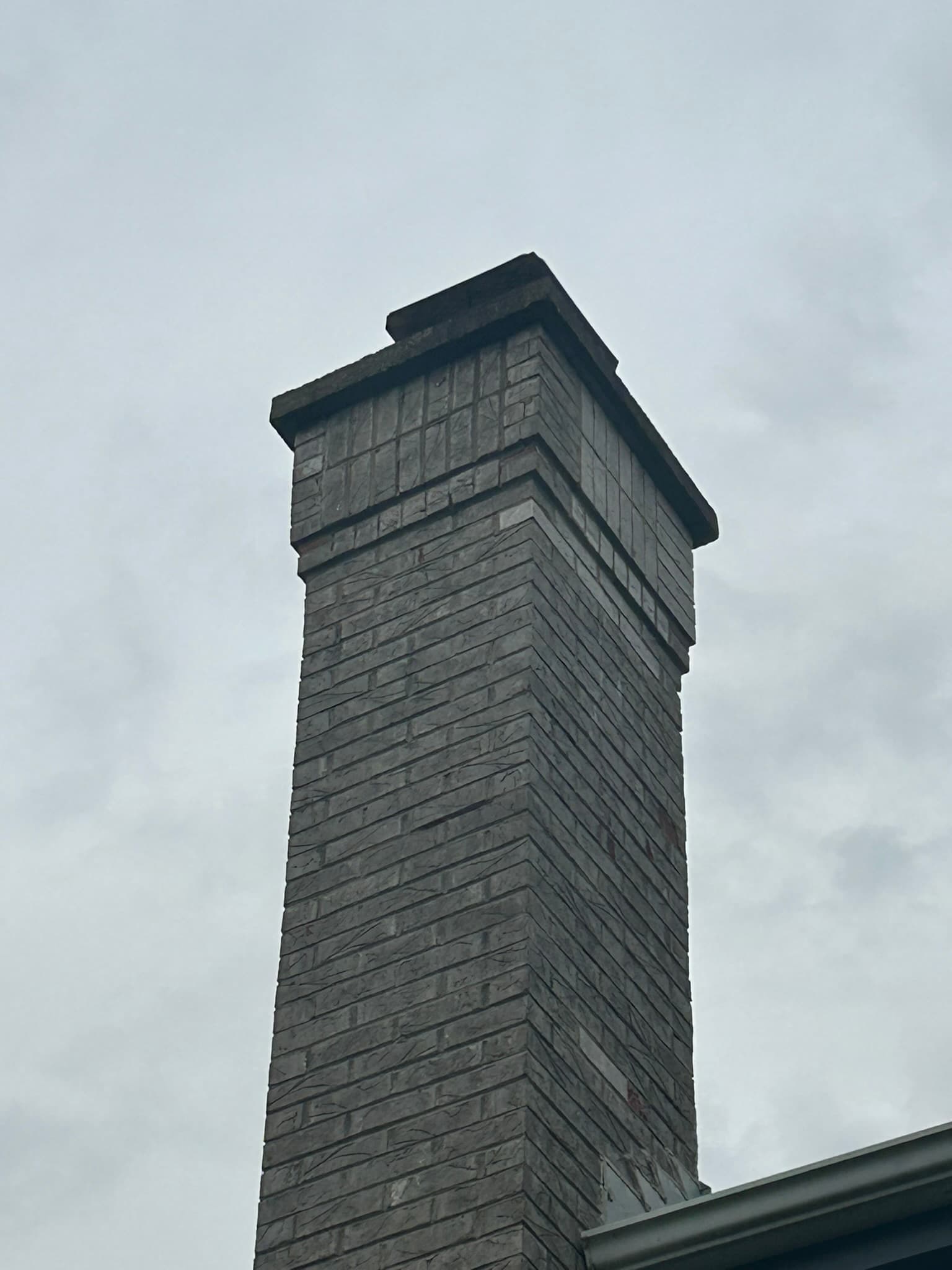
9. Chimneys and the per-unit question
On townhome stock especially, count the chimneys. Each one is the highest, wettest masonry on its building, and each one is a repair item. Then ask a governance question: on many townhome properties a chimney serving one unit is a limited common element, which changes who performs the repair and who pays. HOA versus unit owner responsibility covers the distinction, though your declaration is the authority.
10. Consistency across buildings
On a multi-building property, compare buildings. If one has been repointed and five have not, the association is working through a plan — ask to see it. If one building is visibly worse and nothing is underway, the association is working through a budget shortfall.
Cross-examining the reserve study
Now put the walk-around next to the paperwork.
| What you saw | What to check in the packet | |---|---| | Patchy mismatched repointing | Ten years of repair invoices — one contractor or six? | | Blocked weeps, open coping joints | Is there a written masonry scope with quantities, or only a reserve line? | | Horizontal floor-line cracking | Has any engineer or mason ever assessed it? Anything in the minutes? | | Balconies sealed repeatedly | Is balcony work funded, deferred, or absent from the plan? | | Nothing visibly wrong | Is the maintenance documented, or just lucky so far? |
The key thing to understand about a reserve study masonry line is that it is a planning placeholder — generally built from an assumed service life and an assumed unit cost, not from anyone opening a wall on that property. It is the right tool for funding and the wrong tool for bidding, and it can be off by a wide margin in either direction. HOA masonry maintenance budgets covers how boards convert it into something real, and a multi-year phased programme covers what a board that has done so looks like.
Building age changes what to look for
The same walk-around reads differently depending on when the property was built, and Chicagoland associations cluster into three broad vintages:
Pre-1940 courtyard and walk-up buildings. Solid masonry, soft brick, lime-rich mortar. The risks here are a prior repointing done with a hard modern mix — which spalls the brick faces around joints that still look perfect — plus cornices, parapets and limestone trim with concealed corroding anchors. Look for popped brick faces adjacent to newer-looking joints.
1960s–1980s brick-veneer-over-block mid-rises and courtyard complexes. Drained cavity walls. The risks are blocked weeps, missing or unlapped through-wall flashing, corroding shelf angles at floor lines, and balconies. This is the vintage where the worst problems are concealed and the wall can look reasonable from the parking lot.
1985–2005 townhome and rowhome associations. Brick on part of the elevation only, with siding, trim or stucco above. The risks concentrate at the veneer termination — the horizontal seam where the brick stops — and at wide garage-front openings carried on single steel lintels. Look at the transition line and above every garage door.
Knowing the vintage tells you which of the ten items above deserve the most attention, and it tells you whether a clean-looking elevation is genuinely reassuring or merely opaque.
The five questions to ask
- When was the exterior last assessed by a masonry contractor, and can I see the report?
- Is there a written scope with quantities, or only a reserve line item?
- What masonry work has been done in the last ten years, and by how many different contractors?
- Is there a phased plan, and which phase are we in?
- Has a special assessment been discussed in the last three years?
A board that answers all five crisply is a board that plans. Vagueness on all five is itself the answer.
What a mason sees that an inspector does not
A general home inspector is genuinely useful and will flag visible cracking and spalling. What they do not do — because it is not their trade or their equipment — is sound the brick with a hammer to find units that have delaminated internally behind a perfectly good face, probe joints to establish whether mortar is solid at a quarter inch or sand, get onto the roof to open a coping joint, or read a crack pattern's position relative to floor lines and openings to distinguish steel corrosion from movement from settlement.
Those are exactly the findings that carry five- and six-figure numbers. What a mason sees that a home inspector doesn't and buying a home with masonry problems cover the gap.
Get a read before you sign
Emerald Masonry LLC is a family-owned commercial masonry contractor serving Chicago and the Chicagoland suburbs, led by career masons with decades of hands-on Chicagoland experience, in commercial tuckpointing, façade and parapet repair, lintel replacement, chimney and stack rebuilds, CMU block repair, brick repair and replacement, foundation and limestone/sill repair, caulking, sealing, and commercial, residential and historic masonry restoration. Free on-site assessments — call (708) 288-1696.
We assess association and multi-family masonry across Chicagoland and will give you a plain written read: what condition the exterior is actually in, what the likely near-term scope is, and whether what you are looking at is a maintained building or a deferred one. Established 2024, family-owned, licensed, bonded and insured.
Related services: tuckpointing and repointing, brick repair, parapet wall repair and commercial masonry restoration. If you end up on the board, our HOA and condo associations page sets out how we scope and phase work — and masonry maintenance on multi-family buildings is where to start.
Twenty minutes in the parking lot
Read the packet. Then go and read the walls, because they were not written to persuade you. If the two disagree, believe the brick.
Call (708) 288-1696 or request an assessment.
Frequently Asked Questions
Can masonry condition really predict a special assessment?
It is one of the better predictors available to a buyer. Masonry is expensive, highly visible, easy to defer and impossible to hide, so a building with years of deferred exterior work is a building whose reserve has been spent elsewhere or was never adequate — and the bill eventually arrives as an assessment.
What is the single clearest warning sign on a walk-around?
Patchy, mismatched repointing. Several different mortar colours and joint profiles on one elevation means the association has been buying small emergency repairs from different contractors instead of executing a plan, which is the signature of a building managed reactively.
Won't the home inspector catch masonry problems?
A general inspector will note visible cracking and spalling, which is useful, but they will not sound brick for units that have delaminated behind an intact face, probe joint depth, get on the roof to check coping, or read a crack pattern for corroding steel. Those are the findings that carry the large numbers.
What does a horizontal crack along a floor line mean?
It usually means the steel shelf angle supporting the brick veneer at that floor is corroding and expanding, lifting the course above it. It is very commonly misread as settlement, and it matters because the repair involves removing and rebuilding masonry rather than repointing it.
Should I worry about white powder on the brick?
Efflorescence is salt left behind by water moving through the wall and leaving, so it tells you water is getting in somewhere. On its own it is not structural, but persistent efflorescence on an association building means an unresolved water path that somebody will eventually have to find and pay for.
What should I ask the board or the management company?
When was the exterior last assessed by a masonry contractor, is there a written scope with quantities, what has been repaired in the last ten years and by whom, is masonry in the reserve study and on what assumptions, and has any assessment been discussed. Vague answers to those five questions are themselves an answer.
Are balconies and walkways part of this?
Very much so, and they are frequently the largest deferred item on a Chicagoland association building. Exterior balconies and open stair towers penetrate the wall at dozens of points, their sealant is often decades past service life, and they are both expensive and disruptive to repair.
Is a well-maintained exterior a guarantee the association is healthy?
No, but it shifts the odds considerably. A building with consistent matched repointing, clear weep holes, sound coping and documented work is a building with a board that plans — and boards that plan for masonry usually plan for the rest.
Can I have a mason look at a building before I buy?
Yes, and on a larger purchase it is cheap relative to an assessment risk. Emerald Masonry LLC assesses association and multi-family masonry across Chicagoland and will give you a plain written read on condition and likely near-term scope — call (708) 288-1696.