
Chimney Repair · Chicagoland, IL
Masonry Repairs Before Winter: What Can't Wait Until Spring in Illinois
Every Chicagoland masonry problem gets worse over a winter, but only a handful get dramatically worse. Here is how to sort the open chimney crown and the loose brick over the front door from the efflorescence and the tired joints that can safely wait for spring.
2026-10-01
Quick Answer
Before the first hard freeze in Chicagoland, fix anything that lets water into the top of the masonry or that could fall: cracked or open chimney crowns, missing chimney caps, failed flashing, loose bricks overhead, open joints above windows and lintels, and actively moving cracks. Efflorescence and modestly receded joints can usually wait for spring. Emerald Masonry LLC triages pre-winter masonry across Chicagoland — (708) 288-1696.
Masonry Repairs Before Winter: What Can't Wait Until Spring in Illinois
Before the first hard freeze, fix anything that lets water into the top of your masonry or anything that could fall. In practice that means a cracked or open chimney crown, a missing chimney cap, failed chimney flashing, loose bricks above a door or walkway, open joints above windows and lintels, and cracks that are visibly getting wider. Almost everything else — white efflorescence, joints that have receded a little, cosmetic staining, sealing — can wait for spring, and is usually done better then. Emerald Masonry LLC, a family-owned masonry contractor led by career masons with decades of hands-on Chicagoland experience, triages pre-winter masonry across Chicago and the suburbs. Call (708) 288-1696.
Every masonry problem gets worse over a Chicagoland winter. That isn't the useful question.
The useful question is which problems get dramatically worse — the ones where a few months of freezing turns a repair into a rebuild, or a nuisance into a hazard — and which simply age another season at the same slow rate they've been aging for years.
That sorting job is what this guide is for. If you have the budget and the calendar to fix everything, fix everything. Most homeowners in October don't, so here is how a mason actually triages the list.
Why winter is the deadline, not just a bad season
Brick, block, stone and mortar all absorb water. That's normal and the wall is designed for it — as long as the water can leave again.
The problem in Illinois is what happens between leaving. Water that has soaked into a brick face or an open mortar joint freezes, expands by roughly nine percent, and pushes outward from inside the material. Then it thaws, the crack it opened fills with more water, and it freezes again. That is the freeze-thaw cycle, and the Chicago area sees it dozens of times each winter, far more often than places that simply stay frozen. Chicago freeze-thaw versus national averages puts numbers on it.
Freeze-thaw damage is not caused by cold. It is caused by water in the masonry when it gets cold. That is why the pre-winter question is always the same: where is water getting into the top or the inside of this masonry, and can we stop it before December?
That reframes the whole list. A defect that admits a lot of water at the top of a structure — a chimney crown, a coping, a flashing — gets triaged ahead of a defect that is ugly but dry.
The pre-winter triage table
| Problem | Fix before freeze? | Why | |---|---|---| | Cracked or open chimney crown | Yes | Water enters straight down the top of the stack; freeze-thaw spalls the top courses fast | | Missing or damaged chimney cap | Yes | Rain and snow fall straight into the flue; animals move in for winter | | Failed chimney flashing | Yes | Active roof/attic leak that will soak framing all winter | | Loose bricks over doors, walks, driveways | Yes — or make safe | Ice-jacking can drop them; life-safety issue | | Open joints above windows and at lintels | Yes | Feeds water to the steel lintel; rust expands and cracks brick | | Step cracks that are actively widening | Yes — assess | Movement plus freeze-thaw accelerates displacement | | Wall saturated by overflowing gutters | Fix the water source | Gutter/downspout repair now; masonry may wait | | Leaning or pulling-away chimney | Yes — assess urgently | Risk of partial collapse under wind and snow load | | White efflorescence | Can wait | Symptom of moisture, not structural damage | | Joints receded under ~1/4" on a dry wall | Can wait | Slow-aging; spring tuckpointing cures better | | Hairline cracks that aren't moving | Can wait (monitor) | Mark the ends and check again in spring | | Brick sealing / water repellent | Usually wait | Never seal over open joints or wet brick | | Cosmetic staining, cleaning | Wait | Cleaning in cold weather risks damage and poor results |
What must be fixed before the freeze
Chimney crown cracks and missing caps
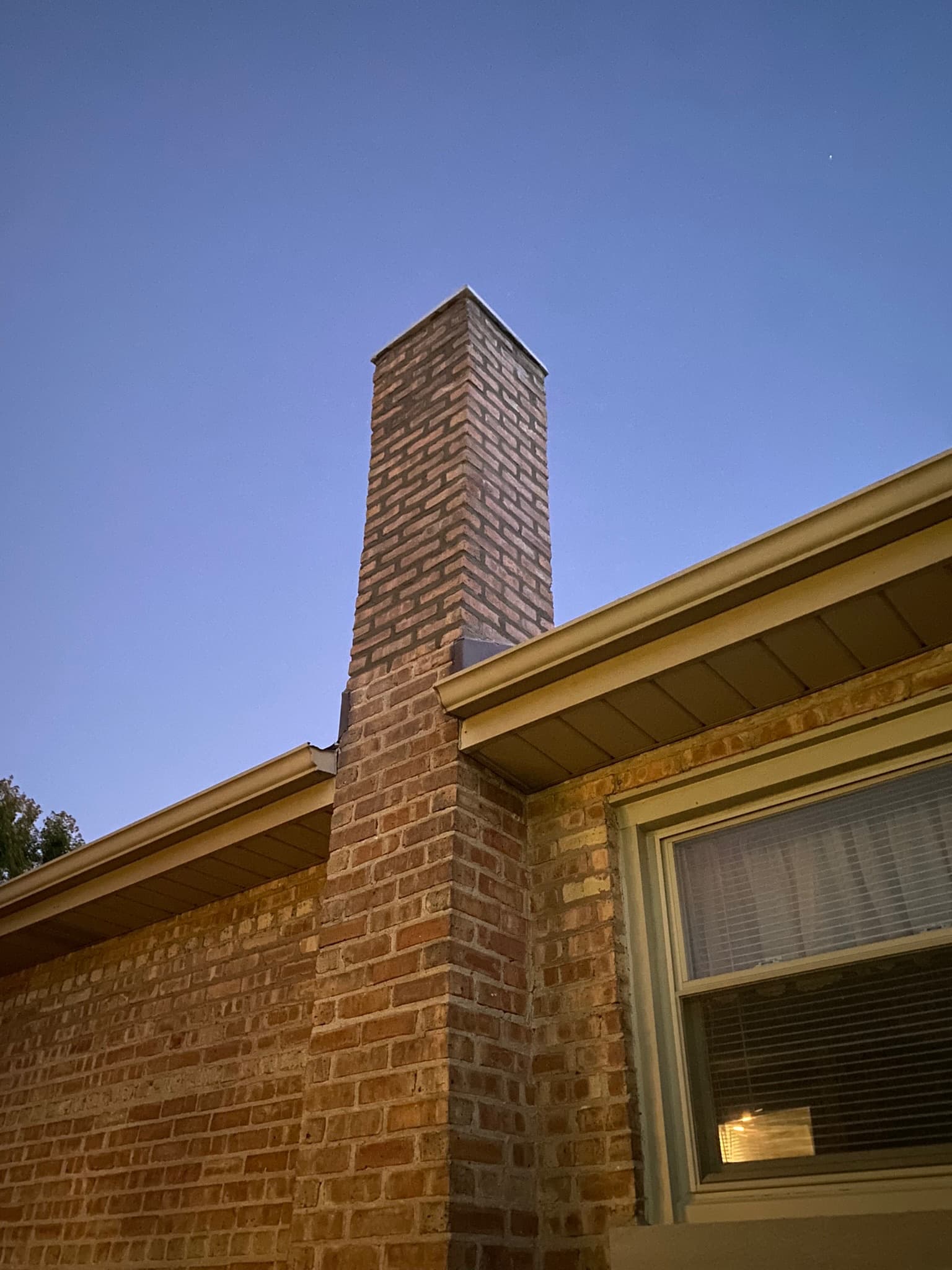
The chimney crown is the concrete or mortar slab capping the top of the brick stack. It is the most exposed horizontal masonry on most Chicagoland homes. When it cracks — and on bungalows and post-war homes it very often has been patched with a thin mortar wash that was never a proper crown — water runs straight down into the top courses of the chimney.
Those top courses then spall, the mortar sands out, and by spring you are no longer pricing a crown. You are pricing a top-of-stack rebuild. Why the top of your chimney fails first walks through that progression, and chimney crown vs. chimney cap explains the difference between the two parts.
A missing chimney cap is the cheaper half of the same problem: rain and snow fall straight into the flue, and squirrels, raccoons and birds look for exactly that kind of warm opening in October. Both items are short-duration jobs and are routinely done in fall weather. See our chimney repair service.
Failed chimney flashing
Flashing is the metal that seals the joint where the chimney passes through the roof. When step flashing or counterflashing has pulled loose or the sealant has dried out, water enters the attic and runs down the inside of the chimney chase.
Through a winter of snow sitting against the upslope side of the chimney, that becomes a steady leak into framing and ceilings. It is the single most common "the roof is leaking" call that turns out to be masonry. Chimney flashing leaks in Chicago covers how to tell.
Loose bricks above people
This one is not about cost. It is about safety.
A brick that has lost its mortar bond above a front door, a stoop, a garage apron or a gangway is held in place by friction and habit. Ice forming behind it in January can be enough to push it out. If it can't be properly reset before the freeze, it should be made safe: taken down, bagged and labelled for re-use, and the opening protected. What to do when a brick falls off your house covers the emergency side.
Open joints above windows and lintels
Above most windows and doors in brick construction sits a steel lintel carrying the brick overhead. The joint directly above it and the joints at its bearing ends are where water reaches that steel.
Wet steel rusts, and rust occupies several times the volume of the steel it came from. That expansion — called rust-jacking — lifts the brick above it and cracks it in a characteristic stair pattern from the window corners. Each winter of water feeding that steel accelerates it. Open joints in that zone are worth tuckpointing before the freeze even if the rest of the wall waits. See lintel rust stains and our lintel repair service.
Step cracks that are moving
A step crack follows the mortar joints diagonally up a wall. A step crack that was there last year and looks the same this year is often old settlement. One that has visibly widened, has fresh clean edges, or has a brick shifted out of plane is moving — and freeze-thaw will push it further. That one needs eyes on it before winter, and sometimes a structural engineer. See step cracks in brick walls.
The water source, even if the masonry waits
A wall darkened and streaked below an overflowing gutter or a disconnected downspout is being saturated every rain. Through winter that saturated zone is the part of the wall that will spall. You often don't need a mason in October for this one — you need the gutters cleaned and the downspouts extended. Fix the water, and the masonry repair can usually wait for spring. Gutters, downspouts and grading explains why.
What can safely wait until spring
Efflorescence
The white, powdery bloom on brick is efflorescence — soluble salts carried to the surface by moisture and left behind when it evaporates. It looks alarming, and it tells you water is moving through the wall, but it is not itself damage. If the source is a gutter or an open joint above, fix that. The bloom can be cleaned in spring. Why efflorescence keeps coming back goes deeper.
Modestly receded mortar joints on a dry wall
Joints that have receded an eighth or a quarter of an inch on a wall that isn't leaking are aging, not failing. Tuckpointing them properly — grinding or raking out to a consistent depth, packing in matched mortar, tooling the profile — is better done in spring, when the mortar cures in steady temperatures and moisture. How to tell if mortar is failing helps you judge the difference. Our tuckpointing service covers the full process.
Hairline cracks that aren't moving
Mark the ends of the crack with a pencil and the date. Check it in March. If it hasn't grown, it can be dealt with in a spring repointing scope.
Sealing
A breathable penetrating water repellent can be a sensible measure on a sound wall — but never over open joints or wet brick. Sealing a damaged wall before winter traps water inside it and makes freeze-thaw worse. Repair first, seal second, and usually in spring. How often should you seal brick and breathable vs. film-forming sealers explain the products.
The temperature rule for fall masonry work
Mortar gains strength through a chemical reaction with water. If the water in fresh mortar freezes before that reaction has progressed, the mortar can be permanently weakened.
The working rule masons use is 40°F and rising, with no hard freeze forecast during the first days of cure. In Chicagoland that usually means:
- September and October — generally full working conditions, with attention to overnight lows.
- Early-to-mid November — workable days still common; short-duration tasks like crowns, caps and spot repointing fit well; protection blankets often needed overnight.
- Late November through March — major tuckpointing generally waits; urgent work is done with heated enclosures, insulated blankets and cold-weather practices, or the area is made safe and finished in spring.
Mix choice matters as well. Many older Chicagoland homes need a softer Type N or lime-rich mortar rather than a harder Type S, and softer mixes are even less tolerant of an early freeze. That is one more reason proper repointing of older brick tends to be scheduled for spring rather than squeezed into December. Type N vs. Type S mortar and cold-weather masonry work go into the detail.
Temporary make-safe measures
When the permanent repair can't happen before the freeze, a good contractor will tell you what can be done instead. Legitimate stopgaps include:
- Elastomeric crown coating over a cracked but intact chimney crown.
- Installing a chimney cap to stop direct water and animal entry into the flue.
- Taking down loose units and protecting the opening rather than leaving them in place.
- Temporary sealant at a failed flashing or a coping joint, clearly labelled as temporary.
- Gutter and downspout repair to stop saturating a wall.
- Cordoning off a walkway or entrance below a suspect area.
What a stopgap is not: a smear of mortar over cracks, a can of spray foam in a joint, or a waterproof coating rolled over a whole saturated wall. Those tend to trap water and cost more in spring.
The process when you call in the fall
A sensible pre-winter visit from a masonry contractor looks something like this:
- Walk the exterior from grade, with binoculars where needed, and from the roof at the chimney.
- Prioritise by water entry and safety — top-of-structure defects and anything overhead first.
- Separate the scope into "before freeze" and "spring," in writing.
- Schedule the urgent items in the next workable window, with cold-weather protection specified if needed.
- Make safe anything that can't be permanently repaired before winter.
- Return in spring for tuckpointing, cleaning and sealing with proper cure conditions.
What drives the cost of pre-winter repairs
We don't quote exact prices without seeing the building, because the same words — "fix the chimney" — can describe a two-hour cap install or a full rebuild above the roofline. What actually drives cost:
- Scope and extent — one cracked crown versus a stack with spalled top courses.
- Height and access — a one-storey bungalow chimney versus a two-flat stack reached across a steep roof.
- Scaffolding or lifts for elevated wall work.
- Mortar and brick matching on older homes.
- Cold-weather protection — enclosures and blankets add labour late in the season.
- What's found when it's opened up — a rusted lintel behind a cracked joint changes the job.
The cheapest outcome is almost always the one where water is stopped before the winter does its work. Our brick repair and masonry sealing services cover the follow-up work.
DIY vs. hiring a pro
There are pre-winter tasks a homeowner should do: clean gutters, extend downspouts, clear leaves from window wells and against foundations, and look at the chimney from the street with binoculars.
Roof-level chimney work, resetting loose brick and repointing are not good DIY tasks. The mortar has to be matched in strength and colour to the existing wall, the joints have to be raked to proper depth, and the work happens at height. A hardware-store mix of the wrong strength can spall the brick around it within a few winters — see why masonry repairs fail.
The Chicagoland context
Chicagoland's housing stock makes the fall triage more urgent than in most of the country. Brick bungalows from the 1920s and post-war homes often carry original chimneys with mortar-wash crowns. Two-flats and greystones have flat roofs behind parapets that nobody walks in October. Many homes across Palos Heights, Oak Lawn, Orland Park, Evergreen Park, Beverly and Mount Greenwood are built from softer brick and mortar than modern construction. Add lake-influenced moisture and dozens of freeze-thaw cycles a year, and a defect left open in October is noticeably worse by April.
Maintenance and prevention through the year
- Every fall: look at the chimney crown, cap and flashing; clean gutters; check for loose brick above entries.
- Every spring: walk the exterior for new spalling, cracks and efflorescence after the freeze-thaw season.
- Every few years: a professional masonry inspection, especially on older homes.
- After severe storms: see our post-storm masonry inspection checklist.
Related services
- Chimney repair — crowns, caps, flashing, top-of-stack rebuilds
- Tuckpointing — repointing with matched mortar
- Brick repair and brick replacement
- Lintel repair — rusted steel over windows and doors
- Masonry sealing — breathable water repellents on sound walls
- Residential masonry restoration
Get your pre-winter list sorted before the freeze
The point of a fall masonry visit is not to sell you everything. It is to separate the handful of defects that one winter will make dramatically worse from the long list that can wait for better curing weather in spring.
Emerald Masonry LLC is a family-owned masonry contractor serving Chicago and the Chicagoland suburbs, established 2024 and led by career masons with decades of hands-on Chicagoland experience, in tuckpointing, chimney and stack repair, brick repair and replacement, lintel, foundation and limestone/sill repair, caulking, sealing, and commercial, residential and historic masonry restoration. Licensed, bonded and insured. Free on-site assessments — call (708) 288-1696 or request an assessment.
Frequently Asked Questions
What masonry repairs should I do before winter in Illinois?
Anything that lets water into the top of the masonry or could fall on someone: cracked or open chimney crowns, missing chimney caps, failed chimney flashing, loose bricks above walkways and doors, open joints above windows and lintels, and cracks that are actively widening. Those are the defects one Chicagoland winter can turn from a repair into a rebuild.
What masonry problems can safely wait until spring?
White efflorescence, modestly receded mortar joints on a wall that isn't leaking, hairline cracks that are not moving, cosmetic staining and sealing a wall that is otherwise sound. Spring work on those items is usually cheaper, cures better and matches better.
How cold is too cold to tuckpoint or lay brick?
The working rule is 40°F and rising, with no hard freeze forecast for the mortar's first few days of curing. Below that, mortar can freeze before it develops strength, so it needs heated enclosures, blankets or a decision to make the area safe and finish in spring.
Is it too late to repair my chimney in October?
Usually not. October and early November in Chicagoland still offer plenty of workable days for crown, cap, flashing and top-of-stack repairs, which are short-duration jobs. The risk is waiting until the schedule fills and the weather window narrows.
Can a chimney crown be temporarily sealed for winter?
Yes. Where a full crown replacement can't be done before the freeze, an elastomeric crown coating or a properly sized cap can slow water entry through the winter. It is a stopgap, not a repair, and it should be followed by the permanent fix in spring.
What do I do about loose bricks I can't get fixed before winter?
Remove the hazard. A mason can take down loose units, bag and store them for re-use, and protect the opening — or cordon off the area beneath. Never leave loose masonry above a doorway, stoop, walkway or driveway through a season of freeze-thaw and ice.
Should I seal my brick before winter?
Only if the joints are sound and a breathable penetrating sealer is the right product for the wall. Sealing over open joints or saturated brick traps water and makes winter damage worse, so repair first and seal second — often in spring.
How do I get a masonry assessment before the freeze?
Call early in the fall. Emerald Masonry LLC offers free on-site assessments across Chicago and the Chicagoland suburbs and will tell you plainly what needs to happen before winter and what can be scheduled for spring — call (708) 288-1696.